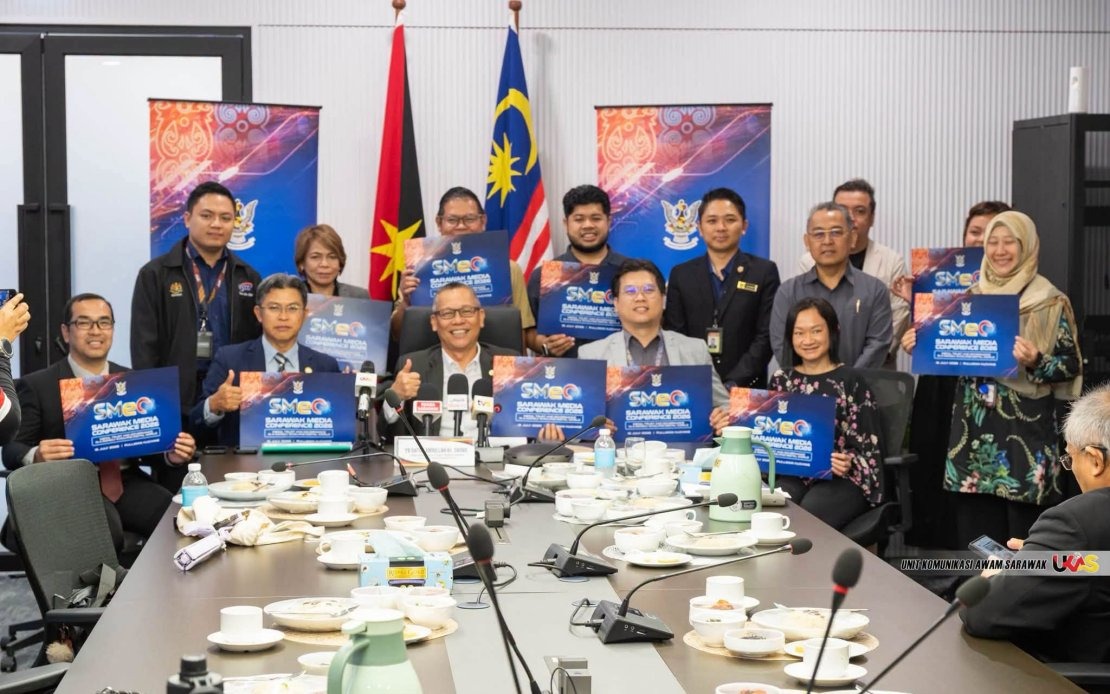
Kuching will host one of East Malaysia's most significant gatherings of media and communications professionals when the Sarawak Media Conference (SMeC) 2026 brings together approximately 800 participants spanning newsrooms, universities, government agencies and technology firms. The conference, coordinated by the Sarawak Government via its Public Communications Unit (UKAS), represents a strategic effort to position the state as a focal point for regional dialogue on contemporary media challenges. Sarawak Premier Tan Sri Abang Johari Tun Openg will formally open the event, underscoring the administration's commitment to engaging with the communications sector on pressing issues affecting the profession and public discourse.
The gathering coalesces around the overarching theme "Media, Trust and Governance in a Rapidly Evolving Digital World," a formulation that reflects anxieties rippling through newsrooms and policy circles across Southeast Asia. In an era when misinformation spreads instantaneously across messaging platforms and social networks, questions about institutional credibility have become increasingly fraught. The conference design aims to move beyond abstract hand-wringing by fostering substantive conversations about how journalists, platforms and regulators might collaborate to restore and maintain public confidence in media institutions. For Malaysian practitioners, this initiative offers rare opportunity to benchmark approaches against peers in Sarawak and engage with regional thought leaders grappling with similar pressures.
According to Datuk Abdullah Saidol, Deputy Minister in the Sarawak Premier's Department overseeing corporate affairs and public communications, the conference will prioritize two interconnected imperatives: strengthening audience faith in journalistic output and ensuring media organisations uphold ethical standards while navigating digital transformation. Abdullah articulated that deliberations will extend beyond critique to encompass concrete pathways toward rebuilding trust through transparent editorial processes and accountability mechanisms. The emphasis on governance signals recognition that media institutions cannot sustain credibility through journalism alone—they must demonstrate institutional integrity, clear ownership structures and responsive management practices that resonate with increasingly sceptical audiences.
Artificial intelligence and algorithmic content distribution occupy central positions within the conference agenda, reflecting genuine uncertainty about technology's role in shaping information ecosystems. Machine learning systems now determine what news reaches billions of users daily, yet questions persist about algorithmic bias, the concentration of editorial power among technology corporations, and journalism's capacity to compete for attention in algorithmic environments. The conference framework promises exploration of both opportunities—such as AI-assisted research and audience analytics—and profound challenges including job displacement, automated misinformation generation, and the erosion of gate-keeping functions that historically distinguished professional journalism from unvetted online content.
The speaker roster signals attempts to assemble diverse expertise rather than showcase hometown talent exclusively. SOL Digital founder Lunnie Gan brings perspective from the Southeast Asian digital media entrepreneurship ecosystem, while Malaysian Media Council deputy chairman Premesh Chandran contributes institutional vantage on self-regulatory frameworks and industry standards. This composition reflects understanding that media challenges transcend state boundaries; solutions emerging from one jurisdiction often require adaptation elsewhere. For Malaysian practitioners attending, exposure to how neighbouring colleagues address similar predicaments could illuminate alternative policy approaches and professional practices worth piloting domestically.
The conference schedule encompasses a formal dinner honouring journalists at the national and state levels, incorporating the Sarawak-level National Journalists' Day (HAWANA) 2026 observance. Deputy Prime Minister Datuk Seri Fadillah Yusof's participation in this evening event carries political weight, signalling federal-level interest in media sector affairs and the government's investment in dialogue with communications professionals. Recognition ceremonies often represent ceremonial moments, yet their framing—in this instance, acknowledging journalists alongside technology operators and influencers—communicates subtle messages about whose voices register within official estimation and how traditional and digital-native media practitioners ought to understand their respective standing.
The awards presentation encompasses five categories reflecting contemporary media's fragmented landscape: Editor/Journalist/Stringer, Photographer, Videographer, Radio News Presenter/Broadcaster and Social Media Influencer. This taxonomy encapsulates the Sarawak Government's calibrated approach to professional recognition—it honours established journalism designations while explicitly validating social media influencers as legitimate participants in the information ecosystem. Such categorisation proves significant within Malaysian context, where debate persists about whether influencers merit classification as media practitioners or represent separate phenomena entirely. The decision to include them within awards architecture suggests acceptance that influence operates across traditional and digital channels simultaneously.
For Sarawak's media practitioners, the conference provides platform to articulate local concerns and experiences to state and federal policymakers. East Malaysian newsrooms operate under distinct commercial and regulatory conditions compared with Peninsular counterparts; circulation patterns, advertising markets and audience demographics differ substantially. The SMeC 2026 structure potentially enables Sarawak-based journalists to advocate for policies addressing regional specificities rather than accepting one-size-fits-all approaches formulated in Kuala Lumpur. Equally, the gathering offers policymakers opportunity to understand how communications sector dynamics play out in Sarawak's particular context before implementing broader initiatives.
The conference's emphasis on governance and trust reflects broader recognition that media's legitimacy rests upon more than professional competence—it requires institutional structures that audiences perceive as accountable and principled. Southeast Asian societies have experienced erosion of media trust concurrent with rising digital platform adoption, declining newspaper circulations and fragmentation of information sources. Whether through collaborative self-regulation, transparent ownership disclosure or institutional investment in community engagement, media organisations increasingly recognise that trust cannot be asserted but must be continuously demonstrated through transparent operations and responsiveness to criticism.

