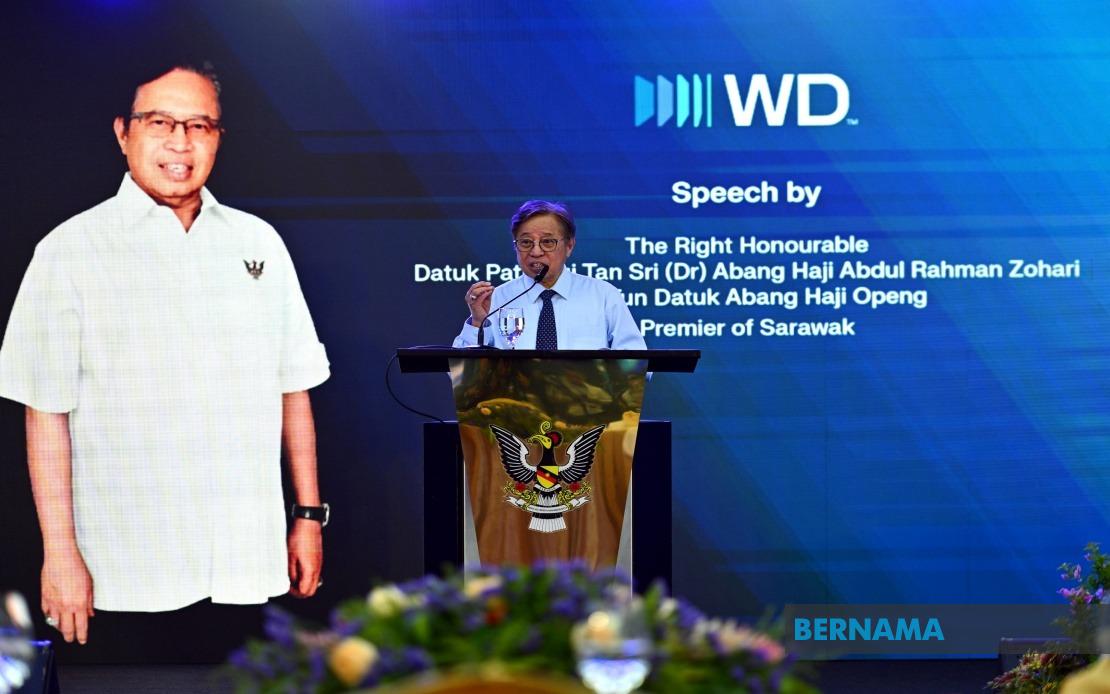
Sarawak's leadership has signalled openness to negotiating a higher special grant from the federal government, though the state remains mindful of Kuala Lumpur's fiscal constraints. During remarks at a Western Digital programme in Kuching on July 2, Premier Tan Sri Abang Johari Tun Openg stressed that any expansion of funds disbursed under Article 112D of the Federal Constitution should align with the nation's budgetary reality. His measured position reflects Sarawak's balancing act between asserting its constitutional entitlements and maintaining cordial federal-state relations as Malaysia navigates economic challenges.
Abang Johari's carefully worded statement — that Sarawak "welcomes" an increase if the Federal Government "can afford it" but "understands" if it cannot — underscores the pragmatism increasingly characterising Sarawak's dealings with Putrajaya. The Premier indicated no formal, detailed negotiations on the grant quantum have commenced, though preliminary discussions occurred during Prime Minister Datuk Seri Anwar Ibrahim's recent visit to Bintulu. This suggests both sides are testing the ground before embarking on substantive talks over a matter of considerable fiscal and political significance to East Malaysia.
The special grant mechanism established under Article 112D represents a fundamental component of Malaysia's federal compact, particularly for Sarawak and Sabah. These grants, distinct from ordinary revenue allocations, carry constitutional weight and reflect the original intent of the Malaysia Agreement 1963 to preserve certain autonomy and financial independence for the peninsula's newer partners. In recent years, Sarawak has quietly advocated for revision of these disbursements, arguing that rates set decades ago no longer reflect the state's development needs or economic contribution. At the Dewan Rakyat on June 30, Prime Minister Anwar confirmed that discussions continue in the spirit of MA63, suggesting the government recognises the legitimacy of Sarawak's concerns.
The timing of these negotiations coincides with broader federal fiscal pressures. Malaysia's debt-to-GDP ratio remains elevated, and Putrajaya faces competing demands from welfare expansion, infrastructure investment, and debt servicing. Against this backdrop, any increase in special grants requires careful management to avoid perceptions of favouritism or unsustainable spending. Abang Johari's acknowledgment of federal constraints demonstrates that Sarawak's leadership understands the delicate fiscal environment, even as it presses its constitutional case. This diplomatic tone may prove advantageous, as it positions Sarawak as a reasonable partner willing to work within national parameters rather than as a demanding claimant.
Perhaps more revealing than the grant discussion itself were Abang Johari's remarks about Sarawak's emerging economic direction. The Premier framed the state's renewable energy advantages and abundant water resources as crucial attractions for technology investors, specifically highlighting Western Digital's three-decade partnership as testament to Sarawak's competitive positioning. This pivot towards high-technology data storage and artificial intelligence infrastructure suggests Sarawak sees its economic future increasingly decoupled from hydrocarbon revenues — a significant strategic reorientation. Western Digital's continued investment in glass substrate-based recording technology, which dramatically increases data storage density, positions Sarawak at the frontier of next-generation digital infrastructure development.
The emphasis on data storage technology as a future economic engine carries profound implications for Sarawak's development calculus. If realised, a thriving AI-driven data centre and semiconductor materials sector could generate wealth rivalling or exceeding oil and gas revenues while providing more stable, long-term employment. This transformation would fundamentally alter the state's fiscal profile and negotiating position within the federation. Sustained high-technology manufacturing also creates multiplier effects throughout the economy, supporting suppliers, skilled workers, and ancillary services. For Malaysian policymakers, Sarawak's emerging tech sector offers a template for economic diversification that other resource-dependent regions might study.
Water security and renewable energy availability, which Abang Johari identified as Sarawak's competitive advantages, increasingly matter to multinational technology corporations facing mounting pressures to decarbonise operations and demonstrate environmental stewardship. Sarawak's hydroelectric capacity and abundant freshwater supplies position it favourably relative to competing jurisdictions in Southeast Asia and globally. This environmental dimension also carries geopolitical weight; as advanced economies prioritise green technology investment, Sarawak's clean energy profile becomes a strategic asset in attracting capital flows that might otherwise gravitate towards other Asian economies.
The special grant negotiations must also be understood within the broader context of East Malaysian autonomy. Sarawak and Sabah have long asserted that their constitutional position differs fundamentally from peninsular states, granting them greater say over matters including immigration, land policy, and natural resource management. While these discussions occur largely outside public view, they shape federal-state dynamics in ways that affect infrastructure funding, policy autonomy, and economic development priorities. A resolution of the special grant question could establish precedent for addressing other MA63-related matters that Sarawak considers unresolved or inadequately implemented.
Looking forward, the trajectory of these negotiations will signal whether Malaysia's federal system can evolve to meet 21st-century realities. Sarawak's shift toward high-technology manufacturing and data infrastructure represents a genuine economic transition, not merely political positioning. How the federal government responds to revised grant requests will indicate whether Putrajaya views East Malaysia as a junior partner with fixed entitlements or as an economic powerhouse deserving proportionate investment and autonomy. Abang Johari's diplomatic framing creates diplomatic space for federal negotiators to engage seriously without appearing to capitulate to pressure, potentially facilitating substantive discussions that benefit both parties.

