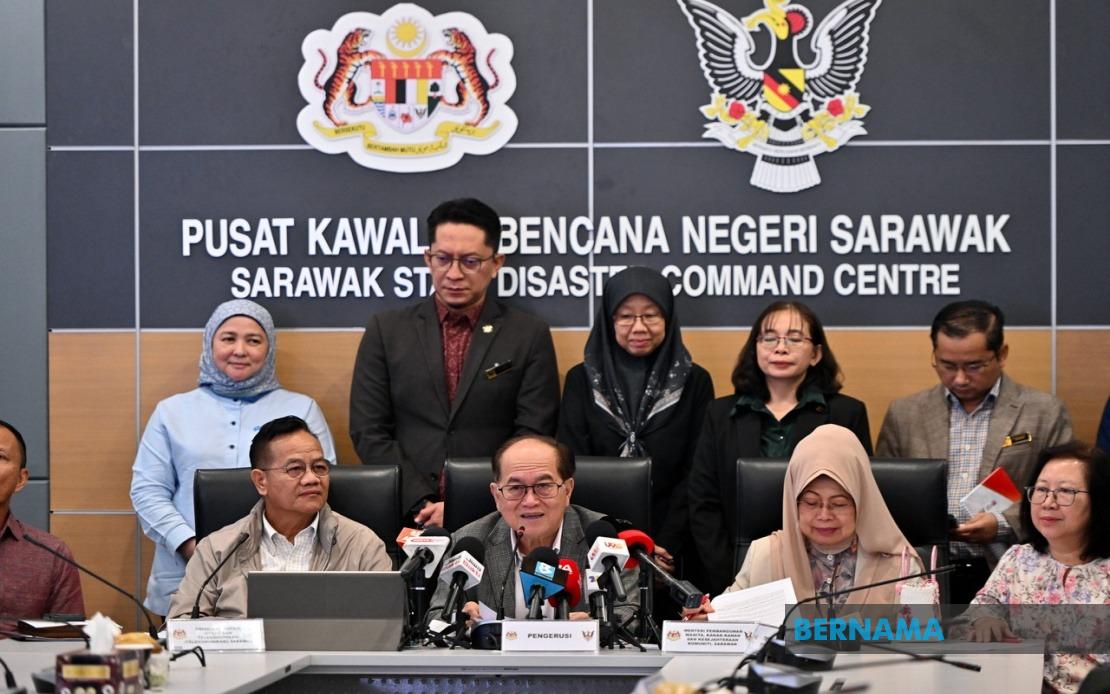
Sarawak's leadership has established a clear threshold for declaring a state of emergency in response to dangerous air pollution, signalling the regional state's preparedness to activate stringent public health measures when conditions become critically hazardous. Sarawak Deputy Premier Datuk Amar Douglas Uggah Embas announced that an Air Pollutant Index reading of 500 will automatically trigger emergency protocols across affected areas, marking a concrete benchmark that provincial authorities will use to determine when extraordinary interventions become necessary.
Once such an emergency declaration is made, responsibility for escalating the response will transfer to the National Disaster Management Agency in Kuala Lumpur, which operates at the federal level and coordinates Malaysia's approach to major disasters and environmental crises. This hierarchical escalation ensures that transboundary haze events, which frequently affect Sarawak and other Malaysian states during the seasonal burn period across Indonesia, receive coordinated national attention rather than remaining confined to regional-level decision-making.
The implementation of emergency measures would fundamentally reshape daily life in affected communities. All government offices, as well as commercial and industrial establishments, would cease regular operations, with only critical services maintaining limited functionality. This approach acknowledges the severe health risks posed by extremely poor air quality, where hazardous particulate matter can penetrate deep into respiratory systems and exacerbate cardiovascular conditions. Schools, shops, factories, and administrative centres would close, forcing the broader reorganisation of economic and social activities until pollution levels decline to manageable thresholds.
Uggah, who chairs the Sarawak State Disaster Management Committee, contextualised the haze challenge as inherently requiring regional solutions rather than unilateral action. Cross-border air pollution originating from agricultural burning and land clearance activities across the border in Indonesia cannot be effectively combated through domestic measures alone, reflecting a fundamental reality of Southeast Asian environmental governance. The nature of atmospheric circulation means that emissions generated in Indonesian territory inevitably drift across maritime boundaries and blanket Malaysian regions, regardless of local emission controls or air quality management efforts.
To address this reality, Sarawak's disaster management committee has engaged Natural Resources and Environmental Sustainability Minister Datuk Seri Arthur Joseph Kurup, who serves as the committee's deputy chairman, to facilitate diplomatic engagement with Indonesian counterparts. This engagement is deliberately channelled through established ASEAN mechanisms rather than ad hoc bilateral approaches, recognising that formalised regional frameworks possess greater institutional weight and established protocols for addressing transnational environmental issues. The multilateral approach also sends a signal that Southeast Asian governments view seasonal haze as a collective challenge requiring coordinated regional governance rather than isolated national responses.
Sarawak's state authorities have committed to maintaining ongoing cooperation with Malaysia's federal government to ensure that provincial concerns receive appropriate consideration within broader national and ASEAN-level discussions. Any proposals to provide material assistance to Indonesia—whether in the form of technical expertise, firefighting resources, or capacity-building initiatives—will be evaluated and coordinated by Kuala Lumpur through official governmental channels. This centralised approach prevents a fragmented regional response and ensures that Malaysian assistance aligns with federal diplomatic objectives and bilateral relationships.
Simultaneously, Sarawak is implementing cloud seeding operations, a technological intervention designed to artificially stimulate precipitation and improve air quality by removing particulate matter from the atmosphere. The initiative is scheduled to commence on September 3 and continue through September 5, contingent upon prevailing meteorological conditions that must be conducive to successful seeding operations. This timing reflects coordination with seasonal weather patterns and reflects the state's attempt to deploy multiple tools within its direct control.
Cloud seeding serves a dual purpose that extends beyond immediate haze mitigation. The operation is intended to replenish water reservoirs and recharge municipal water supplies, addressing an ancillary crisis triggered by the same meteorological systems that generate cross-border haze. Prolonged dry spells accompanying the haze season have depleted critical water catchment areas throughout Sarawak's interior regions. Four catchment zones—Simunjan, Lingga, Spaoh, and Lijok—are currently experiencing significant water depletion, creating potential shortages in drinking water supply and irrigation capacity for agricultural communities.
The convergence of air quality deterioration and water scarcity illustrates how environmental crises in tropical Southeast Asia frequently cluster during specific seasonal windows, creating compounded challenges for state authorities. By deploying cloud seeding technology, Sarawak attempts to generate positive externalities from precipitation stimulation, simultaneously addressing atmospheric pollution and water resource constraints. This integrated approach reflects pragmatic governance, recognising that environmental interventions can be designed to produce multiple beneficial outcomes rather than single-purpose solutions.
The establishment of concrete API thresholds for emergency declaration provides clarity for businesses, educational institutions, and residents regarding when extraordinary disruptions to normal activities will occur. Organisations can plan contingency arrangements for remote operations or temporary closure, reducing panic and facilitating orderly transitions when emergency protocols activate. For Malaysian states and regions similarly vulnerable to seasonal haze, Sarawak's transparent emergency framework may serve as a template for standardising cross-state responses and ensuring consistency in public health protection measures across affected areas.
Looking forward, the persistent nature of transboundary haze underscores the critical importance of strengthening ASEAN mechanisms for addressing shared environmental challenges. While individual nations maintain sovereignty over their territories and natural resource management decisions, the atmospheric commons transcend borders, necessitating genuine multilateral cooperation that extends beyond diplomatic rhetoric to concrete commitments regarding land use practices and fire prevention measures. Malaysia's engagement through established ASEAN channels reflects recognition that sustainable solutions require sustained regional dialogue and mutual accountability.

