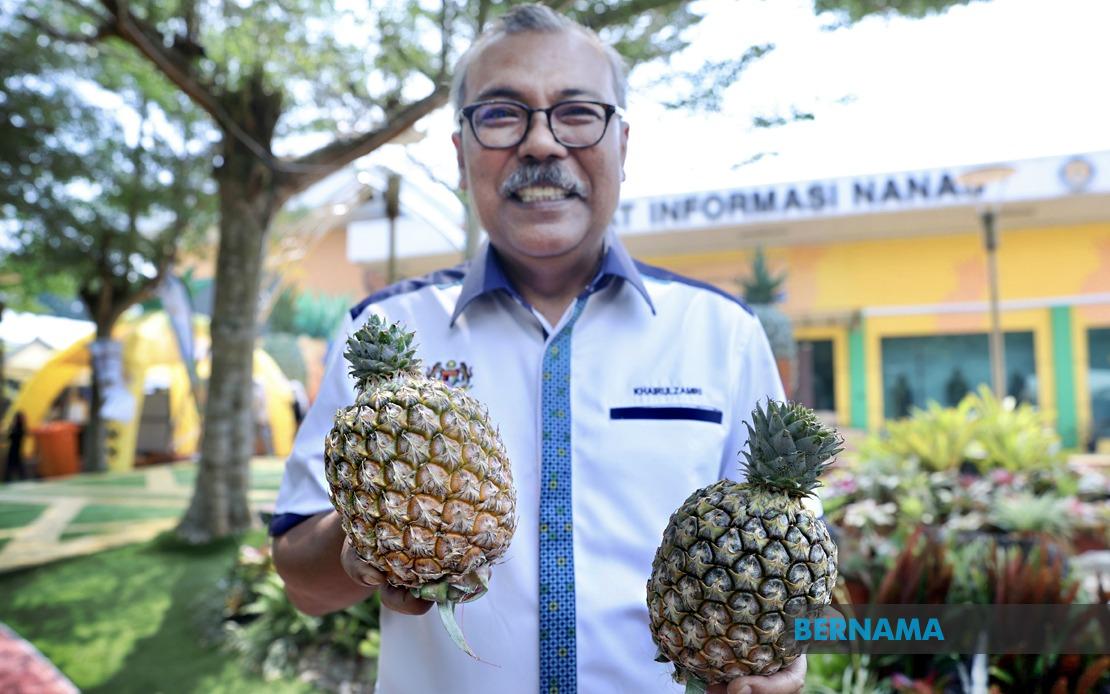
A newly developed pineapple variety from Sarawak is generating considerable interest among agricultural stakeholders and industry observers at MAHA 2026, the nation's largest agricultural exposition currently underway at the Malaysia Agriculture Expo Park in Serdang. The Sarawak Gold (SG1) pineapple, represented by seven tonnes of fresh produce on display at the expo's Laman Nanas section, represents a significant advancement in tropical fruit cultivation and signals the potential for Malaysian farmers to capture a growing share of regional and international markets.
According to Mohd Khairuzamri M. Salleh, director-general of the Malaysian Pineapple Industry Board (LPNM), the SG1 variety combines several competitive advantages that distinguish it from established commercial cultivars. Originally discovered and first cultivated in Miri, this premium variety maintains the appealing sweetness levels comparable to the widely-grown MD2 pineapple while introducing distinctive visual characteristics that enhance market appeal. The fruit's crown exhibits an unusually symmetrical rose-like formation, an aesthetic quality that appeals to both fresh-market consumers and exporters seeking products that command premium pricing through differentiation.
Perhaps the most compelling commercial advantage of SG1 lies in its dramatically shortened maturation period. Whereas the MD2 variety requires fourteen months from planting to commercial harvest, SG1 achieves full maturity in merely nine months, substantially reducing the capital lockup period for farmers and enabling faster capital turnover. This accelerated production cycle carries profound implications for farming economics across Malaysia and the wider Southeast Asian region, where land availability pressures and rising input costs continue to squeeze agricultural margins.
The cultivation density potential of SG1 further amplifies its economic attractiveness to producers. The variety tolerates remarkably tight planting configurations ranging from 25,000 to 30,000 plants per acre, a density substantially higher than conventional pineapple production systems. This capacity enables growers to extract significantly greater output from existing landholdings without requiring expansion into new agricultural territory, an increasingly valuable attribute as competing land uses intensify across Malaysia's populated regions and in neighboring countries similarly experiencing rural-to-urban conversion pressures.
The LPNM has initiated an expansion strategy to introduce SG1 cultivation beyond its Sarawak birthplace into Peninsular Malaysia's established pineapple growing regions. Distribution of SG1 seedlings to interested growers throughout the peninsula is anticipated to commence within the coming year, enabling a gradual transition toward wider adoption of the superior variety. This phased introduction approach reflects prudent agricultural policy, allowing farmers time to acquire cultivation expertise and adjust farming systems to accommodate the new variety's distinct agronomic characteristics before scaling production volumes.
International market development initiatives have already commenced, with promising early results. Trial export shipments dispatched from Sarawak to Singapore have successfully navigated quarantine protocols and demonstrated strong commercial reception, validating the variety's transportability and shelf-life characteristics essential for regional trade. The SG1's robust resilience profile extends commercial horizons considerably beyond Southeast Asia, with serious potential for penetrating distant markets including China and New Zealand, where premium pineapple varieties command substantial price premiums and where Malaysian exporters have demonstrated existing market access capabilities.
Beyond the immediate commercial dimensions, the SG1 development reflects broader strategic thinking within Malaysia's agricultural sector concerning value chain optimization. The thematic framework for this year's MAHA exposition, "Value Creation for Food Security," emphasizes the pineapple industry's capacity to generate returns across multiple harvest streams and processing pathways. The conceptual framework, articulated as "one planting, three harvests," encapsulates an integrated production philosophy extending well beyond conventional fresh-fruit commercialization.
The multi-product valorization potential encompasses traditional fruit production complemented by secondary harvests of crown and sucker propagation material, while agricultural residue streams previously regarded as waste now merit serious processing consideration. Processing pathways transform plant biomass into diverse value-added products including specialized ruminant feedstuffs for livestock operations, textile fibers with applications in sustainable apparel manufacturing, and cellulose-based materials suitable for paper production. This circular approach to agricultural resource utilization aligns with contemporary sustainability imperatives while maximizing revenue extraction from every planted hectare.
The timing of SG1's prominence at MAHA 2026 carries significance beyond horticultural novelty. The exposition itself encompasses approximately 2,000 exhibitors and anticipates visitor attendance exceeding four million individuals throughout its August 28 to September 6 operational window. This massive assembly of agricultural professionals, farming practitioners, agribusiness entrepreneurs, and consuming public creates an ideal platform for rapid dissemination of knowledge regarding SG1's capabilities and for cultivation of market enthusiasm among potential adopters positioned across Malaysia's agricultural landscape.
For Malaysian pineapple growers confronting intensifying global competition from established producers in Costa Rica, the Philippines, and Brazil, the SG1 variety offers a tangible mechanism for enhancing competitiveness through differentiation rather than purely cost-based competition. The combination of accelerated production cycles, enhanced planting densities, superior aesthetic qualities, and robust export performance characteristics positions the variety as a potential catalyst for agricultural productivity improvements across a significant sector of Malaysia's rural economy.
The successful development and commercialization of SG1 additionally underscores Sarawak's growing importance as an agricultural innovation center within Malaysia's federal system. The state's tropical environment, existing pineapple cultivation infrastructure, and demonstrated research capacity have collectively enabled the discovery and refinement of a variety with potentially transformative implications for regional farming systems. This achievement may catalyze increased investment in agricultural research capabilities throughout Malaysia's less-developed states, encouraging technological innovation as a mechanism for rural economic advancement.

