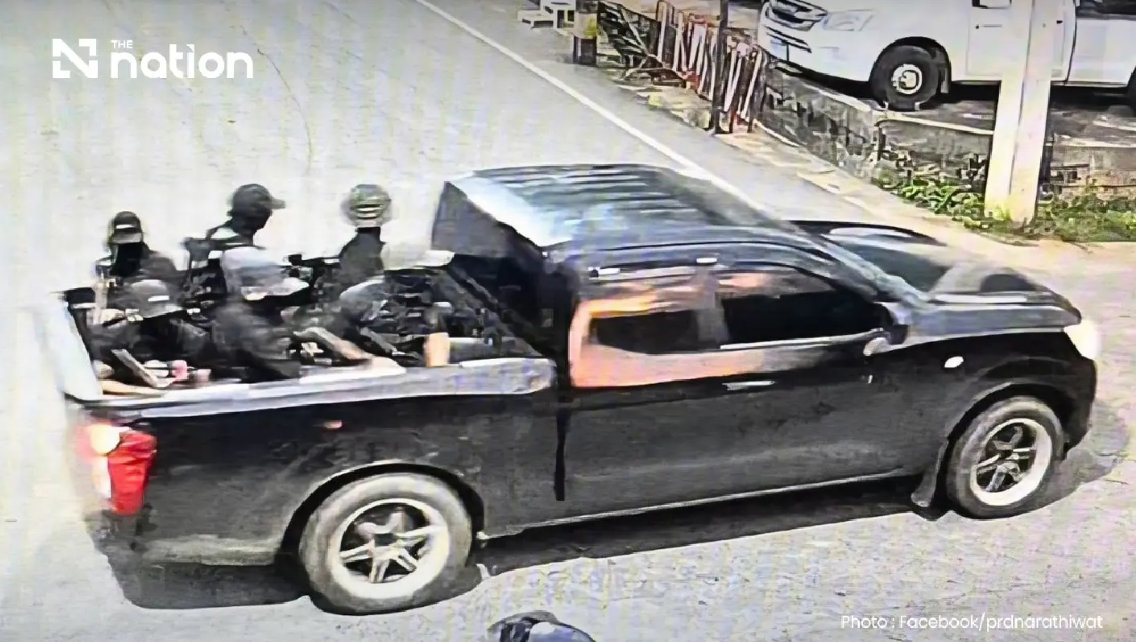
Nine coordinated attackers executed a devastating raid on the Bukeh Sami checkpoint in Narathiwat province on Wednesday evening, leaving five paramilitary rangers dead and six civilians wounded in a calculated 90-second strike. The assault, captured by multiple security cameras, reveals the operational sophistication of the militant group responsible, presenting fresh challenges for Thailand's counterinsurgency efforts in the violence-plagued southern border region—a situation with potential implications for Malaysia's eastern states given the porous frontier and historical cross-border movement of insurgent networks.
The assault unfolded around 6:45 pm at the checkpoint located in Village 7 of Tanyong Mat subdistrict, Ra-ngae district, where members of the 4509th Ranger Company under the 45th Ranger Regiment Task Force were stationed. Initial assessments suggested six assailants were involved, but comprehensive video analysis from external cameras revealed the true scale of the operation: a nine-person contingent split into two specialized units, each with distinct tactical roles during the strike. This discrepancy between preliminary field estimates and forensic video reconstruction underscores the fog of combat and the importance of thorough post-incident investigation in understanding militant tactics across the region.
The primary assault force travelled in a black Nissan pickup truck registered in Songkhla, with six armed personnel positioned in the truck bed while a seventh operated the vehicle. All wore black attire mimicking paramilitary uniforms and broad-brimmed hats that obscured their facial features—a deliberate choice indicating operational security awareness and possible training in counter-identification protocols. A secondary team provided mobile backup via a red-and-white Honda Wave motorcycle, with the driver armed with an 11mm pistol and the passenger, disguised in a black women's hijab, carrying an AK-type rifle. The use of civilian vehicles and the passenger's unconventional disguise demonstrate adaptive tactics designed to minimize checkpoint detection and maximize tactical advantage.
As the pickup approached from Tanyong Mat market, three rangers positioned at the roadside checkpoint became the initial targets. When the vehicle slowed, occupants unleashed concentrated fire from M16 and AK-type rifles, rapidly overwhelming the forward position. Following the collapse of the initial defensive line, armed group members dismounted and maintained suppressive fire toward the checkpoint bunker where two additional rangers sought shelter. The systematic elimination of the forward guard before engaging the fortified position illustrates a methodical approach to overwhelming checkpoint defenses rather than hasty violence.
After neutralizing resistance, the attackers conducted what appeared to be a deliberate search and seizure operation, recovering weapons and equipment before withdrawing. As the group retreated, one operative deployed a pipe bomb toward an elevated structure near the adjacent bridge, suggesting an attempt to create additional casualties or disrupt pursuit operations. The attackers then withdrew through the Dusongyo subdistrict toward Ra-ngae district, with the motorcycle functioning as rearguard cover during the escape phase. The operation's sequential stages—initial assault, engagement of fortified positions, materiel acquisition, and structured withdrawal—indicate training in small-unit assault tactics.
All five fatalities were confirmed as personnel of the 4509th Ranger Company: Sergeant Major First Class Theerayut Somakerd, ranger volunteers Sakiriya Jena, Wimon Dabthong, Nattasit Kaewsena, and Salahuding Pi. Six civilians sustained injuries during the assault, including a 10-year-old child, with all requiring hospitalization in local medical facilities. Initial casualty reports fluctuated between two and five civilian wounded, reflecting the confusion inherent in immediate post-attack documentation before thorough scene investigation clarified the final toll.
Governor Boonchuay Homyamyen coordinated an overnight investigation involving senior officials including Provincial Police Region 9 commissioner Pol Lt Gen Piyawat Chalermsri, Narathiwat police chief Pol Maj Gen Prayong Khot Sakha, and Col Witthaya Sariya commanding the 45th Ranger Regiment Task Force. Specialized teams including bomb-disposal units, tactical police, and forensic investigators worked through the night gathering evidence at the scene. This multi-agency response reflects the strategic significance accorded to incidents in southern Thailand's restive border zones.
Forensic examination uncovered more than 100 spent cartridge cases scattered across the checkpoint approaches, including rounds from M16 rifles, AK-pattern weapons, and an 11mm pistol. Evidence suggested the attackers had cleared weapon malfunctions during the firefight, as ammunition ejected during stoppage-clearance procedures was recovered separately from normal round expenditure patterns. The checkpoint bunker itself bore extensive bullet scarring, with ballistic evidence concentrated in positions consistent with suppressive fire tactics. Physical evidence from the pipe bomb detonation site provided additional investigative leads.
The attackers secured substantial armaments during the raid: four AK-pattern rifles with folding stocks, one 11mm pistol, four ammunition magazines, and four body armor vests. Authorities continued verifying the complete inventory of seized materiel, as preliminary accounts contained conflicting details regarding the quantity and specific types of weapons taken. The recovery of military-grade body armor suggests possible access to professional-grade equipment caches, potentially indicating supply relationships with broader insurgent networks.
The black Nissan pickup believed to have transported the assault team was subsequently discovered abandoned and deliberately torched, an apparent attempt to eliminate forensic evidence and impede vehicle-tracking investigations. Security forces rapidly established roadblocks and checkpoints along probable escape corridors in the immediate aftermath, though the early start gained by the withdrawing attackers significantly complicated apprehension prospects. The destruction of the primary vehicle, combined with the motorcycle's unclear registration details, substantially limited vehicle-based investigative avenues.
This attack represents another episode in Thailand's ongoing southern insurgency, which has claimed thousands of lives since intensifying in 2004. The operational sophistication demonstrated—coordinated team deployment, role specialization, tactical assault procedures, and deliberate evidence destruction—differs markedly from spontaneous or unorganized violence. For Malaysia and regional security observers, the incident illustrates the enduring challenge posed by militant groups operating in Thailand's Yala, Narathiwat, and Satun provinces, where cross-border connections and sanctuary movements continue to complicate counterterrorism efforts across Southeast Asia's borders.
The investigation underscores persistent vulnerabilities in checkpoint security despite years of military and police presence in the region. The speed of the assault—executed in 90 seconds—suggests detailed advance reconnaissance and timing coordination that raises questions about intelligence penetration within security force ranks or communications intercept capabilities among the militant organization. Thai authorities will likely conduct comprehensive reviews of checkpoint procedures, defensive positions, and early-warning systems, while regional partners including Malaysia will monitor developments given historical patterns of operational support networks spanning the Malay Peninsula's border zones.

