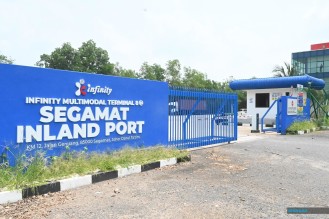
Segamat Inland Port has set its sights on processing more than 6,000 twenty-foot equivalent units of containers before 2026 concludes, marking a significant acceleration in activity since the facility resumed operations on June 25 following a dormancy spanning over a decade. The port, now managed by Infinity Logistics & Transport, handled approximately 1,000 TEUs during its opening month, establishing a foundation for what port officials believe could become a transformative hub for Malaysia's inland freight network.
The strategic importance of Segamat Inland Port extends across four states, with Samuel Ho, the facility's manager, emphasizing that operations are tailored to serve industrial zones throughout northern Johor, southern Pahang, southern Negeri Sembilan, and Melaka. This geographic coverage positions the port as a crucial distribution node for manufacturers and traders operating across the peninsula's central-southern corridor, regions that have historically relied heavily on road-based logistics.
The reactivation of Segamat represents a deliberate pivot within government policy toward rail-based freight movement, aligning with what transport authorities describe as the Road to Rail initiative, executed in partnership with Keretapi Tanah Melayu Bhd. This strategic shift reflects broader recognition among policymakers that Malaysia's road infrastructure is reaching capacity limits, with congestion and safety concerns driving the search for alternative transport corridors. Rail freight offers inherent advantages in both efficiency and safety metrics, reducing the accident risk associated with heavy trucks navigating congested highways.
Environmental and economic efficiency calculations underscore the business case for modal shift. A single cargo train journey eliminates the need for approximately eighty container trucks on the road, translating into substantial diesel savings and measurable reductions in carbon emissions. Ho articulated this arithmetic plainly: the operational efficiencies gained through consolidated rail movement make financial sense even before accounting for the broader societal benefits of reduced congestion and improved road safety.
For over a decade, Segamat Inland Port remained underutilized because the railway corridor operated as a single-track system, constraining scheduling flexibility. The competing demands of passenger services and freight movements made rail freight operations impractical, limiting cargo trains to roughly one journey weekly. This operational bottleneck has now been eliminated following the completion of double-tracking work extending to Johor, fundamentally altering the facility's capacity and commercial viability.
The infrastructure upgrade enables Segamat to accommodate up to four cargo dispatch and receiving cycles per week, representing a fourfold increase in operational frequency. This improvement directly translates into more reliable scheduling for shippers and greater predictability in supply chains, factors that heavily influence location decisions for manufacturing and warehousing investment. The port can now efficiently connect major maritime gateways including Port Klang, Port of Tanjung Pelepas, and Johor Port in Pasir Gudang, creating integrated logistics pathways that were previously constrained.
The first operational phase occupies 20.23 hectares adjacent to Segamat Railway Station and has already generated over 200 employment opportunities for local residents, with expectations that job creation will accelerate as additional phases come online. Beyond direct employment in port operations, the facility's presence is anticipated to catalyze secondary economic activity through attraction of warehouse operators and light industrial manufacturers seeking proximity to efficient freight networks. This clustering effect has historically proven significant in logistics hubs throughout Southeast Asia, where accessibility to multiple transport modes drives location decisions.
Transport Minister Anthony Loke Siew Fook, who officiated the port's formal reopening, characterized the facility as having potential to function as an economic development accelerator for northern Johor, particularly benefiting districts such as Batu Pahat and Kluang. The minister's framing reflects official ambitions to leverage logistics infrastructure as an instrument for regional economic diversification, particularly in areas that have historically depended on agriculture and traditional industries.
Quantifying the network impact, officials project that Segamat's operations could eliminate approximately 18,000 lorry movements monthly from Malaysian roads, a substantial figure given the port's current processing volumes and anticipated growth. This reduction in heavy vehicle traffic carries multiplier benefits: improved road safety through reduced accident exposure, measurable congestion alleviation on highways serving the central peninsula, extended pavement lifespan through reduced axle loading, and optimized utilization of rail capacity that remains chronically underdeployed relative to regional standards.
The facility is pursuing knowledge partnerships with academic institutions, notably Universiti Tun Hussein Onn Malaysia, to build local expertise in rail-based port operations. These collaborative arrangements reflect recognition that Malaysia's inland port sector requires specialized skill development and that educational institutions can contribute practical knowledge transfer alongside conventional academic study.
Segamat Inland Port's trajectory will serve as a bellwether for Malaysia's commitment to modal shift in freight transportation. Achieving the 6,000 TEU target by year-end would validate the business case for railway-based distribution networks and potentially strengthen the rationale for similar inland port developments elsewhere on the peninsula, particularly in contexts where geographic distances and traffic congestion create natural advantages for rail-based alternatives to increasingly congested highways.

