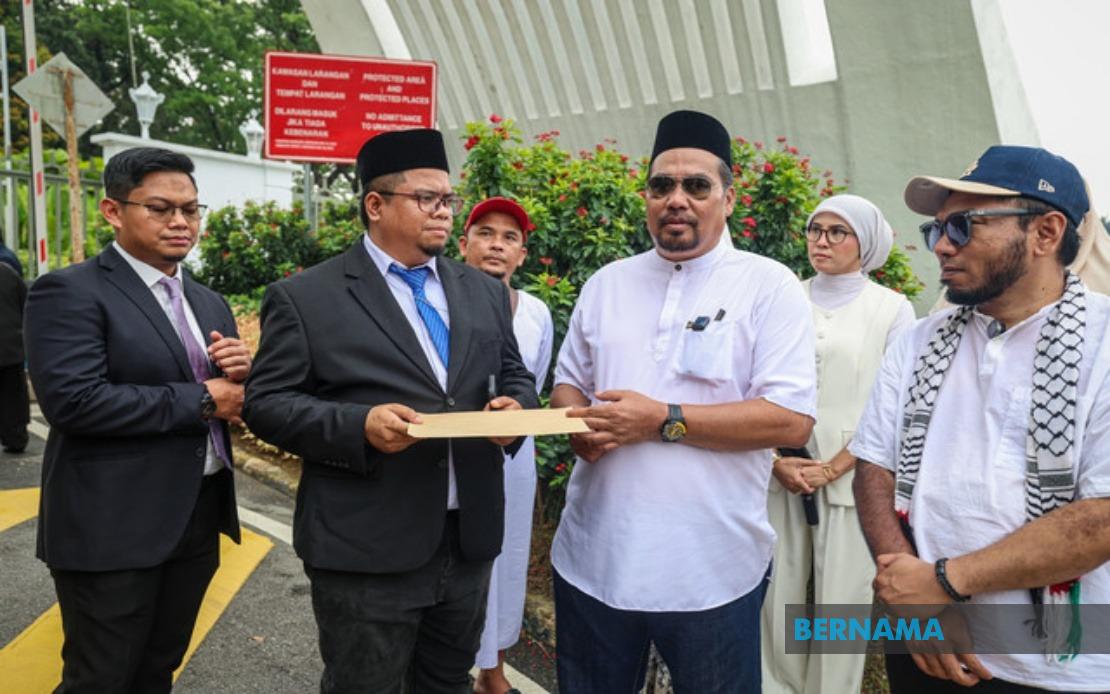
Social media activism group SEKPUR has escalated pressure on the government to hold accountable those responsible for administrative failures at Lembaga Tabung Haji, submitting a formal memorandum at Parliament on August 11 following the public release of a damning Royal Commission of Inquiry report into the pilgrimage fund operator.
The memorandum was delivered during a peaceful demonstration at Parliament's main entrance, handed to Zairudin Hashim, press secretary to the Minister in the Prime Minister's Department (Religious Affairs), for transmission to Minister Senator Dr Zulkifli Hasan. SEKPUR secretary Mohd Yani Alias emphasised that the group's intervention followed the Yang di-Pertuan Agong's explicit directive that individuals implicated in TH's troubles be prosecuted with maximum rigour, setting a strong moral and constitutional imperative for executive action.
The 211-page Royal Commission report, released publicly on July 29, documented systemic weaknesses spanning TH's governance and operational management between 2014 and 2020. The timing of SEKPUR's memorandum coincided with a special parliamentary sitting convened to allow the government minister to brief the Dewan Rakyat on the commission's findings and outline strategies for financial recovery. Notably, TH has already begun implementing the report's recommendations, achieving a 75 per cent completion rate by July 30, suggesting some institutional momentum toward reform even as questions of accountability remain unresolved.
Mohd Yani Alias framed the call for prosecutions as politically neutral, stating explicitly that organisational loyalty or party affiliation should carry no weight in determining consequences for wrongdoing. He underscored that TH is not a private concern but a custodial institution serving Malaysia's Muslim and Malay communities, whose financial security and trust depend on rigorous ethical stewardship. This framing transforms the accountability question from a technocratic management issue into one touching Islamic principles of fiduciary responsibility and communal protection.
Beyond immediate prosecutions, SEKPUR raised concerns about TH's structural financial viability and the adequacy of hibah distributions to depositors—returns that have suffered as the institution grapples with the consequences of prior mismanagement. The sustainability of these distributions remains uncertain given TH's weakened balance sheet, a reality that affects millions of ordinary Malaysians who view TH savings as essential retirement and life-milestone funding. The group's focus on competitive hibah rates acknowledges that depositors face opportunity costs when TH underperforms relative to alternative investment vehicles.
A secondary dimension of SEKPUR's advocacy centred on the escalating financial burden imposed by rising haj costs. The memorandum flagged that pilgrims increasingly face higher fees for performing one of Islam's Five Pillars, effectively pricing out lower-income believers and creating access inequality inconsistent with Islamic egalitarianism. This concern resonates particularly in Malaysia, where haj participation carries profound religious and social significance. SEKPUR simultaneously demanded transparency in the administration of haj quotas, hinting at potential misallocation or opaque distribution mechanisms that might favour connected applicants.
The Royal Commission's 25 recommendations signal acknowledgement at the highest institutional level that TH requires fundamental restructuring. With three-quarters of these recommendations already operationalised by late July, the implementation trajectory appears accelerated, possibly reflecting political recognition that public confidence in TH—critical for a savings-dependent institution—cannot tolerate extended inaction. However, implementation of procedural reforms differs markedly from prosecutorial accountability, and SEKPUR's intervention indicates civil society expects both tracks to advance in parallel.
For Malaysian readers and regional observers, the TH episode illustrates broader governance challenges within Islamic financial institutions across Southeast Asia. Trust-dependent institutions managing community savings require not merely technical compliance and process improvement but demonstrated accountability for leadership failures. The failure to prosecute or publicly sanction responsible individuals risks signalling that institutional size or religious character provides insulation from consequences—a message antithetical to equitable governance and potentially corrosive to confidence in similar funds operating regionally.
The memorandum also reflects evolving activism strategies in Malaysia, where social media-organised groups leverage parliamentary procedures and formal petitioning to amplify pressure beyond digital spaces. SEKPUR's choreographed delivery to parliamentary officials, timed to a government briefing, demonstrates strategic understanding of how institutional leverage points can concentrate political attention. This hybrid approach—combining grassroots mobilisation with procedural formality—has become characteristic of contemporary Malaysian civil society engagement.
Moving forward, the government faces a narrowing window to demonstrate decisive action without appearing either vindictive or performative. The Yang di-Pertuan Agong's directive carries constitutional weight, and SEKPUR has publicly invoked it as a normative anchor for prosecution demands. Any perceived reluctance to pursue accountability—whether from fear of political embarrassment or institutional loyalty—will likely intensify civil society pressure and potentially invite further parliamentary scrutiny. For TH itself, the convergence of operational reform and accountability mechanisms may prove essential to rebuilding depositor confidence and securing the institution's long-term viability as a trusted pillar of Islamic finance in Malaysia.

