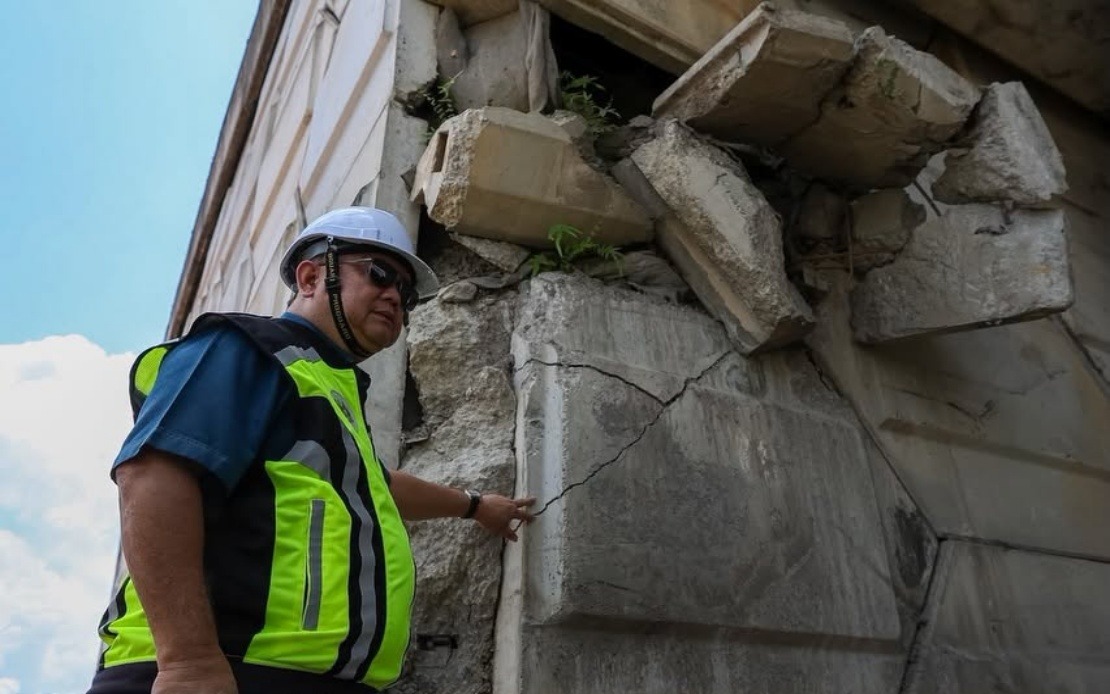
Works Minister Datuk Seri Alexander Nanta Linggi has promised that the damaged Selangau-Mukah Interchange Flyover on the Pan Borneo Highway will gradually return to service only after comprehensive safety assessments and repairs are finished, with uncompromised structural integrity restored. The reassurance came following a site visit where Nanta confirmed that Ramp 1 sustained significant damage when struck by a palm oil tanker, compromising its stability and forcing authorities to implement the closure for public protection.
The minister's statement reflects growing public anxiety over the extended closure, which has created substantial disruption across the transport corridor linking Bintulu, Mukah, and Sibu. The structural failure affected the retaining wall, requiring controlled demolition and reconstruction rather than superficial patching. This level of damage necessitated immediate preventive action despite the severe inconvenience to daily commuters and commercial operators depending on this crucial artery through Sarawak's central coast.
Nanta outlined a three-pronged approach to managing the crisis. First, maintaining rigorous safety standards for all road users without exception or compromise. Second, rigorous oversight of the repair timeline to prevent unnecessary extension of the closure period. Third, ensuring transparent public communication regarding alternative routes, current blockages, and progress updates on reconstruction efforts. This coordinated strategy attempts to balance legitimate safety concerns with public frustration over disrupted travel patterns.
The minister acknowledged that his ministry takes community feedback seriously, whether expressed through conventional media channels or social media platforms. This recognition signals official awareness that public perception and trust in infrastructure management significantly influence confidence in transport systems. For Malaysian and Southeast Asian readers, this demonstrates how pressure from affected residents can shape government responsiveness to critical infrastructure failures.
The phased reopening approach represents a calculated middle ground between immediate full restoration and indefinite closure. Unaffected routes will be progressively cleared for traffic as safety certifications are obtained for individual sections, while problem areas remain cordoned off until repair completion. This graduated strategy aims to restore partial functionality quickly while maintaining absolute safety standards for opened segments.
For the broader Sarawak economy, this closure carries material consequences. The Bintulu-Mukah-Sibu corridor supports significant commercial traffic, including agricultural produce movement, resource transport, and passenger services. Extended disruption affects business schedules, increases logistics costs, and threatens time-sensitive shipments. The Pan Borneo Highway, as a critical national infrastructure project, must maintain reliable operations to justify its substantial investment and support Sarawak's economic integration.
The tanker collision represents a broader vulnerability in highway infrastructure design. Fixed barriers and structures must account for potential vehicle impacts, particularly from heavy commercial traffic. This incident may prompt engineering reviews across the Pan Borneo Highway and other major Malaysian routes to identify similar risk points and recommend protective modifications. Southeast Asian highway authorities frequently confront comparable challenges managing high-speed corridors through mixed-use environments.
Nanta's emphasis on safety prioritisation reflects standard infrastructure management protocols, yet such closures create genuine hardship for dependent communities. Residents and businesses operating along the corridor face increased travel times, inflated transportation costs, and scheduling complications. Small enterprises lacking alternative logistics options suffer disproportionate impacts compared to larger commercial operators capable of routing around the closure.
The reconstruction timeline remains unspecified in official statements, creating uncertainty for affected parties. Typical retaining wall reconstruction projects require engineering assessment, materials procurement, skilled labour deployment, and staged installation—processes typically spanning weeks or months depending on damage severity. Malaysian and regional readers should anticipate extended disruption, potentially lasting through multiple months, though official progress updates should provide clearer estimates as repair work advances.
This incident demonstrates why critical infrastructure requires redundancy and backup systems. Single-point failures on major highways create cascading economic and social disruptions affecting entire regions. Future highway planning in Malaysia and Southeast Asia should incorporate design features reducing vulnerability to such incidents through better barrier systems, impact-resistant engineering, and alternative route provisions for essential corridors.
The government's commitment to transparent communication will be tested as repair timelines develop. Commuters and businesses require reliable updates enabling rational transport planning. Communication failures during infrastructure crises undermine public confidence more severely than the disruptions themselves. Effective stakeholder engagement throughout reconstruction can mitigate frustration and maintain social licence for infrastructure maintenance activities.
For Malaysian readers monitoring this situation, the Selangau-Mukah closure exemplifies broader infrastructure challenges facing developing economies balancing rapid expansion with operational reliability. The recovery process will inform how Malaysia manages similar incidents on other critical transport corridors. Regular progress reports and transparent timeline adjustments represent essential components of responsible infrastructure stewardship, particularly affecting communities like those dependent on the Sarawak highway system.

