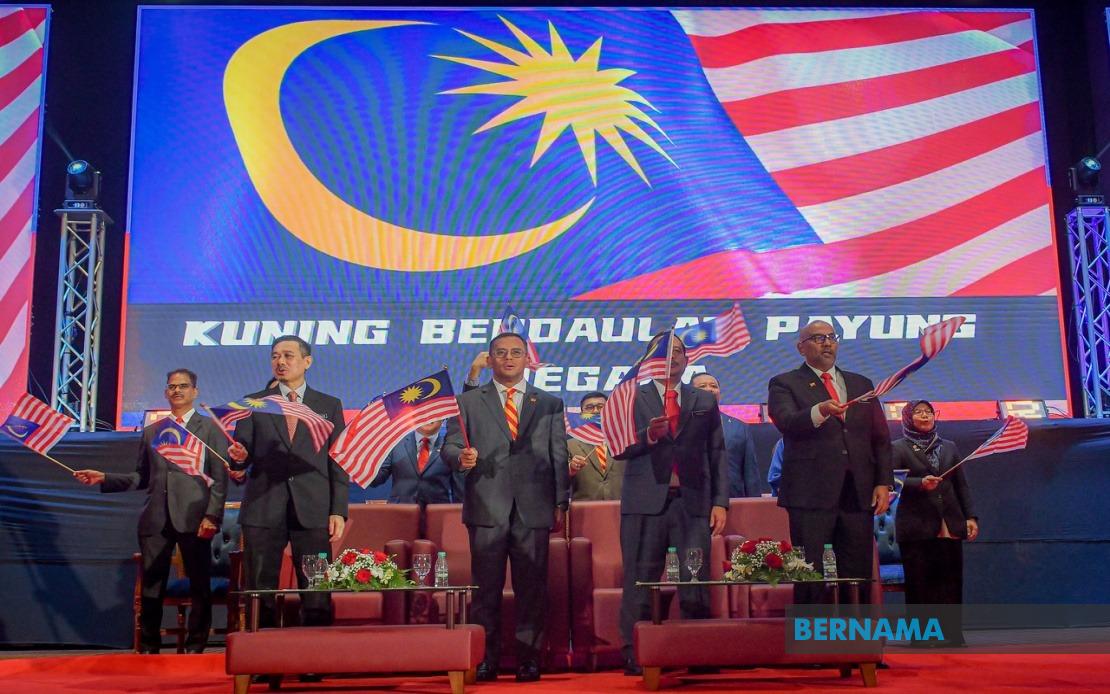
The Selangor state government is on track to receive a formal determination regarding the status of a disputed state assembly seat within the coming days, Menteri Besar Datuk Seri Amirudin Shari announced on Saturday in Shah Alam. Once the Selangor State Legislative Assembly Speaker formally notifies the administration of the seat's status, the Election Commission will then assess whether a by-election must be held, he explained to waiting reporters after presiding over the Menteri Besar's Assembly with civil servants and launching the Fly the Jalur Gemilang campaign.
The administrative process is moving through its designated channels with methodical precision. The state's legal adviser is currently preparing the requisite legal memorandum that will accompany the Speaker's formal pronouncement to all concerned authorities. Amirudin emphasised that this task falls squarely within the Speaker's constitutional remit, and the legal department's completion of documentation this week will set the stage for the Election Commission's subsequent evaluation. The state leadership has committed to honouring whatever conclusion the federal electoral body reaches, he stressed, indicating Selangor's preparedness to trigger a by-election if the legal framework dictates such action.
Underlying this procedural development are unconfirmed reports that one Selangor state assemblyman's eligibility to hold his seat has been questioned. The exact nature of these allegations remains undisclosed in official statements, though media outlets have circulated suggestions that they concern the legislator's qualifications to serve. The matter has sufficient weight that it has engaged the attention of the Speaker's office and prompted legal scrutiny at the state level. Whether the seat ultimately becomes vacant will hinge upon how both the Speaker and the Election Commission interpret relevant provisions of electoral law.
For Malaysian observers, the situation underscores the institutional machinery through which state legislatures maintain democratic integrity. The need to verify that elected representatives meet constitutional and legal prerequisites is fundamental to democratic governance, even when such verification creates procedural complications and electoral uncertainty. The Selangor case demonstrates how states navigate the tension between administrative efficiency and the rigorous standards that must attach to legislative office. A by-election, should one be called, would represent a legitimate democratic exercise rather than a setback, as voters would have the opportunity to reaffirm or alter representation in that constituency.
In remarks touching on a separate but politically sensitive matter, Amirudin addressed the contentious issue of stray dogs in Selangor, a topic that has generated heated public debate and gained royal attention. The state government maintains an active posture on animal control to protect public safety, the Menteri Besar explained, yet it seeks to execute this responsibility without cruelty or abandonment of compassion. He portrayed enforcement as requiring constant calibration—neither inaction that courts danger, nor harshness that violates humanitarian principles. This balancing act has proven difficult in practice, as incidents captured on social media have sparked outrage among animal welfare advocates.
Tengku Permaisuri Norashikin of Selangor has prominently voiced her distress at recent instances of animal cruelty involving pets and stray animals that have circulated virally, particularly involving dogs and cats. Her public expression of sadness, disappointment and anger carries significant weight in Malaysian civil society, elevating animal welfare from a routine administrative concern to a matter of princely attention. The Istana Alam Shah released a statement noting that the Tengku Permaisuri has called upon the Federal Government to review and strengthen penalties enshrined in the Animal Welfare Act 2015, advocating for stricter and more consistent application of law against those convicted of animal cruelty.
Amirudin, however, pushed back against suggestions that local authorities have been reactive or neglectful on the stray animal question. He contended that enforcement action has routinely been taken to safeguard public safety, and that this priority predates recent viral incidents and social media campaigns. The Menteri Besar noted that the issue of roaming animals had previously been raised in the State Legislative Assembly itself, including by the Port Klang representative. His implicit argument was that public safety concerns around stray animals represent a longstanding constituency worry rather than a newfound enthusiasm born of social media pressure.
The controversy also reflects a deeper tension within Malaysian governance regarding the treatment of animals and the respective responsibilities of state and federal authorities. While state governments oversee local animal control through municipal councils and local authorities, animal welfare law remains a federal domain. This jurisdictional split creates situations where state enforcement officials implement federal law according to state-level priorities and resources, sometimes generating friction between humanitarian advocates and public safety officials. The intervention of a senior member of Selangor's royal household has brought additional scrutiny to how those officials discharge their duties.
Amirudin's defence of his government's enforcement approach hinged on the principle that officers cannot be simultaneously blamed for acting and for failing to act. This rhetorical framing glosses over the genuine complexity that lies beneath: the question is not whether enforcement should occur, but how it should be conducted. Critics are not uniformly arguing for non-enforcement; many are arguing for enforcement that prioritises capture and rehoming over euthanasia, or that emphasises prevention through spay-neuter programmes and community education. The Menteri Besar's commitment to taking note of the Tengku Permaisuri's concerns and ensuring enforcement remains humane suggests that some accommodation between safety and compassion may be possible, though the practical details remain opaque.
The government's undertaking to conduct enforcement in accordance with law while respecting the imperative of compassion represents the stated position, yet implementation will ultimately determine whether this pledge carries substantive meaning. Malaysian readers watching these developments will note that both the seat status matter and the stray animal controversy illustrate how state administrations must navigate competing legal obligations, public expectations, and humanitarian considerations. The coming week will clarify the electoral question; resolving the animal welfare challenge may prove more prolonged.

