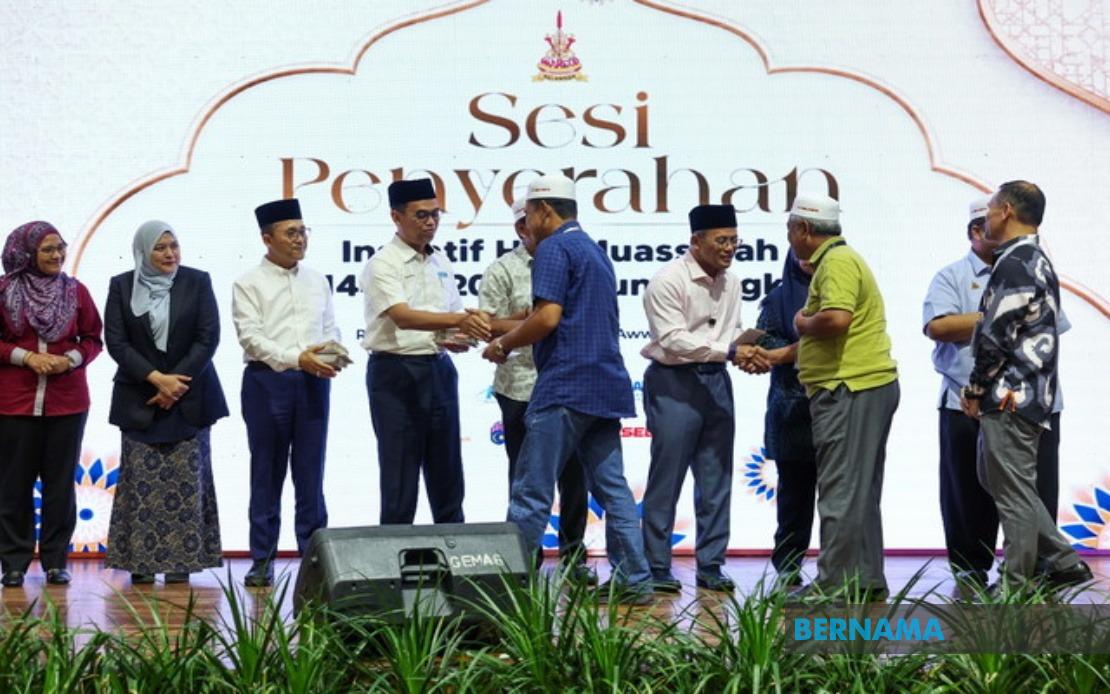
The Selangor state government is in the final stages of distributing a RM9 million financial assistance package for pilgrims preparing for the 2026 Haj pilgrimage. As of late August, 4,800 recipients out of the targeted 6,000 have already collected their allocations, with Menteri Besar Datuk Seri Amirudin Shari confirming that the remaining disbursements should be completed by the end of September at the latest. The achievement represents substantial progress in what has become one of Selangor's signature assistance programmes for Muslim residents preparing for their religious obligation.
The initiative, formally known as the 2026 Muassasah Haj Incentive Programme, forms part of a broader effort by the Selangor state government to support its Muslim population during major religious observances. Administered through the Selangor Menteri Besar Incorporated Foundation, the programme distributes funds specifically earmarked for the practical necessities of pilgrimage preparation. The assistance takes a targeted approach by covering identifiable expenses that represent genuine barriers to participation, rather than providing unfocused cash transfers.
Each of the 6,000 approved recipients receives RM1,500 in direct assistance, a sum carefully calibrated to address multiple dimensions of Haj preparation. Pilgrims can allocate these funds across several essential categories: religious equipment required for the pilgrimage rituals, prescription medications and health supplies needed for the physical demands of the journey, appropriate clothing suitable for the climate and customs of the holy sites, and other practical necessities that ensure comfort and safety during the weeks-long pilgrimage. The specificity of eligible expenditure categories reflects a deliberate policy choice to maximise the practical impact of each ringgit distributed.
The completion of the identification and contact process for the remaining 1,200 recipients underscores an important administrative dimension often overlooked in discussion of welfare programmes. Selangor's government has undertaken the labour-intensive work of locating all approved recipients, a task that involves cross-referencing multiple databases and conducting direct outreach to individuals who may be difficult to reach. This operational commitment signals that policy makers view the programme not as a one-time announcement but as a binding commitment requiring sustained administrative effort to fulfil.
Among the recipients receiving their allocations in recent ceremonies was a cohort from the Dengkil state constituency, where 259 recipients participated in a formal presentation at the Putra Perdana Community Hall in Puchong. The decision to conduct formal handover ceremonies, rather than simply processing electronic transfers or postal deliveries, suggests the state government views these moments as opportunities for civic engagement and reinforcement of the state's commitment to supporting its Muslim residents. The attendance of Deputy Housing and Local Government Minister Datuk Aiman Athirah Sabu, who simultaneously holds the position of Sepang Member of Parliament, indicates the programme has achieved sufficient political prominence to warrant ministerial-level presence at constituency-level events.
The phased approach to disbursement, with ceremonies occurring across multiple Selangor constituencies throughout the month, reflects both logistical constraints and a deliberate communication strategy. By staging multiple handover events rather than conducting a single centralised distribution, the state government generates repeated opportunities for local media coverage, allows elected representatives to engage directly with constituents, and prevents the administrative bottlenecks that might arise from concentrating transactions into a limited timeframe. This distributed approach also provides multiple opportunities for recipients to raise questions or concerns about the programme's implementation.
Looking beyond the immediate 2026 cycle, Amirudin indicated that the state government harbours ambitions to enhance the programme's generosity substantially. He outlined plans to increase the per-recipient allocation from RM1,500 to RM2,000, with a target implementation date ranging between 2027 and 2028. However, he explicitly cautioned that such expansion remains contingent on the state's fiscal trajectory and broader economic circumstances. This conditional framing acknowledges the vulnerability of discretionary spending to budgetary pressures, a reality that Malaysian state governments face acutely given their limited revenue-raising authority compared to the federal government.
The fiscal arithmetic underlying this expansion proposal merits scrutiny. An increase from RM1,500 to RM2,000 per recipient would require an additional RM3 million annually if the beneficiary pool remains constant at 6,000 pilgrims. Whether Selangor's revenue growth trajectory can accommodate such an increase while simultaneously funding expanded provision across other policy domains remains uncertain. The Menteri Besar's candid acknowledgment that unexpected financial constraints could necessitate programme recalibration reflects political realism about the limits of state capacity, even in a relatively prosperous state like Selangor.
The programme itself carries broader significance for understanding the political economy of Islamic welfare provision in Malaysia. As states compete for legitimacy through demonstration of their commitment to Muslim residents' wellbeing, targeted assistance programmes like Selangor's Haj incentive represent a relatively visible and politically costless mechanism for state governments to demonstrate responsiveness. Unlike systemic reforms to education or healthcare, which generate fiscal obligations in perpetuity and encounter competing claims from non-Muslim populations, a time-bound Haj subsidy programme can be calibrated precisely and targeted exclusively to a specific demographic. This political arithmetic shapes the incentive structures surrounding such programmes across Malaysia's state governments.
For pilgrims themselves, the RM1,500 assistance materially alters the feasibility calculus surrounding Haj participation. While the annual Haj subsidy from the federal Tabung Haji institution remains the primary financial mechanism enabling Malaysian participation, supplementary assistance from state governments can address the gap between Tabung Haji provision and the actual costs incurred by individual pilgrims. For Selangor residents of modest means, the state government's contribution may well prove decisive in enabling participation in a pilgrimage that represents a central aspiration within Islamic tradition. The programme thus functions simultaneously as welfare provision, religious facilitation, and political positioning by the state government.
The anticipated completion of disbursements by September represents a significant administrative accomplishment for Selangor's public sector. Conducting a comprehensive financial assistance programme affecting 6,000 individuals, with formal ceremony components distributed across multiple constituencies, requires substantial coordination across multiple government agencies and contracted service providers. The successful progression toward full disbursement demonstrates that the state government's bureaucratic apparatus possesses the capacity for large-scale programme implementation, an important signal for a state government seeking to build public confidence in its governance competence.
As Selangor contemplates programme expansion, officials will benefit from collecting systematic data on programme outcomes and recipient satisfaction. Understanding which components of Haj preparation the funds primarily address, whether recipients perceive the assistance as genuinely consequential, and whether the programme generates positive political returns for the state government would inform decisions about future expansion. The investment in formal presentation ceremonies suggests the state government already recognises the political economy of such programmes and views visible programme delivery as central to the initiative's legitimacy and value.
The Selangor government's commitment to completing full disbursement by September reflects a broader pattern of state governments utilising targeted religious assistance programmes to demonstrate responsiveness to Muslim constituents' priorities. While the absolute fiscal magnitude remains modest relative to overall state budgets, such programmes carry disproportionate political significance because they address fundamental religious aspirations and remain comprehensible to recipients as tangible state support. As Malaysia's state governments continue navigating the fiscal pressures of post-pandemic governance, the durability and expansion trajectory of such programmes will offer revealing indicators of the political priority accorded to Islamic social welfare provision.

