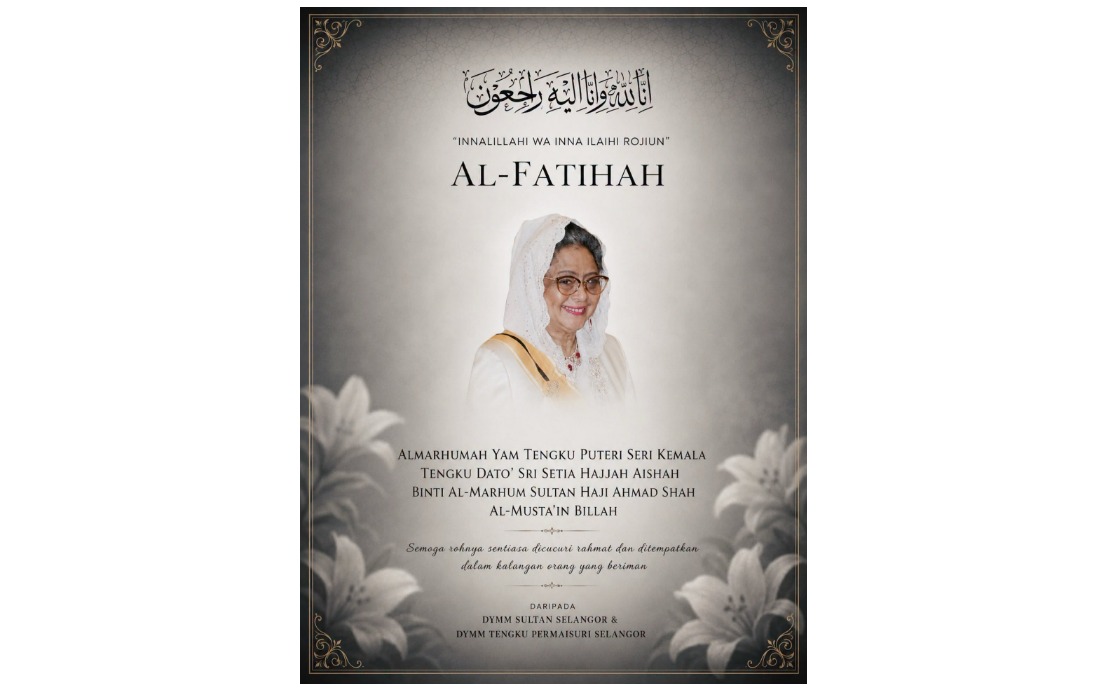
The royal household of Selangor has formally conveyed its condolences to Al-Sultan Abdullah Ri'ayatuddin Al-Mustafa Billah Shah, the Sultan of Pahang, following the death of his elder sister, Tengku Puteri Seri Kemala Tengku Datuk Seri Aishah, daughter of the late Sultan Ahmad Shah. The Selangor Royal Office confirmed that Sultan Sharafuddin Idris Shah and Tengku Permaisuri Norashikin have expressed their sorrow and grief over the loss, joining the broader royal fraternity in mourning the respected member of the Pahang royal family.
Tengku Datuk Seri Aishah passed away at a private hospital in Kuala Lumpur at 9.15 pm on the evening of August 26, after what officials indicated was a period of illness. Her death marks the conclusion of a life spent within Malaysia's highest circles of formal state ceremony and royal obligation, where she maintained the dignified public presence expected of members of the sultanate. The timing of her passing and the medical setting underscore the reality that even the most prominent families face the same vulnerabilities to health challenges as all Malaysians.
The formal expression of condolences from the Selangor palace illustrates the deeply interconnected nature of Malaysia's nine royal households, each bound by bonds of kinship, protocol, and shared institutional interests. When a senior member of one state's ruling family passes, it is customary for counterparts in other states to mark the occasion with official statements of sympathy, reinforcing the collective identity of the Malay-Muslim monarchy as a stabilizing constitutional institution. This practice has been consistent across decades and underscores the formal mechanisms through which Malaysia's rulers acknowledge significant events affecting the broader royal community.
According to the statement released by the Selangor Royal Office, Sultan Sharafuddin and Tengku Permaisuri Norashikin specifically prayed that Tengku Datuk Seri Aishah's soul would receive Allah's mercy and be placed among the faithful. The invocation of Al-Fatihah, the opening chapter of the Quran, represents the Islamic practice of offering spiritual supplication on behalf of the deceased, a gesture that carries particular weight when offered by senior figures of state. Such expressions, while formulaic in their structure, serve to dignify the departed and acknowledge the grief of the bereaved family.
The arrangements for Tengku Datuk Seri Aishah's final rites reflect the ceremonial standards maintained for members of the royal family. Her remains were to be transported to the Pahang Royal Mausoleum located in Pekan, the historic capital of Pahang State, where burial would proceed according to Islamic practice and royal customs. The designation of a full state funeral with honours recognizes her status within the sultanate and the respect accorded to her by both her immediate family and the broader royal establishment. Such ceremonies often involve elaborate security arrangements, attendance by senior government officials, and careful choreography of public ritual.
Tengku Datuk Seri Aishah's position as sister to the reigning Sultan of Pahang placed her within an important but comparatively private sphere of royal life. Unlike sultans themselves, who hold constitutional and ceremonial roles defined by their state constitutions, siblings of reigning monarchs occupy a more peripheral position in formal governance structures. Nevertheless, they retain significant social standing and are often consulted informally on matters affecting the royal institution. Her years would have encompassed periods of profound change in Malaysian society, from the early decades of independence through to the contemporary era of digital communication and evolving expectations of royal conduct.
The death of Tengku Datuk Seri Aishah comes at a time when Malaysia's royal households continue to navigate questions about their constitutional relevance, public accountability, and institutional adaptation to modern democratic expectations. Members of the extended royal family, particularly those in their advanced years, represent connections to Malaysia's earlier historical periods and embody the continuity of monarchical institutions that predate the formation of the federation itself. Their passing thus carries symbolic weight beyond mere familial loss, marking the gradual transition of Malaysia's senior generation of royals.
From a constitutional standpoint, the Pahang sultanate remains one of Malaysia's most historically significant royal houses, with deep roots in the peninsula's pre-colonial and colonial periods. The present Sultan, Al-Sultan Abdullah, ascended to the throne in 2019 following the abdication of his predecessor, an event that attracted considerable constitutional and public attention given its rarity in modern Malaysian history. The loss of an elder sibling within such a household carries emotional significance that extends beyond the private realm into the broader narrative of Malaysia's reigning families.
The formal nature of the Selangor palace's statement, released through official channels, demonstrates the continued importance placed on protocol and ceremonial acknowledgment within Malaysia's constitutional monarchy. In an era where social media has democratized communication, the persistence of formal royal office statements through traditional media outlets signals that the institution maintains careful control over the framing and presentation of significant events. Such precision in messaging serves multiple purposes: it honors the deceased, extends sympathy to the bereaved family, and reinforces the dignity and formality associated with the monarchical institution itself.
The broader implications of this event for Malaysian politics remain subtle but meaningful. The interconnectedness of the royal households and their demonstrated support for one another through public expressions of condolence reinforce the notion that Malaysia's rulers, despite occasional disputes over constitutional interpretation or political role, fundamentally view themselves as members of a shared institutional ecosystem. This solidarity becomes particularly important in periods when the monarchy faces external criticism or when questions arise about the contemporary relevance of hereditary, ceremonial heads of state. The collective acknowledgment of significant life events within royal families thus serves a dual purpose: honoring the immediate loss while subtly reaffirming the institution's internal cohesion and legitimacy.

