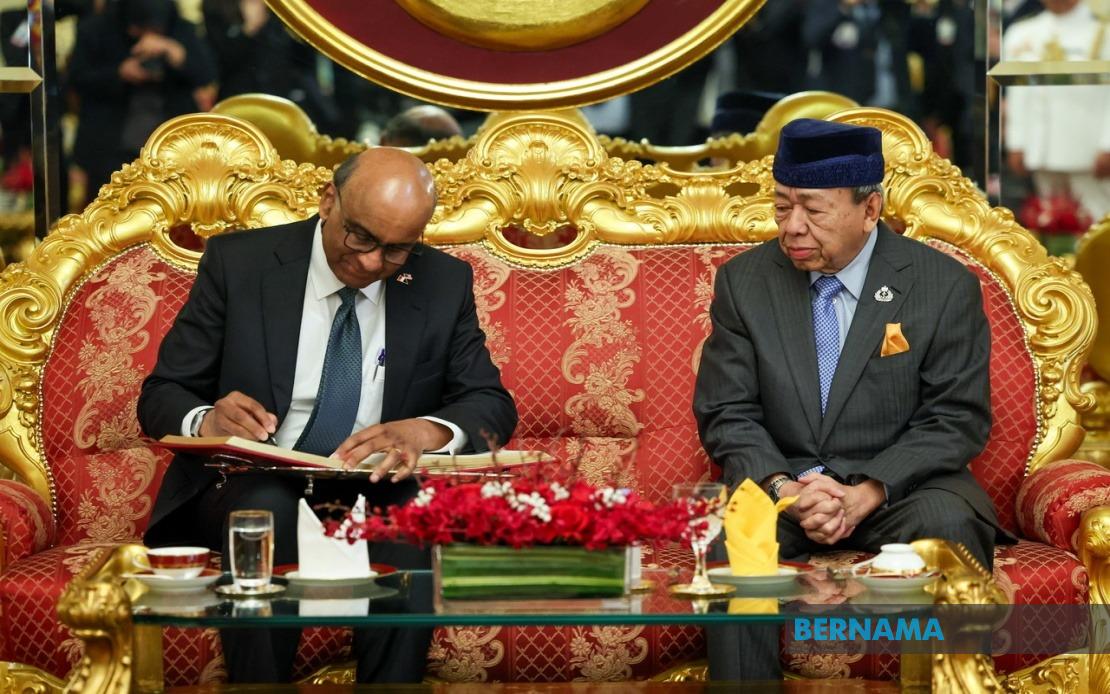
Singapore President Tharman Shanmugaratnam paid a formal courtesy call on the Sultan of Selangor, Sultan Sharafuddin Idris Shah, at Istana Alam Shah in Klang on July 14 as part of his ongoing three-day state visit to Malaysia. The meeting, which commenced at 11 am and extended for approximately ninety minutes before concluding at 12.40 pm, underscored the diplomatic protocols observed between the two neighbouring nations and their respective leadership hierarchies.
The Singapore president was formally received by the Raja Muda of Selangor, Tengku Amir Shah, and the gathering was attended by Malaysia's Entrepreneur Development and Cooperatives Minister Steven Sim, who held the position of minister-in-attendance for the duration of the presidential visit. The presence of these officials reflected the significance accorded to the meeting and the broader state visit framework.
Tharman's visit to Malaysia, which commenced on July 13 and will conclude on July 15, represents a reciprocal diplomatic engagement. The Foreign Ministry explained that this state visit responds to the reciprocal visit undertaken by His Majesty Sultan Ibrahim, King of Malaysia, to Singapore on May 6 and 7, 2024. Such exchanges of state visits between heads of state serve to reinforce institutional relationships and reaffirm commitments to bilateral cooperation across multiple sectors.
The timing and structure of the visit reflect the depth of the Malaysia-Singapore relationship, which extends far beyond ceremonial protocols. Singapore stands as Malaysia's second-largest trading partner globally, a position of considerable economic consequence for both nations. More significantly within the Southeast Asian context, Singapore represents Malaysia's largest trading partner among the ten member states of the Association of Southeast Asian Nations, a distinction that underscores the centrality of bilateral economic linkages to broader regional integration efforts.
This economic interdependence carries implications for Malaysian policymakers and businesses engaged in regional trade networks. The consistent high-level diplomatic engagement between Malaysian and Singaporean leadership demonstrates a commitment to maintaining stable, predictable relations that undergird the commercial partnerships between enterprises in both countries. For Malaysian exporters and investors, the strength of the bilateral political relationship provides reassurance regarding the continuity of market access and regulatory frameworks.
The formal nature of Tharman's audience with the Selangor Sultan also highlights the constitutional architecture of Malaysian governance. As a constitutionally sovereign state within the federation, Selangor maintains its own protocol for receiving foreign dignities, and the Sultan's role as the head of state in Selangor necessitates that visiting presidents accord proper respect to this institutional arrangement. The involvement of Tengku Amir Shah in receiving the Singapore president reflects the ceremonial expectations embedded within Malaysia's federal system.
For Malaysian readers tracking developments in bilateral relations, the three-day visit provides an opportunity to assess whether any substantive agreements or policy announcements emerge from the engagement between Malaysian and Singaporean leadership. State visits frequently serve as occasions for unveiling collaborative initiatives, whether in trade facilitation, infrastructure connectivity, or people-to-people exchanges. The courtesy call at Istana Alam Shah represents one component of a broader diplomatic programme that may include meetings with federal leadership in Kuala Lumpur.
The continuity of high-level exchanges between Malaysia and Singapore reflects a regional approach to managing complex bilateral relationships. Despite occasional disagreements over maritime boundaries, water supply arrangements, and other contentious issues, both nations have demonstrated a capacity to compartmentalize disputes and maintain productive engagement across domains where mutual interests align. The state visit mechanism provides a structured framework for sustaining these relationships at the level of national leadership.
For Southeast Asian observers, the Malaysia-Singapore dynamic carries broader significance for regional stability and integration. These two nations represent the commercial and financial heart of ASEAN, and their bilateral relationship sets a tone for the entire regional grouping. The commitment to state visits and formal diplomatic protocols suggests a preference for institutionalized engagement that could serve as a model for managing bilateral relationships elsewhere in the region, particularly where historical grievances or contemporary disputes complicate relations.
The presence of Minister Steven Sim at the Istana Alam Shah meeting also signals Malaysia's institutional approach to managing high-level visits. By designating a specific minister as the in-attendance official, Malaysia ensures that visiting dignitaries have direct access to government personnel empowered to discuss substantive matters, should the occasion warrant such discussions. This procedural element reflects professionalism in diplomatic protocol and ensures that courtesy calls, while ceremonial in nature, can transition into substantive engagement if necessary.

