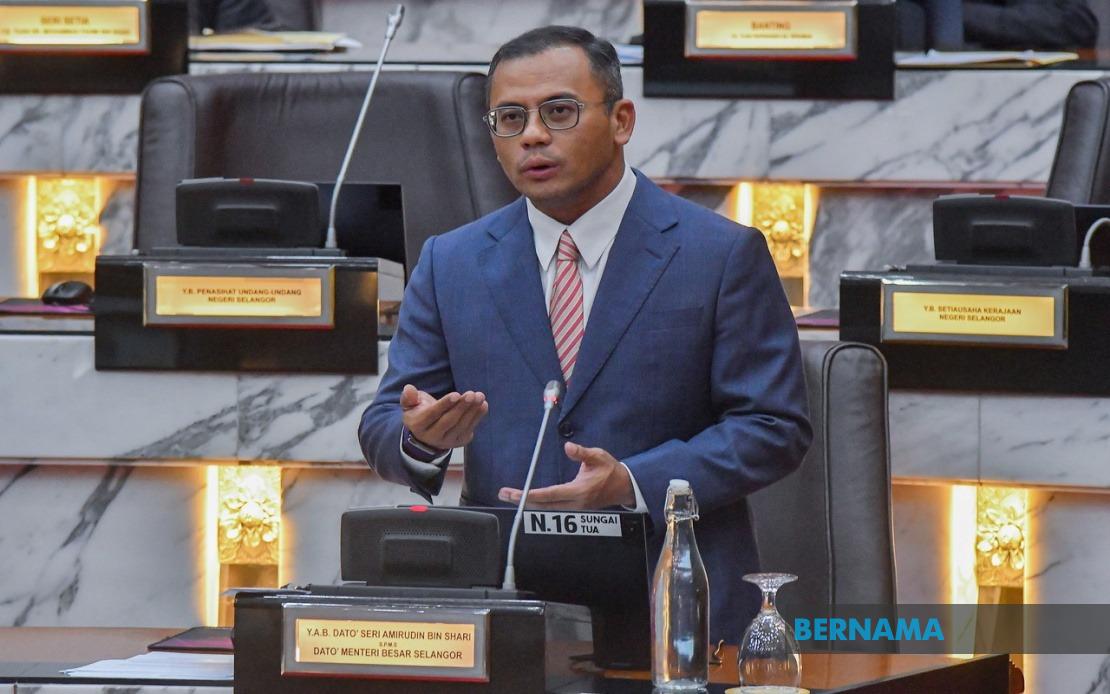
Selangor's Menteri Besar Datuk Seri Amirudin Shari has directed all local authorities in the state to undertake a thorough review of connectivity infrastructure serving public transportation networks, signalling the government's commitment to addressing long-standing accessibility challenges that have increasingly drawn public attention. The directive emerged during state legislative proceedings as the government grapples with mounting complaints about disconnected transit hubs, particularly concerns involving LRT3 and its surrounding catchment areas that have gained traction through social media discussions.
The state government stands ready to inject additional financial resources into upgrading pedestrian infrastructure, recognizing that comfortable and secure walkways represent essential components of any functional transit ecosystem. Rather than viewing this as a costly undertaking, Amirudin framed the investment as strategically aligned with Selangor's broader mobility objective of shifting commuters away from private vehicles toward more sustainable public transport options. This perspective underscores an emerging understanding among state policymakers that connectivity failures do not merely represent service gaps but rather act as active disincentives discouraging public transport adoption.
The Menteri Besar emphasized that local authorities must adopt a more proactive operational stance, addressing accessibility challenges through direct engagement with community stakeholders rather than waiting for public complaints to escalate across digital platforms. His comments suggested frustration with reactive governance patterns, where authorities become aware of infrastructure deficiencies only after grievances circulate on social media channels including X and Threads. This shift toward anticipated problem-solving reflects broader administrative reform efforts aimed at improving service delivery responsiveness across Selangor's municipalities.
The policy intervention was prompted by representations from Danial Al-Rashid Haron Aminar Rashid, the Batu Tiga assemblyman, who raised connectivity inadequacies during legislative debate on the Selangor Resilience Strengthening Package. His intervention highlighted how transit gaps between rapid transit lines and residential areas have become sufficiently acute to generate viral social media discussions, transforming a technical transportation issue into a political concern demanding executive attention. The issue encapsulates broader challenges facing Malaysia's urban transport systems, where capital infrastructure investments often proceed without corresponding attention to the crucial final segments connecting stations to residential, commercial, and institutional destinations.
Responsibility for coordinating the connectivity initiative has been assigned to Ng Sze Han, chairman of the state's Investment, Trade and Mobility Committee, who will convene meetings with all public transport operators functioning within Selangor. These consultations aim to develop comprehensive service mapping documents identifying specific geographic and temporal gaps in transport accessibility. Such mapping represents an essential prerequisite for targeted intervention, allowing government and operators to distinguish between areas suffering from infrastructure deficiency and those facing inadequate service frequency or operational hours.
The state government intends to deploy subsidy mechanisms as a tool for improving service quality, though Amirudin acknowledged that financial support alone cannot address operational shortcomings. His remarks suggest that some operators may be underutilizing allocated resources or operating with suboptimal scheduling that fails to serve commuter demand patterns effectively. By conditioning subsidy continuation on improved service mapping and coverage, the government appears to be leveraging financial incentives as a mechanism for behavioral change among transport operators.
Amirudin's commentary revealed important strategic thinking about how first-mile and last-mile connectivity directly influences transportation choices at the household level. When commuters encounter significant time penalties or physical obstacles accessing transit stations, they rationally choose private vehicles despite broader policy preferences for public transport adoption. This recognition that convenience and accessibility function as primary determinants of modal choice suggests the state government understands that achieving sustainable transportation goals requires addressing not merely the transit corridors themselves but the entire journey experience from origin to destination.
The emphasis on cost-effectiveness indicates awareness that Selangor's local authorities operate under resource constraints limiting the scope of infrastructure improvements. Rather than implementing expensive standalone connector facilities, the government appears inclined toward pragmatic solutions emphasizing improved pedestrian pathways and enhanced operational coordination. This approach acknowledges that many connectivity gaps may be addressable through better service planning and modest infrastructure investments rather than requiring major capital projects.
For Malaysian commuters and urban planners, this initiative carries significant implications extending beyond Selangor's boundaries. The state's approach to systematizing connectivity assessment and operator coordination could establish a replicable framework for other Malaysian transit authorities confronting similar challenges. Kuala Lumpur and Putrajaya, together with emerging transit systems in other states, face comparable first-mile and last-mile connectivity problems that have proven resistant to conventional solutions. Selangor's experience implementing structured operator consultation and service mapping could inform regional best practices for transit integration.
The timing of this policy intervention reflects broader recognition that Malaysia's public transport systems, despite substantial capital investment in recent years, have failed to achieve usage levels consistent with construction costs and government objectives. Connectivity deficiencies represent a significant contributing factor to this underperformance, as commuters weighing transportation options consider the full journey experience rather than merely the quality of the primary transit corridor. By systematically addressing these access barriers, Selangor's government is tackling a fundamental impediment to public transport competitiveness against private vehicles.
Longer-term success will depend on whether Ng Sze Han's coordination efforts translate into substantive operational changes among transport providers and concrete infrastructure improvements at the local authority level. The government's willingness to allocate subsidies contingent on improved service outcomes suggests a more performance-oriented approach to transit planning than has historically characterized Malaysian urban mobility policy. If implemented effectively, this accountability framework could establish a useful precedent for ensuring that public investment in transport infrastructure yields commensurately improved accessibility and service quality.