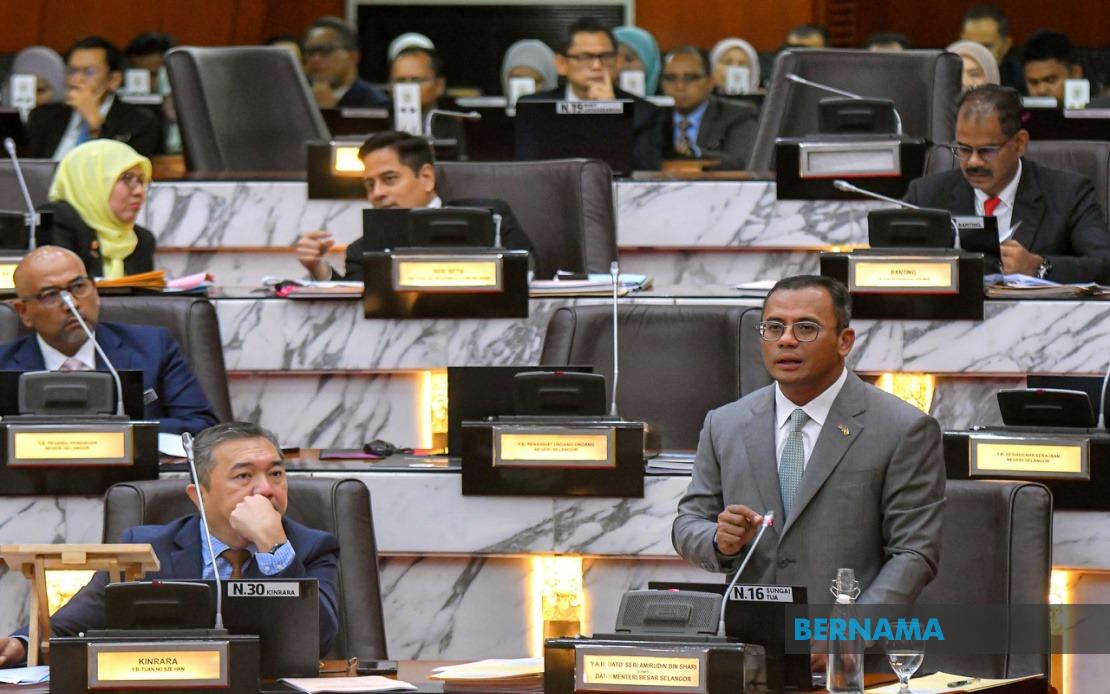
The Selangor state government has announced ambitious plans to significantly expand its scholarship assistance programme, with Menteri Besar Datuk Seri Amirudin Shari confirming that the Higher Education Institution Study Incentive (HPIPT) will be extended to 5,000 recipients in the coming budget cycle, doubling the scheme's current reach and reflecting growing demand from students pursuing tertiary qualifications across the state.
Amirudin revealed during a legislative assembly sitting that the decision to scale up the HPIPT initiative stems from exceptionally high application volumes, with the scheme receiving more than 5,000 applications in both 2025 and the current year. This sustained surge in interest has prompted state administrators to re-evaluate whether the existing quota adequately serves the educational aspirations of Selangor's student population, particularly as more families recognise the financial pressures associated with pursuing higher education.
The Menteri Besar outlined that the state government is currently conducting a financial assessment to determine the optimal expansion trajectory, with discussions centring on whether to increase beneficiaries to somewhere between 5,000 and 6,000 recipients, provided that Selangor's revenue position permits such an investment in human capital development. This cautious yet optimistic approach suggests the government recognises both the necessity and fiscal constraints of substantially broadening the assistance programme.
For Malaysian policymakers and education stakeholders, the Selangor initiative carries significant implications. Rising university enrolment costs and competitive job market pressures have made financial support schemes increasingly essential, particularly for middle and lower-income families who might otherwise struggle to afford quality tertiary education. By expanding HPIPT, Selangor is signalling a commitment to ensuring that financial hardship does not become a barrier to educational attainment, an approach that could influence thinking in other states considering their own scholarship frameworks.
Beyond simply increasing recipient numbers, the state government is also undertaking a comprehensive review of the HPIPT application timeline, recognising that students often experience delays between receiving university admission confirmation and being able to submit financial aid applications. The current procedural framework apparently creates a misalignment between institutional acceptance cycles and assistance application windows, potentially disadvantaging students who require timely notification of financial support before confirming their enrollment decisions.
Amirudin proposed implementing two application periods annually as a potential solution, a structural innovation designed to accommodate students entering higher education institutions at different points throughout the year. This reflects a more flexible and student-centric approach to programme administration, acknowledging that traditional single-window application systems may not adequately serve the diverse cohorts entering tertiary education across various intake cycles throughout Malaysia's academic calendar.
The HPIPT itself provides RM1,000 in direct financial assistance to qualified Selangor students enrolled at recognised public and private higher education institutions throughout Malaysia. The scheme's scope encompasses not only traditional bachelor's degree programmes but also Level 4 Skills Certificates and diploma qualifications, recognising that pathways to professional competency extend beyond conventional university degrees and reflecting changing labour market demands in Southeast Asia's increasingly diversified economy.
For Southeast Asian context, Selangor's expansion of education financing represents a regional approach to addressing one of the most pressing challenges confronting middle-income countries: ensuring that educational opportunities remain accessible across socioeconomic strata whilst managing public expenditure responsibly. As tertiary education becomes increasingly costly and competitively necessary for employment prospects, state-level interventions like the HPIPT become critical levers for social mobility and economic development.
The programme's emphasis on both local public institutions and private providers also deserves attention, as it signals that state support extends across Malaysia's diverse higher education landscape rather than exclusively favouring government universities. This inclusivity potentially improves access for students whose circumstances, qualifications, or preferences direct them toward private sector alternatives, whilst still maintaining quality assurance standards through the requirement that institutions be formally recognised.
Looking ahead to the 2027 budget cycle when this expanded HPIPT framework is expected to be formally implemented, the Selangor government's initiative may serve as a template for other Malaysian states evaluating their own educational investment strategies. The combination of responsive expansion based on demonstrated demand, procedural refinement to reduce administrative friction, and flexible application scheduling reflects evidence-based policymaking that addresses real obstacles facing contemporary students.
The decision to potentially restore HPIPT to its previously broader reach of 5,000 recipients, having contracted to 3,000 in recent years, also implies some recognition that fiscal constraints which necessitated earlier reductions may be easing, or that education funding has been reprioritised within state spending allocations. This reorientation toward education financing carries implications for how Malaysian state governments balance immediate service provision against longer-term human development objectives.
Moreover, the strong application response—more than 5,000 annually from a single state—underscores unmet demand for tertiary education financing assistance throughout Malaysia. Were comparable schemes expanded across other states or at the federal level, the aggregate numbers would likely reveal a significant student population benefiting from targeted financial support, suggesting that education financing remains a critical policy frontier for ensuring equitable access to Malaysia's knowledge-based future economy.

