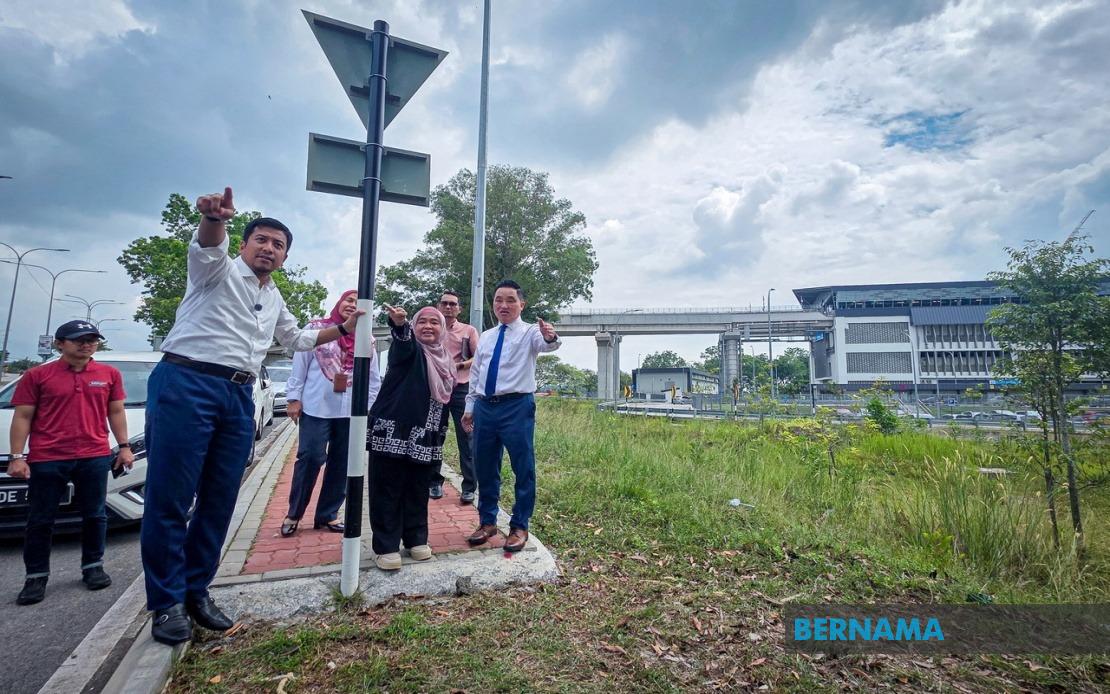
The Selangor State Government has announced an accelerated timeline for finishing pedestrian and crossing facilities at the Shah Alam Line LRT3 stations, responding to longstanding concerns about incomplete infrastructure affecting commuter safety and convenience. State Local Government and Tourism Exco Datuk Ng Suee Lim made the commitment following an on-site inspection that identified gaps in essential connectivity features designed to ease passenger movement between the rapid transit network and surrounding urban areas.
The administration's review has concentrated on two particularly problematic locations: Dato' Menteri Station and Shah Alam Stadium Station. These hubs are essential gateways within the Klang Valley's expanding public transport network, yet have been hampered by incomplete amenities including pedestrian walkways, zebra crossings, and related infrastructure essential for safe and seamless transfers. The delays have frustrated regular users and raised questions about the effectiveness of handover procedures following the line's opening.
For Dato' Menteri Station, officials have identified administrative hurdles as the primary constraint. Datuk Ng indicated that permit approvals and regulatory clearances have slowed progress, yet committed that Prasarana, the transport authority managing LRT operations, would complete required facilities within a two-month window. This relatively compressed deadline reflects the state government's determination to move beyond the typical inertia that often characterises post-opening remedial work on major infrastructure projects.
Shah Alam Stadium Station presents a more complicated situation, with completion hindered by the tender process initiated by neighbouring developers responsible for adjacent mixed-use projects. Rather than imposing a fixed timeline, the state government has adopted a monitoring approach, acknowledging that the involvement of private entities requires coordination and negotiation beyond direct government control. Nevertheless, the commitment to oversight indicates that bureaucratic delays will not be tolerated indefinitely.
The acknowledgment that newly opened projects inevitably exhibit operational weaknesses represents a pragmatic stance. Datuk Ng's candid admission that issues emerge only after systems commence operation suggests the state is learning from experience and willing to take corrective action promptly rather than deferring problems to later phases. This contrasts with historical patterns where infrastructure deficiencies at major transport nodes have persisted for years without resolution.
The Shah Alam City Council (MBSA) will assume responsibility for monitoring enhancement progress, with coordination meetings scheduled between government officials and private developers to accelerate timelines. This multi-agency approach recognises that effective delivery requires sustained pressure and communication among stakeholders holding different but complementary responsibilities. The state government's willingness to convene regular progress meetings suggests accountability mechanisms are being embedded into the process.
Extending beyond the immediate problem stations, the Selangor administration has instructed all local authorities operating stations within their jurisdictions to conduct comprehensive reviews of connectivity shortcomings. This broader audit approach acknowledges that the LRT3 line encompasses multiple stations that may harbour similar unaddressed issues, and that a systematic state-wide assessment would identify patterns requiring attention. The order represents preventative governance, attempting to catch and remedy issues across the network rather than responding reactively to individual complaints.
The involvement of the Royal Klang City Council (MBDK) and other relevant local bodies underscores the distributed nature of responsibility for public infrastructure oversight in Malaysia's federal system. Datuk Ng's instruction to council members and assemblymen to report feedback through established channels formalises a feedback loop that should catch emerging problems before they escalate. By mobilising elected representatives at multiple governance levels, the state aims to establish rapid communication pathways for identifying deficiencies.
For Malaysian commuters, particularly the Klang Valley's growing ridership base, this commitment addresses persistent frustrations with incomplete facilities at major transport nodes. The LRT3 line, which serves crucial corridors between Shah Alam and downtown Kuala Lumpur, has faced criticism since opening for exactly these kinds of last-mile connectivity gaps. Incomplete pedestrian infrastructure undermines the fundamental logic of rapid transit investment—moving people efficiently from origin to destination requires seamless integration across the entire journey, not merely high-speed core operations.
The Selangor government's public acknowledgment of infrastructure weaknesses and willingness to accept responsibility for remedial work represents a notable shift in Malaysian governance discourse. Rather than deflecting blame between agencies or insisting that projects are acceptable despite evident gaps, officials are committing to visible improvement timelines and establishing public monitoring mechanisms. This approach may set an expectation that subsequent infrastructure projects will be held to similar accountability standards.
The two-month deadline for Dato' Menteri Station improvements and the monitoring commitment for Shah Alam Stadium Station should be viewed as test cases for the state's broader infrastructure governance capacity. Implementation success will demonstrate whether Selangor can execute rapid remedial work efficiently, or whether bureaucratic and tender processes will again extend initial estimates. Commuters and transport analysts will be watching closely to assess whether stated commitments translate into completed facilities within promised timeframes.

