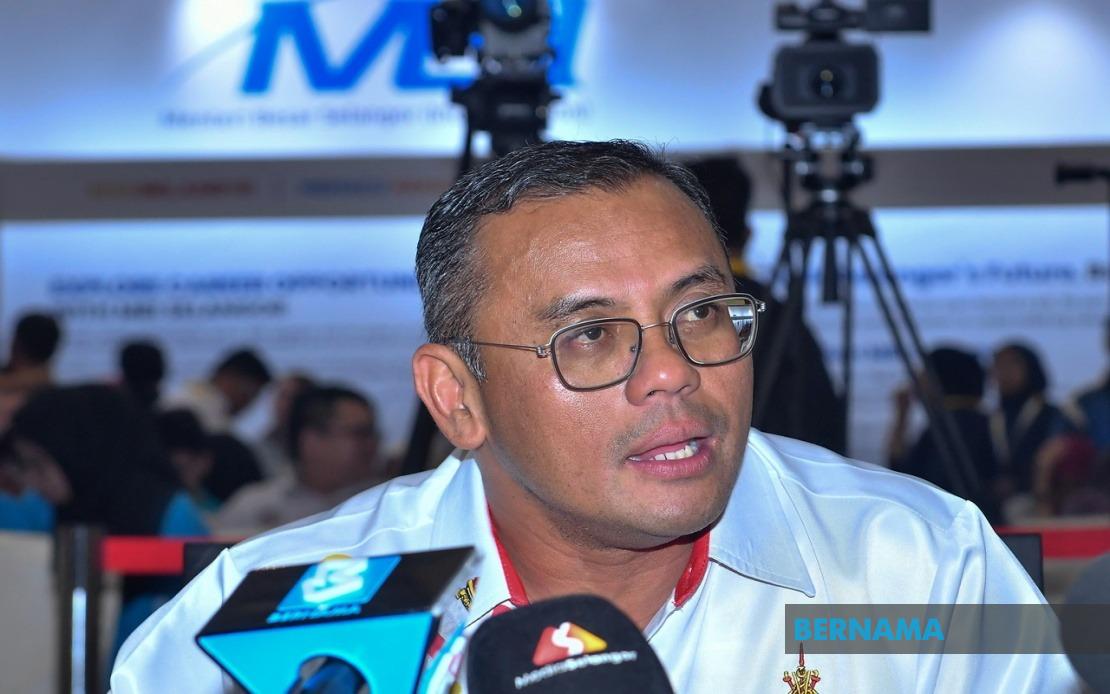
The Selangor state government has committed to meeting workers facing displacement from Panasonic AVC Networks Kuala Lumpur Malaysia Sdn Bhd (PAVCKM) within the coming week, with plans to explore financial assistance and job placement options as the company winds down television production operations. Menteri Besar Datuk Seri Amirudin Shari announced the intervention during his address at the Selangor Mega Jobcare 2026 programme in Shah Alam, underlining the state's proactive approach to managing the anticipated retrenchment fallout affecting approximately 400 workers by the end of March 2026.
The scheduled engagement will be spearheaded by V. Papparaidu, chairman of the State Human Resources, Poverty Alleviation, Indigenous & Minority Affairs Committee, working in tandem with officials from the Social Security Organisation (PERKESO). This collaborative structure reflects an integrated strategy to gather detailed information from affected workers while simultaneously facilitating access to existing welfare schemes and employment support systems. The involvement of PERKESO signals that displaced workers may benefit from newly enhanced unemployment insurance provisions recently introduced by the federal social security body.
According to Panasonic Malaysia Sdn Bhd's statement, the company has decided to cease production operations for two specific product lines, creating a sudden employment crisis for a workforce that has been instrumental in the company's Malaysian operations. The timeline provided—with closures taking effect by 31 March 2026—offers a window of approximately eight months for affected workers to plan their transition, though industry observers note that manufacturing facility closures typically involve compressed adjustment periods for workers seeking alternative positions.
The state government's initial relief measures will encompass immediate necessities such as food baskets, acknowledging the financial vulnerability of affected families during the transition period. However, state officials have signalled that temporary relief measures represent merely the opening phase of a more comprehensive support architecture. The emphasis on sustainable solutions through active job placement represents a departure from purely palliative assistance, reflecting lessons learned from previous factory closures across the Klang Valley industrial belt where workers faced extended unemployment.
Papparaidu elaborated on PERKESO's enhanced unemployment insurance scheme, which extends staged financial payments to retrenched workers during their job-seeking period. The programme commences with 80 percent wage replacement in the first month, gradually declining to 50 percent in the second month and 30 percent thereafter, establishing a financial buffer that allows workers to pursue employment opportunities without immediately depleting savings. This safety-net architecture becomes particularly significant given that many manufacturing workers in Selangor operate within tight household budgets with limited accumulated reserves.
The state government's simultaneous launch of the Selangor Mega Jobcare 2026 career fair demonstrates strategic timing in addressing the anticipated employment gap. The event, orchestrated in partnership with MYFutureJobs, mobilises 147 participating employers who collectively advertise more than 11,000 job vacancies across multiple sectors and skill levels. Notably, 62.2 percent of advertised positions offer monthly remuneration exceeding RM3,000, positioning the fair as a potentially viable channel for workers seeking comparable wage levels to their previous manufacturing roles.
The career fair operates at the Shah Alam Convention Centre across two days, extending from 9 am to 5 pm, with registration open to participants aged 18 to 60. This inclusive age bracket proves significant given that manufacturing workforces typically encompass workers across diverse career stages, from early-career technicians to mid-career specialists approaching retirement. The broad availability of vacancies suggests that retraining or lateral career transitions may present realistic alternatives for displaced Panasonic workers, particularly those possessing transferable skills from electronics manufacturing.
The Panasonic situation reflects a broader trend affecting Malaysia's electronics manufacturing sector, which has faced intensifying competitive pressures from lower-cost regional producers and shifting global supply chain dynamics. Selangor, historically the epicentre of Malaysia's manufacturing economy, has experienced successive facility closures and capacity reductions as multinational corporations optimise production footprints across Southeast Asia. This context underscores why state-level intervention mechanisms have become increasingly critical for managing workforce displacement and maintaining economic stability across export-dependent communities.
The coordination between state government agencies, federal social security bodies, and private employers evident in the current response reflects institutional lessons from previous industrial transitions. Unlike earlier manufacturing downturns where worker support remained fragmented, the integrated approach combining immediate relief, income insurance, and active job placement demonstrates a more sophisticated understanding of workforce management during economic dislocation. However, success ultimately depends on whether the advertised vacancies can accommodate workers whose manufacturing background may require reorientation toward different sectoral demands.
For Malaysian policymakers and Southeast Asian economists monitoring employment trends, the Panasonic closure and Selangor's response offer a case study in how developed state infrastructure and coordinated governance can partially cushion against sudden job losses. The 400 affected workers represent a measurable but contained challenge compared to large-scale factory relocations elsewhere in the region. Nevertheless, the incident underscores the vulnerability of manufacturing-dependent economies to global production decisions and the necessity of maintaining robust transition support systems as industrial structures evolve.

