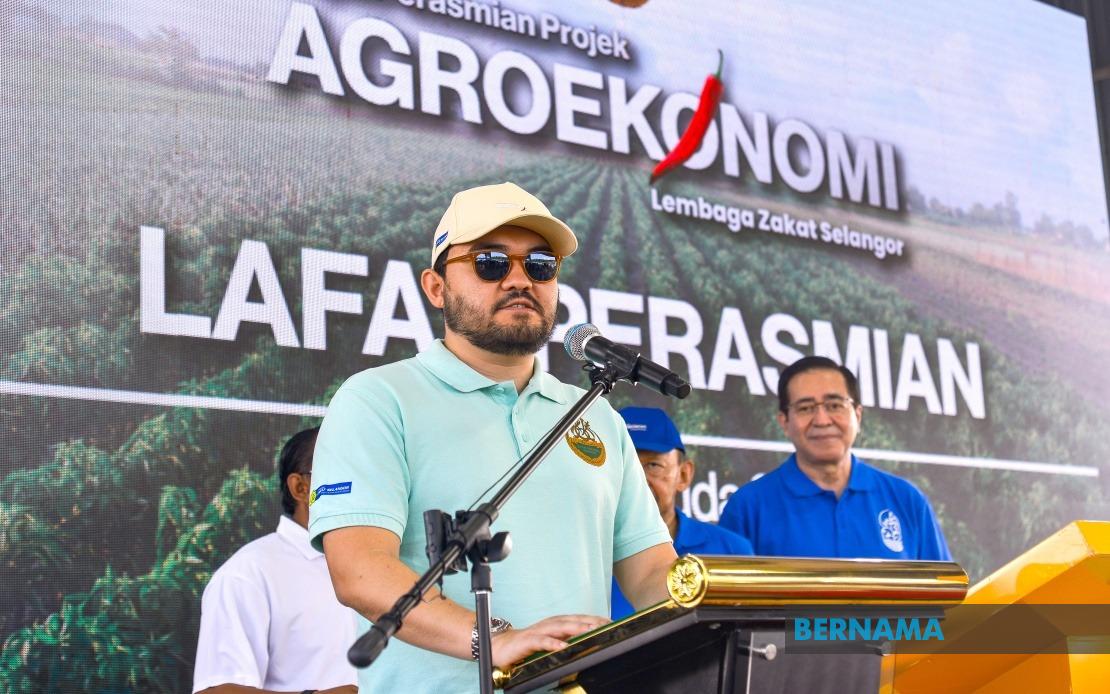
The Selangor Zakat Board has shifted its approach to poverty alleviation beyond conventional cash assistance, introducing a comprehensive agro-economy initiative designed to create lasting income streams for disadvantaged Muslim families. Launched on July 1 at Laman Agro Ehsan in Bukit Beruntung by Raja Muda of Selangor Tengku Amir Shah Sultan Sharafuddin Idris Shah, the project represents a significant departure from traditional welfare models toward skills-based, market-oriented solutions that aim to achieve genuine economic independence for participating asnaf recipients.
The initiative has absorbed a capital investment of RM26 million and operates across a 110-acre site, with 76 acres specifically allocated to active agricultural production. The focus on commercial chilli cultivation using advanced fertigation technology demonstrates a calculated effort to position participants within a viable agricultural commodity chain rather than merely providing subsistence opportunities. This approach acknowledges the reality that sustainable poverty reduction requires participants to engage with established market structures and production standards rather than relying solely on philanthropic support.
Forty-eight carefully selected participants have been enrolled in what organisers describe as a structured three-year development programme. The screening process, conducted jointly with the Kuala Langat Area Farmers' Organisation, sought to identify individuals with capacity to absorb training and commit to agricultural operations over an extended timeframe. Each participant receives a 0.5-acre cultivation plot containing approximately 2,000 chilli plant bags, translating to 96,000 planting units across the entire operation during each production cycle. This standardised plot allocation reflects an intentional design to create comparable outcomes and facilitate peer learning among programme cohorts.
Projected income figures suggest participants could achieve monthly revenues reaching RM4,000 once production systems stabilise and crop management reaches consistent standards. This target income level, roughly equivalent to Malaysia's median household earnings, indicates the scheme's ambition to elevate participants beyond poverty thresholds into economically viable household situations. The timeline acknowledges that agricultural productivity builds incrementally, requiring both horticultural maturation and participant skill development across multiple cultivation cycles before optimum yields materialise.
Beyond cultivation plots, the programme encompasses residential support extending beyond typical agricultural schemes. Participants occupy homes within the Prima Beruntung housing complex with Zakat Selangor fully underwriting rental expenses throughout the programme duration. This accommodation provision addresses a fundamental challenge confronting rural development initiatives—enabling participants to relocate near productive assets without creating unsustainable housing burdens. The removal of residential cost barriers reduces participant financial stress and theoretically improves focus on agricultural skill acquisition.
The project reflects sophisticated partnerships channelling corporate Islamic financial institutions into development activities. Strategic collaborators including the Pilgrims Fund Board, RHB Islamic Bank Berhad, and Cagamas Berhad have contributed wakalah-structured funding totalling RM2.07 million, expanding the financial base beyond traditional zakat collections. These partnerships illustrate how Islamic banking institutions increasingly incorporate social development objectives into business strategies, creating hybrid funding models where commercial actors support welfare objectives through structured investments rather than charitable donations.
Participant testimonies reveal psychological dimensions often overlooked in economic programme assessments. Norfhadilah Mohd Shafiin, a 45-year-old mother of five entering the scheme in 2025, emphasises how the programme delivers not merely income replacement but confidence-building and skill acquisition that position participants toward long-term self-direction. Similarly, Raimi Rusydi Rodi, a father of two, highlights the knowledge transfer and collaborative dimensions of group-based agricultural training, suggesting that collective learning environments reinforce individual capability development. These accounts suggest the initiative's architecture intentionally cultivates psychological transformation alongside material circumstances improvement.
The significance of this initiative extends beyond individual beneficiary circumstances into broader policy frameworks governing Muslim welfare provision throughout Malaysia. By demonstrating that zakat funds can finance productive asset deployment and skills development rather than exclusively funding consumption-oriented transfers, Selangor Zakat Board has established a replicable model potentially adoptable across other state zakat institutions. The agricultural sector's labour intensity creates employment for asnaf populations with limited formal qualification attainment, addressing demographic realities within disadvantaged communities where educational advancement remains constrained by socioeconomic circumstances.
However, agricultural commodity markets impose discipline on participants that welfare-dependent populations may find demanding. Chilli production, while commercially established in Malaysia, remains subject to price volatility, disease risk, and production uncertainties inherent to agriculture. Participant income projections of RM4,000 monthly assume stable yields and maintained market demand, conditions external to individual effort. The programme's success ultimately depends not merely on participant motivation but on market conditions, input cost stability, and pest management effectiveness extending beyond the Selangor Zakat Board's direct control. Complementary institutional support addressing price risk and production insurance would strengthen programme resilience.
The three-year duration establishes a defined graduation timeline distinguishing this initiative from indefinite welfare dependency. Implicit within this timeframe is an expectation that participants either establish independent agricultural operations, transition to employment relationships, or develop alternative income strategies before support concludes. This temporal boundedness creates productive tension encouraging active engagement rather than passive benefit receipt, though transition support mechanisms determining post-programme pathways remain insufficiently detailed in available programme documentation. Clarity regarding exit planning would strengthen confidence that participants develop genuine self-sufficiency rather than entering post-programme vulnerability.
Regionally, this model carries implications for Southeast Asian development discourse emphasising inclusive growth and poverty alleviation through skills development. Malaysia's relative prosperity positions its zakat institutions among the region's best-resourced Islamic welfare systems capable of implementing capital-intensive productive schemes. Successful demonstration of commercially-oriented agricultural development funded through Islamic welfare mechanisms could influence development approaches across Indonesia, Bangladesh, and Pakistan, where zakat systems operate with comparable philosophies but frequently constrained financial bases. Knowledge transfer and technical partnership with regional counterparts could amplify this initiative's development impact beyond Selangor's immediate boundaries.
The programme ultimately reflects a sophisticated understanding that genuine poverty reduction demands movement beyond charity toward sustainable economic participation. By combining productive asset access, technical training, residential security, and market linkages within integrated programming, Selangor Zakat Board has constructed an intervention architecture addressing multiple constraints simultaneously rather than presuming income transfers alone resolve complex household disadvantage. Whether participants sustain agricultural operations beyond programme conclusion and whether income targets materialise across the full participant cohort remain open questions determining ultimate impact assessment, but the initiative's design demonstrates serious institutional commitment to transforming welfare provision from transfer-dependent toward capability-building foundations.

