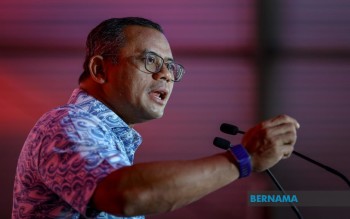
Selangor has reinforced its position as Malaysia's economic engine, with its gross domestic product swelling to RM460.1 billion in 2025—a substantial increase of RM28 billion from the previous year. The expansion represents a significant milestone for the industrial state, which now accounts for more than one-quarter of the nation's total economic output. Menteri Besar Datuk Seri Amirudin Shari emphasized that this growth trajectory has no peer among Malaysia's other states, with Selangor's economic gains alone dwarfing the performance of any individual competitor.
The acceleration in Selangor's economic activity has lifted the state's contribution to Malaysia's gross domestic product from 26.2 percent to 26.5 percent, according to data from the Department of Statistics Malaysia released recently. This expanded footprint underscores the state's outsized influence on national economic fortunes. By comparison, Selangor's economy now measures 1.7 times larger than Kuala Lumpur's—which itself recorded impressive growth of RM13.2 billion to reach RM265.1 billion—and nearly three times the size of Johor's economy. The wealth gap between Selangor and other major economic centres is widening, a phenomenon that carries implications for regional development policy and resource allocation across the federation.
The state's growth rate of 6.3 percent decisively outpaced the national economic expansion of 5.2 percent, demonstrating that Selangor's performance is not merely riding a nationwide wave but rather pulling the broader Malaysian economy forward. This performance differential suggests that Selangor's structural advantages—including its concentration of industrial facilities, proximity to the Klang Valley manufacturing belt, and dominance of financial services activity—continue to provide competitive edges that regional competitors have struggled to replicate. The achievement also exceeded projections developed through collaboration between Universiti Putra Malaysia and the Selangor Research Institute, which had forecast growth to approximately RM455.3 billion.
Three economic sectors drove the expansion. The services segment generated RM15.9 billion of new economic value, reflecting Selangor's deepening role as Malaysia's financial and business services hub. Manufacturing contributed RM5.3 billion, maintaining the state's historical strength in industrial production despite global headwinds and supply chain volatility. Construction activity added RM3.7 billion, pointing to sustained confidence in infrastructure development and property investment within Selangor's borders. These three sectors collectively account for the overwhelming majority of economic gains and shape the state's development trajectory.
Selangor's commanding market share across key economic sectors underscores its structural dominance within the Malaysian economy. The state now accounts for 35.9 percent of all construction activity nationwide, meaning more than one-third of Malaysia's building, infrastructure, and real estate development occurs within Selangor's jurisdiction. Its manufacturing footprint has expanded to capture 32.8 percent of national output, while its services sector contribution has climbed to 27.1 percent. These concentrations reveal how heavily Malaysia's economic apparatus depends on Selangor's continued performance and raise questions about regional economic imbalance and the concentration of wealth-generating activity in a single state.
Much of this expansion can be traced to deliberate policy frameworks implemented at the state level. The First Selangor Plan, a five-year socioeconomic development strategy covering 2021 to 2025, structured investment priorities and economic restructuring efforts designed to diversify income sources and expand productive capacity. Over this entire planning period, Selangor's economy has expanded by 33.94 percent—more than one-third of its baseline value—accumulating RM116.6 billion in additional economic output. The state's GDP grew from RM343.5 billion at the plan's outset to RM460.1 billion upon its conclusion, demonstrating the potential impact of coordinated state-level economic planning when executed effectively.
Menteri Besar Amirudin's remarks cautioned against complacency despite the remarkable figures. He articulated an ambition for Selangor to become the first Malaysian state to achieve a RM500 billion economy, requiring sustained effort and cooperation between government, the private sector, and workers. This target implies annual growth rates comparable to 2025's performance or possibly higher, depending on the timeframe envisioned. The statement signals that state leadership views current achievements as a foundation rather than a destination, and expects heightened productivity from both public and private institutions.
The state's forward-looking agenda emphasizes translating economic gains into tangible improvements in living standards for ordinary Selangorians. While GDP expansion demonstrates aggregate growth, the challenge facing policymakers involves ensuring that productivity increases and wealth generation reach households across income levels. The administration has identified this distribution challenge explicitly, pledging that future economic progress will be measured not solely by headline GDP figures but by measurable enhancements to quality of life among the state's residents. This framing reflects growing awareness that economic growth alone, without corresponding improvements in welfare, wages, and access to services, generates incomplete development outcomes.
Invest Selangor, the state's investment promotion agency, characterized the 2025 results as evidence of powerful momentum building across the economy. The achievement of surpassing RM400 billion in successive years—RM406.1 billion in 2023 and now RM460.1 billion in 2025—establishes Selangor as the first Malaysian state to sustain operations above this threshold consistently. This milestone carries symbolic significance beyond the raw figures, signifying that Selangor has transcended a traditional tier of economic activity and entered rarefied territory where only a handful of global subnational economies operate. The agency's emphasis on this consecutive-year achievement suggests that sustainability and momentum, rather than one-time gains, define the state's economic trajectory moving forward.
For Malaysia's broader economic outlook, Selangor's performance carries outsized weight. When a single state contributes more than one-quarter of national GDP, its economic health becomes inseparable from national economic health. Strong growth in Selangor typically signals robust activity across supply chains, labour markets, and investment flows extending far beyond the state's borders. Conversely, any economic contraction in Selangor would reverberate through Malaysia's entire economy with multiplied force. This structural reality positions Selangor's continued expansion as a national imperative, even as it raises longstanding questions about whether Malaysia's development strategy has adequately distributed growth opportunities across all regions and whether smaller or less industrialized states possess sufficient engines for autonomous growth.
The data released by the Department of Statistics Malaysia confirms that Selangor's economic centre of gravity within the federation has stabilized at elevated levels. With more than one-quarter of national output originating from this single state, and with growth rates consistently exceeding national averages, Selangor appears positioned to expand its relative share of Malaysian economic activity for years to come. Whether this concentration ultimately proves beneficial for national development or whether it signals economic imbalance requiring policy intervention remains a question for national leaders to address. What is clear is that Selangor's RM460.1 billion economy now functions as Malaysia's primary economic engine, generating the wealth, employment, and tax revenue upon which national prosperity depends.

