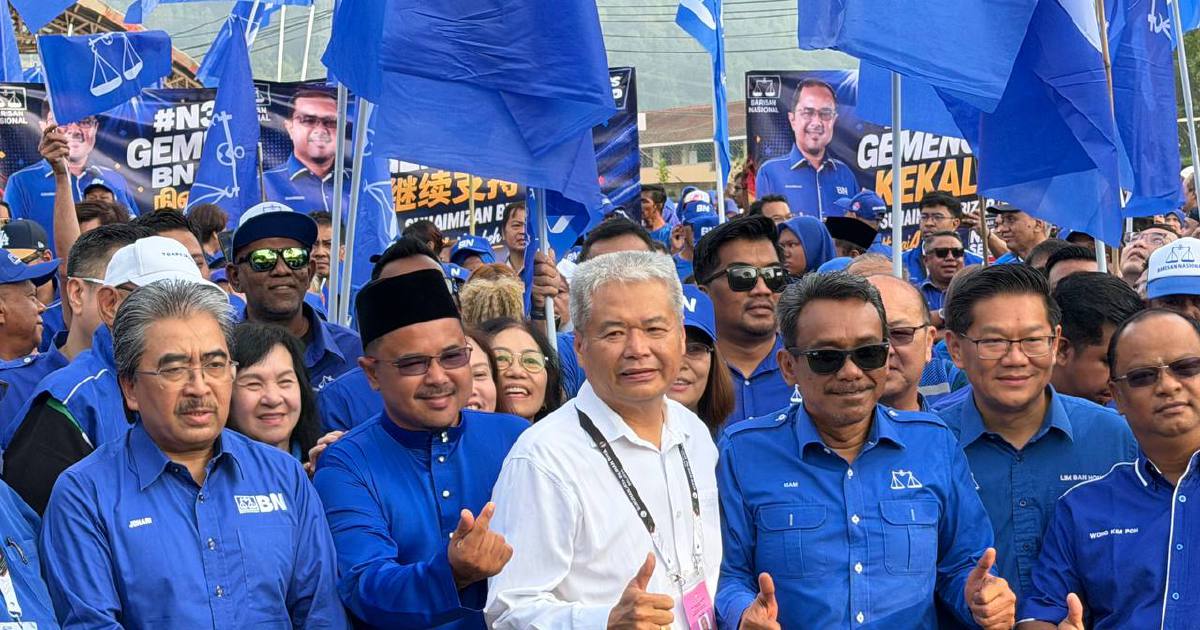
The machinery of Barisan Nasional shifted into high gear in Negri Sembilan this morning as two of Umno's most senior figures arrived at Dewan Perdana Tampin to personally support party candidates filing their nomination papers for the state election. The arrival of Umno vice-president Datuk Seri Johari Abdul Ghani and party treasurer Datuk Seri Tengku Adnan Tengku Mansor underscored the coalition's determination to mount an aggressive challenge in a state where its grip has loosened considerably over recent years.
The deployment of heavyweight party leadership at the nomination centre demonstrates how seriously Umno is treating the Negri Sembilan contest. Both Johari and Tengku Adnan hold influence over party resources and strategic direction, positioning them as symbolic representatives of the wider coalition effort to mobilise grassroots support and demonstrate unity among BN component parties. Their presence at the candidate filing stage—typically less prominent in electoral cycles—suggests BN is attempting to create momentum early in the campaign.
Negri Sembilan has emerged as a key battleground in Malaysian politics, particularly since the political upheavals that reshaped the peninsula's electoral landscape in recent years. The state's relatively mixed demographics and swing-voter populations make it fiercely competitive, with each general election and state election reshaping the composition of the state assembly. For Umno, reasserting dominance in Negri Sembilan is crucial to rebuilding its claim as the central pillar of Malay-Muslim politics beyond the strongholds it maintains in other states.
The appearance of Johari, who serves as Umno vice-president, carries particular significance given his portfolio responsibilities within the party hierarchy. As one of the senior figures tasked with overseeing party strategy and direction, his physical presence at nomination events signals that high command is engaged with ground-level mechanics. Similarly, Tengku Adnan's role as party treasurer places him in a position where campaign finance and resource allocation fall under his purview, making his attendance a reminder that material support for candidates is forthcoming from the centre.
Tengku Adnan Tengku Mansor's participation is noteworthy for another reason: his position as treasurer reflects the complex financing structures that underpin Malaysian party politics. The treasurer's involvement in nomination day activities often serves as a reassurance to candidates that their campaigns will be adequately funded, a critical consideration for first-time or vulnerable candidates contesting in competitive divisions. The symbolic weight of his presence extends beyond morale-building into the practical realm of campaign mechanics.
Barisan Nasional's approach in Negri Sembilan reflects broader coalition strategy across the peninsula. The four component parties—Umno, MCA, MIC, and several regional partners—must coordinate messaging and candidate selection to avoid splitting votes against their competitors. By fielding senior Umno representatives at the nomination centre, BN sought to project an image of a cohesive, organised force ready to contest every seat vigorously. This coordination is especially important in states where opposition coalitions have made significant inroads.
The timing of the Tampin event occurs as nomination centres across the state open for candidate filing. Each hour brings fresh opportunities for parties to generate media attention and demonstrate their organisational capacity. By positioning national-level figures at key nomination venues, BN aims to dominate news coverage and social media discourse during the critical early phase of campaigning when voter attention is beginning to sharpen.
Negri Sembilan's significance extends beyond its 36 state assembly seats. The state serves as a bellwether for broader political trends affecting the Klang Valley and central Malaysian regions. Electoral outcomes here provide early indicators of whether Umno's efforts to stabilise its position following internal upheavals have proven effective. The state is also home to several strategically important parliamentary constituencies that will feature in future federal elections, making current state-level performance a form of infrastructure-building for national contests.
For candidates filing nominations in Tampin and elsewhere across Negri Sembilan, the appearance of Johari and Tengku Adnan sends a message about their party's seriousness and resources. First-time candidates gain confidence from seeing senior party figures invested in their constituencies, while established candidates interpret such support as validation of their continued relevance within party hierarchies. These psychological and practical dimensions of party leadership visibility matter significantly in Malaysian electoral contests, where personal networks and patron-client relationships remain influential.
The mobilisation of BN's senior leadership also reflects anticipated competition intensity. Negri Sembilan is unlikely to prove an uncontested terrain for the coalition; opposition pacts have demonstrated capacity to challenge Umno even in traditionally sympathetic areas. By committing visible national leadership to the state campaign, BN signals that it recognises the competitive environment and is deploying accordingly. This escalatory posture may prompt opposition parties to similarly elevate their campaign visibility in the state.
Looking ahead, the campaign dynamics in Negri Sembilan will likely revolve around several core themes: economic management, delivery of development projects, and integrity in governance. Umno's ability to rebuild trust among Negri Sembilan voters remains contingent on convincing residents that the party has genuinely reformed its approach to politics and public administration. Leadership visibility at nomination events helps construct this narrative, though sustained performance on ground-level issues will ultimately determine electoral outcomes.

