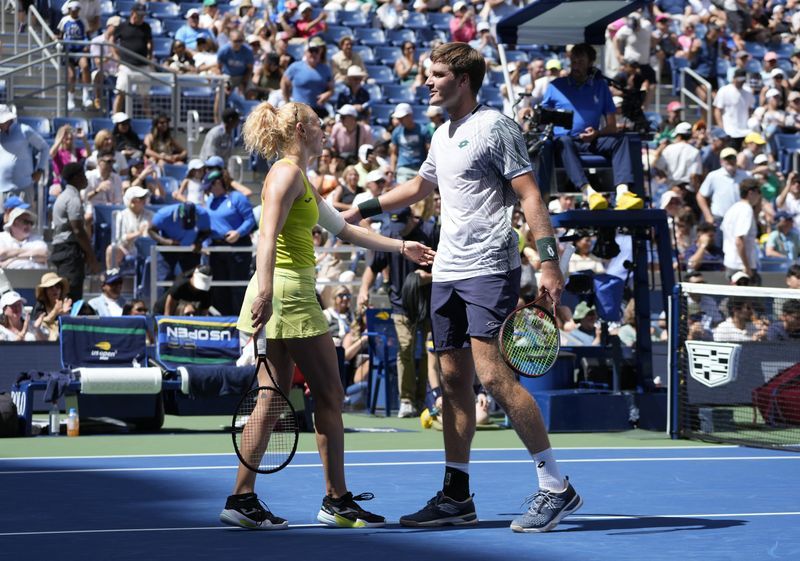
Serena Williams returned to competitive tennis at Arthur Ashe Stadium on Tuesday with a resounding victory, joining forces with Carlos Alcaraz to dispatch Erin Routliffe and Lloyd Glasspool 5-3 4-1 in the opening round of the US Open mixed doubles. The moment marked a significant milestone for the 23-time Grand Slam champion, who had not stepped onto the iconic court since her emotional farewell from professional tennis in 2022. The crowd responded with palpable emotion as the 44-year-old legend took centre stage, affirming that her return had captured the imagination of American tennis fans and beyond.
Williams' partnership with Alcaraz, who is more than two decades her junior at 21 years old, proved remarkably complementary despite the substantial age gap. The pair displayed genuine chemistry throughout the match, exchanging smiles and comfortable banter as they progressed smoothly into the quarter-finals, where they will face Belinda Bencic and Flavio Cobolli later in the day. The sight of these two generational talents collaborating against a younger doubles pairing symbolised a broader shift in professional tennis, where mixed doubles has increasingly become a venue for top singles players to showcase their versatility and engage with audiences in fresh ways.
Williams' opening stroke set the tone for her comeback match. She struck a backhand winner on her very first touch of the ball, triggering an immediate roar of approval from the packed stadium. Later in the opening set, during the seventh game, she unleashed a 120 mph ace that left spectators audibly gasping—a reminder that despite her lengthy absence from competition, the fundamentals of her game remained as formidable as ever. Alcaraz, who has been sidelined since April with injury, appeared to shake off accumulated rust as the match progressed, ultimately sealing the first set with a decisive forehand winner.
The second set became virtually one-sided as Williams and Alcaraz moved through their opposition with increasing confidence and fluidity. By the time they embraced following their victory, both players were visibly energised, their matching royal purple outfits adding a symbolic flourish to the moment. Alcaraz, a seven-time Grand Slam finalist, acknowledged the significance of sharing the court with Williams, remarking that he was focused on implementing the tactical guidance she had offered him during their partnership.
The mixed doubles competition itself reflects a deliberate reimagining of how professional tennis markets itself to global audiences. This year marks the second iteration of a revamped format designed to elevate the visibility and commercial appeal of mixed doubles by scheduling it in the week preceding the singles main draw and positioning it as a standalone spectacle rather than an ancillary event. The strategy has proven remarkably successful commercially, generating sellout crowds and attracting some of the sport's most recognisable singles champions. However, this innovation has not been universally embraced; established doubles specialists have voiced concerns that the format marginalises traditional pairings and diminishes the competitive standing of those who have dedicated their careers to the doubles game.
The day's results told a starkly different story for tennis's other marquee names. Top-seeded pair Novak Djokovic and Aryna Sabalenka suffered a startling early exit, losing to the experienced doubles combination of Henry Patten and Katerina Siniakova 1-4 4-2 10-2. Siniakova delivered the decisive blow with an ace positioned wide on match point, capping a performance that underscored how the compressed nature of the mixed doubles format—with its abbreviated set structure—can rapidly punish even the highest-ranked competitors when they fail to secure early momentum. Patten acknowledged the volatility inherent in the competition, noting that a single poorly played game can prove catastrophic given the quick pace at which sets conclude.
Defending champions Sara Errani and Andrea Vavassori, the Italian pairing who claimed the title last year, similarly exited in the opening round at the hands of Russian combination Mirra Andreeva and Andrey Rublev. The scoreline of 1-4 4-1 11-9 indicated another dramatic reversal, with the Russians mounting a comeback through an extended final-set tiebreak. The loss eliminates Errani and Vavassori from contention to become the first repeat champions under the reformatted structure. The remaining field includes several competitive pairings: the eventual winner of the Casper Ruud and Diana Shnaider matchup against Americans Jessica Pegula and Taylor Fritz will advance from their bracket, whilst married couple Gael Monfils and Elina Svitolina have already secured a place in the semi-finals, as have Karolina Muchova and Jakub Mensik.
For Malaysian and Southeast Asian tennis followers, Williams' return carries particular resonance. Her comeback narrative—an athlete of extraordinary accomplishment choosing to re-enter competitive sport after stepping away—offers an inspirational counterpoint to the typical professional arc. At 44, she defies conventional assumptions about athletic longevity and the perceived end-point of a career, potentially encouraging conversations about age, capability, and the possibility of reinvention within the sports community across the region. Additionally, Alcaraz's participation and visible partnership with Williams demonstrates how the sport's current generation of emerging champions are building relationships across generational lines, fostering mentorship connections that benefit the overall health of professional tennis.
The mixed doubles format innovation also warrants attention from a regional perspective. Tennis in Southeast Asia has traditionally prioritised singles competition, with mixed doubles receiving comparatively limited attention and investment. The US Open's experiment—successfully translating doubles into compelling commercial entertainment—could influence how tournaments throughout Asia structure their own programmes. If mixed doubles competitions continue drawing strong audiences and media attention, regional tournaments might allocate greater resources to promoting this format, potentially creating additional pathways for Asian players to compete on prestigious stages.

