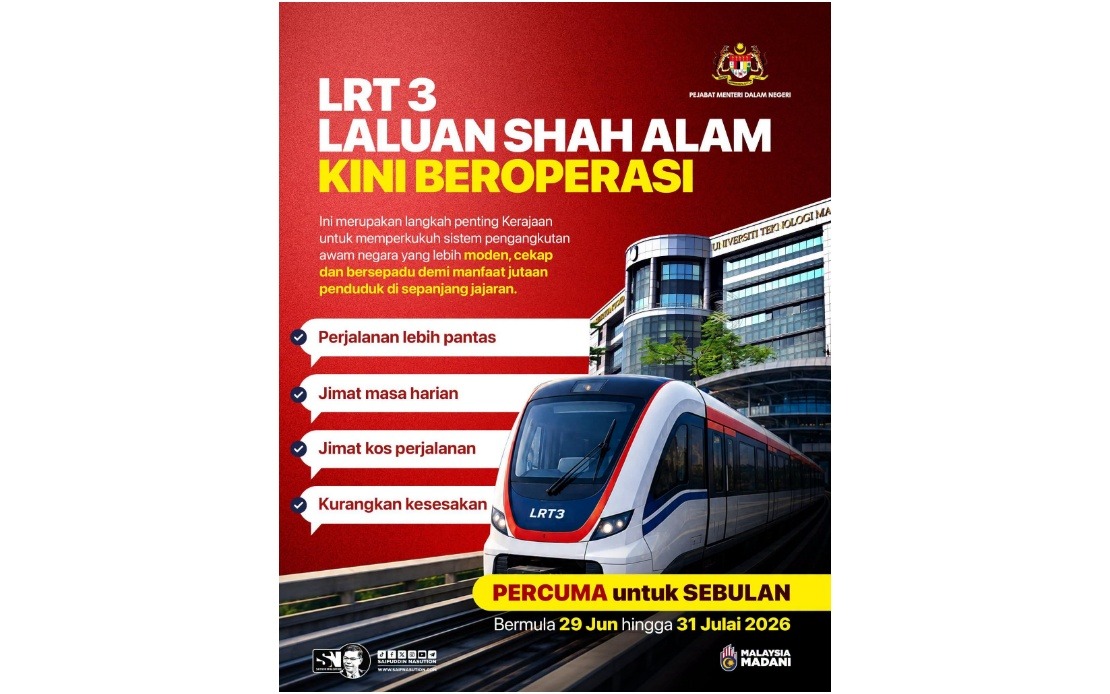
The Shah Alam Line LRT3 stands as a tangible demonstration of the MADANI Government's determination to overhaul public transportation systems that serve millions of commuters daily across the Klang Valley. Home Minister Datuk Seri Saifuddin Nasution Ismail has positioned the new rail corridor as evidence of the administration's broader commitment to enhancing urban mobility and quality of life for ordinary Malaysians who depend on reliable transit options to navigate their daily routines.
The corridor's development addresses a critical infrastructure gap in one of Southeast Asia's most congested metropolitan regions. The Klang Valley continues to grapple with severe traffic congestion during peak hours, a problem that compounds travel times and raises operational costs for businesses reliant on timely logistics and service delivery. By introducing the Shah Alam Line into the existing rapid transit network, authorities have effectively created an alternative route that distributes passenger flows away from the most saturated transportation arteries, offering both immediate relief and long-term capacity expansion.
Saifuddin's statements underscore the multifaceted benefits that the government expects from this infrastructure commitment. The new line does not merely provide a single transit option; rather, it represents an integrated approach where feeder bus services connect neighbourhoods to the main rail corridor, creating a comprehensive ecosystem that captures commuters at various points along their journeys. This integration proves particularly crucial in sprawling suburban areas like Shah Alam, Klang, and Subang, where dispersed residential patterns would otherwise render a standalone rail line insufficient for comprehensive coverage.
The economic implications for daily commuters extend beyond convenience. By reducing journey times and vehicle dependency, the LRT3 directly decreases household transportation expenditures—a significant factor for middle and lower-income earners who allocate substantial portions of their income to commuting costs. For professionals working in central business districts, the time savings translate into productivity gains and improved work-life balance. Students accessing educational institutions across the Klang Valley gain affordable, reliable access to academic opportunities without family resources being strained by parking fees and fuel expenses.
Prime Minister Datuk Seri Anwar Ibrahim's announcement of complimentary fares from June 29 through July 31 represents a calculated policy decision designed to catalyse behavioural change among motorists. This introductory period serves multiple strategic purposes: it allows commuters to experience the service quality firsthand without financial barriers, generates ridership data that informs future operational decisions, and creates a window for the government to demonstrate its commitment to affordable public services. The free-fare initiative effectively removes the hesitation that many potential users feel when considering unfamiliar transit options, particularly in a region where personal vehicle ownership remains culturally entrenched.
The inclusion of Prasarana Malaysia Bhd feeder bus services within the free-fare promotion proves particularly instructive about contemporary transport planning philosophy. By bundling the rail and bus components, planners acknowledge that first-mile and last-mile connectivity determines whether entire transit networks function effectively. A commuter who faces a lengthy walk or expensive bus ride to reach an LRT station will likely abandon the system regardless of how efficient the rail portion operates. The comprehensive free-fare approach removes this friction entirely, maximising the likelihood that trial users will integrate the LRT3 into their regular commuting patterns.
For Malaysia's broader development agenda, the Shah Alam LRT3 operates as more than a single infrastructure asset. It signals to both domestic and international observers that the MADANI Government prioritises systematic solutions to urban challenges that affect competitiveness and livability. Reliable public transport infrastructure becomes increasingly vital as Malaysia seeks to position itself as a regional knowledge economy attracting foreign talent and investment. Cities with congested, unreliable transit systems struggle to retain skilled workers who can relocate to better-served metropolitan areas. By contrast, regions offering modern, integrated public transport become magnets for human capital and entrepreneurship.
The environmental dimension of this infrastructure development warrants emphasis within the Malaysian context, where air quality and carbon emissions increasingly affect public health and long-term sustainability goals. Each commuter who shifts from private vehicle operation to rail transit removes one car from roadways, proportionally reducing emissions and contributing to national climate commitments. When multiplied across thousands of daily commuters, the aggregate environmental benefit becomes substantial, though such gains require sustained ridership rather than merely initial uptake during the promotional period.
Saifuddin's emphasis on encouraging Shah Alam, Klang, Subang, and surrounding residents to utilise the service reflects administrative recognition that infrastructure investments require active promotion to achieve intended outcomes. Government officials recognise that many potential commuters may harbour inertia toward established mobility patterns, requiring targeted messaging to overcome psychological and practical barriers. The framing of the free-fare period as a time-limited opportunity adds urgency to the government's appeal, encouraging decision-making and trial usage before regular fares commence.
The broader policy context reveals how the MADANI Government differentiates itself through infrastructure investment and public service enhancement. By positioning the LRT3 as a strategic investment rather than a mere transportation utility, officials communicate that public transport represents a foundational element of national development strategy. This framing carries particular significance in Malaysian political discourse, where infrastructure projects often face scrutiny regarding cost-effectiveness and genuine public benefit. By emphasising outcomes like reduced congestion, shortened commute times, and lower household expenses, the government anchors its public transport investment to tangible improvements in citizen wellbeing.
As the Shah Alam LRT3 commences operations under this promotional framework, the service's performance over coming months will significantly influence public perception and future ridership patterns. Successfully converting trial users into permanent commuters depends upon consistent service reliability, cleanliness, safety assurances, and integration with other transit modes. The government's investment in this corridor will ultimately be judged not by construction completion or official launch ceremonies, but by whether ordinary Malaysians genuinely abandon their vehicles and embrace rail-based mobility as their preferred transportation solution.

