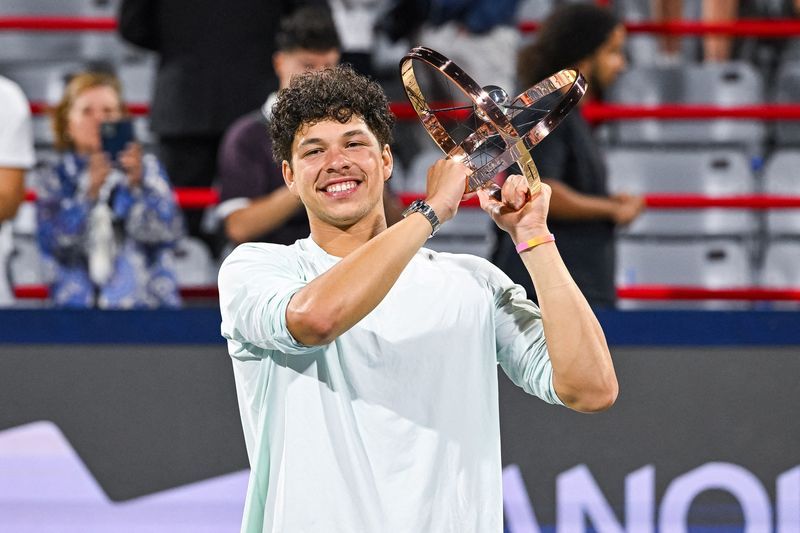
American tennis prospect Ben Shelton arrives at the U.S. Open with renewed optimism, determined to overcome a season of contradictions that has seen him accumulate four tournament titles alongside early eliminations at three of the year's four Grand Slam events. The world number nine, just 23 years old, brings the momentum of a successful Canadian Open defence to New York, where he reached the semi-finals just last year and now appears positioned to mount a genuine title challenge.
Shelton's journey through 2024 has resembled an emotional rollercoaster, as he himself has candidly described it. While he progressed to the quarter-finals at the Australian Open, suggesting a player hitting his stride, his performances deteriorated sharply at subsequent majors. The French Open saw him eliminated in the second round, a result that may have triggered concerns about his ability to compete consistently at the sport's highest level. The situation only worsened at Wimbledon, where the American crashed out in the opening round, a particularly stark reminder of how quickly form can evaporate across different surfaces and competitive environments.
Yet the Canadian Open victory has fundamentally altered his psychological landscape. Shelton did not surrender a single set throughout the tournament, demonstrating a level of control and precision that had eluded him at other major championships. His dominant run culminated in a victory over Brandon Nakashima, providing tangible evidence that his game possesses elite dimensions. Speaking to journalists in Montreal immediately after his triumph, Shelton articulated a shift in his tactical execution. He emphasized improved service return performance, describing moments of genuine excellence in this fundamental area. His breaking of opponent serves came with a consistency and authority that suggests he has unlocked mechanical improvements during his recent tournament preparation.
The American's self-assessment reveals a player aware of untapped potential. Shelton highlighted his enhanced clinical decision-making, pointing to sharper focus and improved balance between defensive solidity and offensive aggression. These are not marginal improvements but rather foundational elements that separate serious contenders from occasional winners at Grand Slam level. His observation that hard-court performance has steadily improved with each tournament suggests he has been making genuine tactical and technical adjustments, a trajectory that could prove decisive at the U.S. Open, which is contested on hard courts.
Shelton carries the expectations of an entire nation into the tournament. No American male player has captured the U.S. Open singles title since Andy Roddick's triumph in 2003, a drought spanning more than two decades. That statistical reality frames Shelton's candidacy not merely as a personal ambition but as a matter of national sporting significance. The narrative weight attached to American dominance in professional tennis—and the subsequent decline in male singles competitiveness—intensifies scrutiny of emerging American talent.
Former U.S. Open champion Andy Roddick has publicly endorsed Shelton's chances in language that reflects genuine assessment rather than casual optimism. In a recent podcast appearance released before Jannik Sinner's withdrawal from the tournament, Roddick suggested that if the top-ranked Italian and Spain's Carlos Alcaraz were not operating at peak competitive levels, Shelton possessed the capacity to challenge seriously for the title. Roddick's observation acknowledges that while Shelton has genuine strengths, he enters as a secondary contender rather than the favorite—a realistic positioning that nonetheless identifies him as capable of a major breakthrough performance.
The withdrawal of Sinner fundamentally alters the championship's landscape. Sinner had been positioned as the tournament favorite, and his absence removes perhaps the most dominant force currently operating in professional tennis. This circumstance, while unfortunate for the sport's narrative, has objectively improved Shelton's path to the final. Alcaraz remains a formidable obstacle, but Sinner's absence means one fewer player of extraordinary quality positioned to obstruct potential deep tournament runs.
Shelton's semi-final appearance at last year's U.S. Open demonstrates he possesses the psychological resilience and technical capacity to navigate the tournament's demanding later rounds. That result, while not a title victory, proved he could sustain excellence across multiple consecutive matches against elite opposition. The distinction between reaching semi-finals and hoisting the trophy may seem vast, but it represents a difference in margins rather than a gap in fundamental capability.
The player himself recognizes that professional tennis offers continuous opportunity for redemption and advancement. Shelton's observation that the calendar provides constant chances to compete, to demonstrate improvement, and to reshape narrative arc reflects mature understanding of sporting psychology. In his framing, any single match possesses potential to transform seasonal trajectory—a perspective that acknowledges both how fragile recent results remain and how quickly momentum can accumulate. For Malaysian and Southeast Asian readers following global tennis development, Shelton's potential emergence as a major championship winner represents the type of generational athletic development that shapes professional sport for decades. The American's success or failure at the U.S. Open will signal whether the current generation of American male tennis players can reverse the nation's recent Grand Slam drought or whether that statistical reality will extend into another calendar year.

