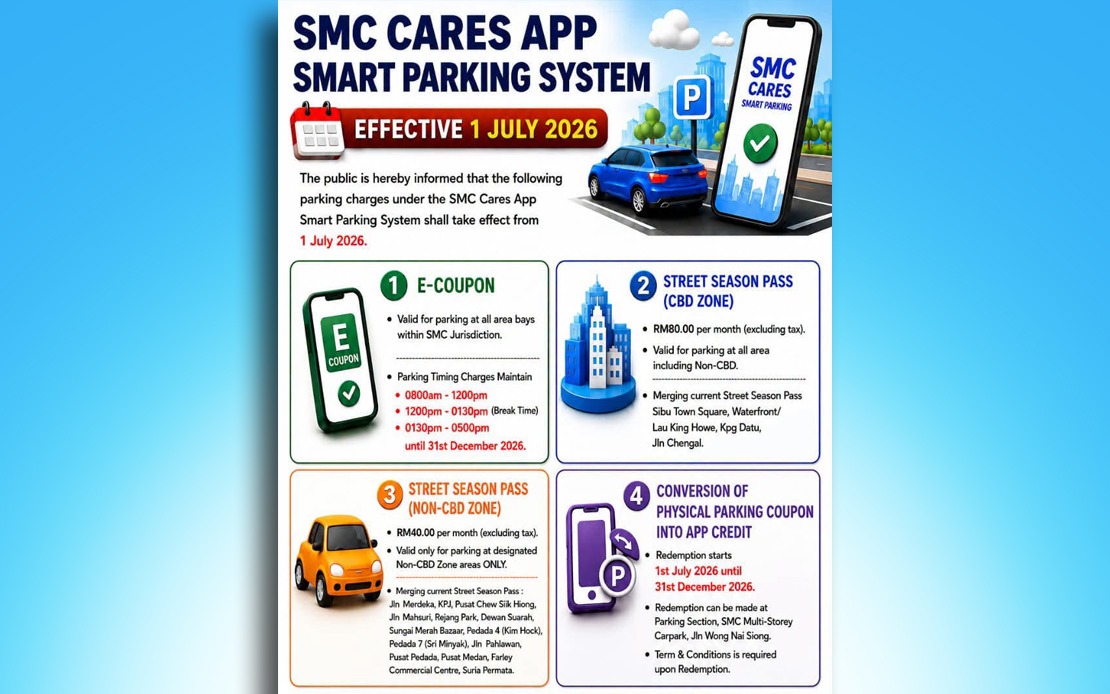
The Sibu Municipal Council has moved to address mounting public discontent with its digital parking enforcement system by introducing a buffer period that will give motorists crucial minutes to complete their transactions before penalties are imposed. The new grace period, ranging from five to ten minutes, represents a significant policy shift designed to accommodate the real-world logistics of parking and mobile application use that have frustrated thousands of drivers since the SMC Cares Smart Parking system went fully operational earlier this month.
Chairman Clarence Ting Ing Horh acknowledged that the previous system had generated legitimate grievances, noting that drivers required reasonable time not only to locate and secure parking but also to physically exit their vehicles and navigate the mobile application. This recognition reflects a broader tension in the rollout of automated enforcement systems across Southeast Asian cities, where the speed and impartiality of digital platforms often clash with the practical realities of user experience. The council's instruction to system provider Primal Solution Sdn Bhd to implement these adjustments signals that municipal authorities can recalibrate their approach when confronted with sustained public resistance, even after significant infrastructure investment and implementation.
Beyond the grace period, the council's decision to introduce a Senior Citizen Parking Pass for motorists aged 60 and above starting in August addresses another critical gap in the system's design. The original rollout had generated particular frustration among elderly drivers unfamiliar with smartphone applications and digital payment platforms, compounding what users described as a deliberately complicated registration process. This initiative acknowledges an important demographic reality across Malaysia: not all residents possess equal technological literacy or digital infrastructure access, and blanket enforcement without accommodation can inadvertently penalise vulnerable populations rather than simply regulate parking behaviour.
The council's acknowledgement of what it characterises as user education challenges reveals significant shortcomings in the system's implementation planning. Ting disclosed that parking enforcement contractors have been instructed to assist users struggling with application navigation, while removing the face coverings that previously limited accountability and approachability. The establishment of a dedicated support counter at Sibu Public Library, staffed to guide residents through registration and application use, represents an implicit admission that the digital transition was executed without adequate consideration for varied user capabilities. This mirrors experiences in other Malaysian cities where smart systems introduction has occasionally preceded sufficient public education and technical support infrastructure.
The controversy surrounding the system's launch has also illuminated broader questions about enforcement methodology and contractor oversight. Ting clarified that parking wardens operating under contract are authorised only to address payment-related violations such as unpaid and expired parking, explicitly stating that enforcement against illegal parking and traffic obstruction remains the responsibility of SMC's dedicated enforcement division and police. This demarcation proves important given social media allegations that contractors had exceeded their mandate, a pattern observed elsewhere where outsourced enforcement sometimes blurs jurisdictional boundaries and creates confusion about legitimate versus unauthorised penalties.
Complaints about the speed of compound issuance have prompted the council to introduce an appeal mechanism that provides motorists recourse when they believe notices were issued in error. The system records photographic evidence for each enforcement action, theoretically creating an audit trail that should reduce arbitrary or mistaken penalties. However, the need to establish a formal appeals process suggests that initial quality control mechanisms were inadequate, and that drivers have insufficient confidence in the system's accuracy. The willingness to review cases involving registration number errors or other legitimate circumstances indicates that the digital system, despite its ostensible objectivity, requires human judgment and correction to function fairly.
Defending the council's parking rate structure against social media claims that Sibu charges the highest fees in Sarawak, Ting asserted that comparative analysis showed the city's rates remain competitive with other local authorities throughout the state. This assertion matters for regional perspectives on smart parking adoption, as affordability concerns often fuel resistance to automated systems. When residents perceive enforcement mechanisms as simultaneously aggressive, technologically frustrating, and expensive, opposition becomes multifaceted and harder to address through technical adjustments alone. The council's revenue model, whereby all parking income flows directly to SMC while the contractor receives separate service fees, remains transparent in theory but requires continuous public communication to maintain trust.
The SMC Cares Smart Parking system has already registered over 93,000 users since introduction, with the council projecting that annual registrations will exceed its initial 100,000 target. These figures indicate substantial adoption despite the system's operational and technical difficulties, suggesting that many residents have overcome initial barriers to digital parking management. However, the persistence of complaints about slow system performance, unexpected logouts, delayed payment processing, and compounds issued before transactions complete indicates that high user numbers do not equate to system satisfaction. A threshold exists beyond which sheer volume of users can strain technical infrastructure and support capacity, potentially degrading service quality despite growing participation.
The council's invitation for direct public feedback and explicit discouragement of reliance on social media intelligence reflects awareness that reputational damage has already occurred through digital channels. However, this appeal to official channels may underestimate the legitimacy of digital communities as forums for genuine problem-reporting and collective advocacy. While unverified information certainly circulates online, so do authentic accounts of system failures and user frustrations. The council's apparent tension between welcoming feedback and cautioning against social media engagement suggests that addressing technical problems may prove more straightforward than rebuilding trust after the launch phase undermined public confidence.
For Malaysian readers and policymakers monitoring smart city initiatives across the region, Sibu's experience offers instructive lessons about implementation sequencing and stakeholder engagement. The willingness to introduce grace periods, accessibility accommodations for elderly users, and formal appeals mechanisms represents pragmatic course correction, but such adjustments ideally precede full rollout rather than follow negative public reaction. The technical issues reported—slow processing, unexpected logouts, delayed payments—indicate that system testing may have been insufficient before operational deployment, a pattern that continues in various smart infrastructure projects throughout Southeast Asia. As local authorities increasingly adopt automated enforcement and digital service delivery, advance investment in user research, technical stress-testing, support infrastructure, and transparent communication may prevent the reputational and operational challenges that Sibu has had to remedy after implementation.
Moving forward, the council's simultaneous management of system refinements and public relations recovery illustrates the complex politics of digital governance in Malaysian municipalities. The introduction of grace periods and senior citizen accommodations will likely reduce some complaints and improve user experience, but the underlying technical and design problems that generated initial frustration may require more substantial investment and potentially system redesign. Whether these incremental adjustments ultimately restore public confidence or simply represent interim measures pending a more comprehensive overhaul will become apparent as the system matures and user satisfaction metrics are tracked through the remainder of the year.

