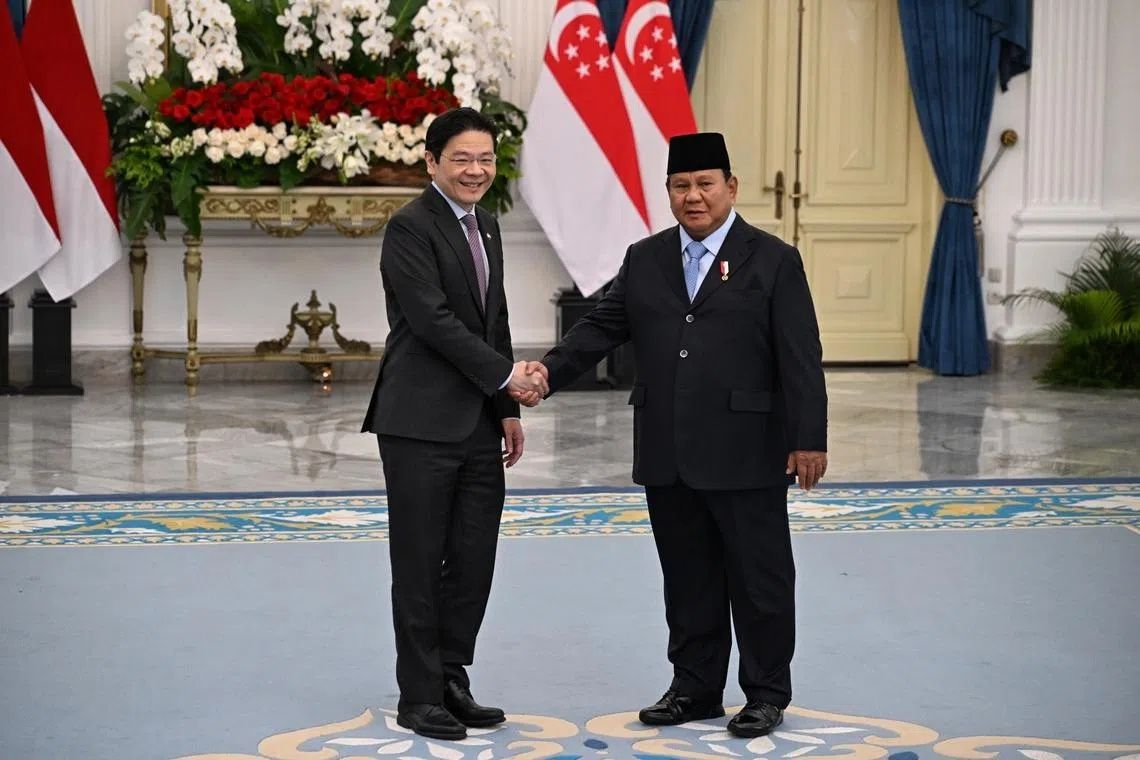
Singapore and Indonesia have reaffirmed their commitment to preserving the Strait of Malacca as a secure, freely accessible maritime corridor for global commerce, marking a significant elevation of maritime security within their bilateral relationship. The pledge emerged from talks between Prime Minister Lawrence Wong and President Prabowo Subianto at the annual Leaders' Retreat on July 6, where both nations framed their cooperation as essential to maintaining regional stability and driving economic expansion. This emphasis reflects mounting geopolitical pressures on one of the world's most critical shipping lanes, through which vast quantities of global trade and energy resources flow daily.
The Strait of Malacca, threading between the Indian Ocean and the South China Sea, occupies a pivotal role in the global economy that few maritime passages can rival. Its strategic importance extends far beyond Southeast Asia, touching the interests of major trading nations and energy-dependent economies worldwide. Any disruption to shipping through this waterway would send ripples through supply chains from East Asia to Europe and the Middle East. President Prabowo emphasized that as countries directly bordering the strait, Indonesia and Singapore bear particular responsibility for safeguarding its security and accessibility. He underscored the necessity of protecting the passage not merely from traditional threats like piracy and robbery, but also from environmental hazards and maritime accidents that could compromise its utility.
The Indonesian leader signalled that his administration would intensify coordination with fellow littoral states Malaysia and Thailand to ensure compliance with international maritime law, particularly the United Nations Convention on the Law of the Sea. This multilateral dimension acknowledges that effective stewardship of the Strait of Malacca cannot rest solely with Singapore and Indonesia, despite their central positions. The commitment to work with other regional players reflects a mature approach to shared maritime governance, though it also hints at potential sensitivities around sovereignty and navigational rights that have historically generated friction in the region.
Prime Minister Wong drew explicit parallels between conditions in the Strait of Malacca and recent disruptions elsewhere, noting that recent events in the Middle East had demonstrated the fragility of global trade arteries. The Iran conflict and its impact on the Strait of Hormuz served as a cautionary tale about the consequences of maritime insecurity for global oil supplies and broader economic stability. By invoking this example, Wong underscored why Singapore and Indonesia must remain vigilant custodians of their own strategic waterway. The two leaders characterized their positions as strategically aligned, sharing fundamental interests in preserving open sea lines of communication and upholding navigational freedoms that underpin the international trading system.
Beyond maritime matters, the retreat catalysed significant progress in new domains that both nations believe will shape their economic futures. Cross-border electricity trade emerged as perhaps the most substantial development, with Indonesia's sovereign wealth fund Danantara positioned to lead implementation efforts. This initiative opens pathways for Indonesia to export renewable energy to Singapore, addressing the city-state's energy security challenges while creating revenue opportunities for Indonesia's developing renewables sector. The collaboration between Danantara and Singapore entities including Keppel Electric, Sembcorp Industries and Singapore Energy Interconnections represents concrete institutional machinery for advancing these negotiations.
Prime Minister Wong characterized the electricity cooperation framework as a foundational building block for the broader ASEAN Power Grid concept, a longer-term vision for regional energy integration that could fundamentally reshape how Southeast Asia sources and distributes power. Such a grid would enhance energy security across the bloc by allowing countries to share renewable capacity and balance fluctuating supply and demand. For Malaysia and other ASEAN members, the precedent set by Singapore-Indonesia cooperation matters considerably, as it demonstrates viability of cross-border energy infrastructure within the region. The initiatives signal that both nations see energy transition not merely as an environmental imperative but as an economic opportunity that can strengthen ties while addressing climate commitments.
The two countries also advanced collaboration in cybersecurity, digital infrastructure and supply chain resilience, domains that have assumed heightened importance following pandemic-era disruptions and geopolitical fragmentation. These sectors represent the technological frontiers where competitive advantage increasingly concentrates. By linking their digital strategies and supply chain approaches, Singapore and Indonesia are positioning themselves to navigate future economic disruptions more effectively than competitors operating in isolation. Such cooperation also carries implications for other ASEAN members contemplating similar initiatives, suggesting that bilateral frameworks on critical infrastructure are becoming standard practice among regional powers.
Prime Minister Wong's repeated affirmations of Singapore's confidence in Indonesia's economic trajectory and long-term partnership commitment carried particular weight given Singapore's position as a major regional investor. His references to Singapore capital flowing into manufacturing, downstream industries and digital infrastructure projects acknowledged that Singapore views Indonesia not as a short-term profit source but as a crucial long-term development partner. The expansion of industrial parks in Batam, Bintan and Karimun, along with the Kendal Industrial Park in central Java reaching full capacity with plans for substantial further expansion, illustrate the concrete dimensions of this partnership. These investments create employment and transfer technological capabilities, benefiting Indonesian workers and enterprises while securing market access and operational flexibility for Singapore firms.
The trajectory of Singapore-Indonesia relations reflects broader regional dynamics where bilateral partnerships increasingly interweave economic and strategic considerations in complex ways. Both nations are navigating geopolitical uncertainties by deepening institutional ties and creating mutual economic dependencies that discourage confrontation. Their approaching 60-year diplomatic anniversary in 2027 provides a symbolic anchor for the relationship, but the substance lies in tangible cooperation on energy, connectivity and maritime governance. For Malaysia, these developments carry particular salience, given its own involvement in Strait of Malacca stewardship and its stakes in regional energy cooperation frameworks.
The emphasis on maritime security and open access at the Leaders' Retreat also reflects implicit concerns about potential restrictions or militarization that could threaten the strait's neutrality. Various regional powers maintain competing strategic interests, and assertive posturing by any nation could undermine the freedom of navigation principles that Singapore and Indonesia have explicitly endorsed. By publicly and repeatedly affirming their commitment to an open strait, both leaders are setting normative expectations for regional conduct. This messaging matters not just for immediate bilateral purposes but for signalling to other regional and global powers what Singapore and Indonesia deem acceptable in Southeast Asian waters.
Looking forward, the framework emerging from the retreat establishes scaffolding for progressively deeper integration across multiple domains. The renewable energy cooperation could expand into broader technology partnerships, while cybersecurity collaboration might extend into financial systems and critical infrastructure protection. Supply chain resilience initiatives could evolve into manufacturing partnerships that increase regional self-sufficiency in strategic sectors. Each successful cooperation project builds trust and creates constituencies within both governments and private sectors favouring continued partnership. For Malaysian observers, the pace and breadth of Singapore-Indonesia cooperation serve as benchmarks against which regional integration progress can be measured and potentially replicated through ASEAN mechanisms.

