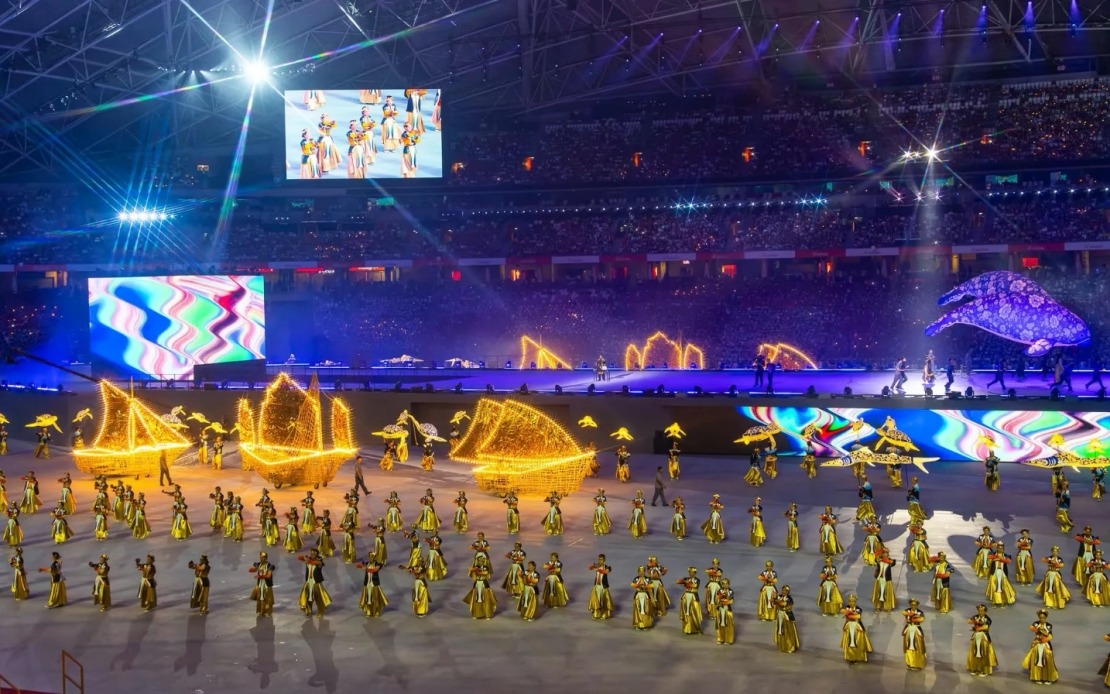
Singapore's 61st National Day celebrations unfolded on Sunday with a landmark moment for the city-state: the return of the National Day Parade to the National Stadium after ten years away. Under the theme "Majulah Singapura, Go Beyond!", the event drew President Tharman Shanmugaratnam, Prime Minister Lawrence Wong, Cabinet ministers and Members of Parliament, alongside approximately 42,000 members of the public who filled the stadium in the traditional red and white national colours.
For the first time in Singapore's six-decade national history, organisers expanded the celebration's geographical reach by conducting the Presidential Gun Salute and State Flag Flypast at Kallang Basin rather than confining them to the stadium grounds. This innovation represented a deliberate effort to extend the ceremonial experience across a wider audience, recognising that many Singaporeans might not secure stadium seats. The decision reflects a shift in how the nation-state approaches its most important civic ritual, prioritising inclusivity and accessibility for the broader population.
The gun salute segment employed four 25-pounder Howitzer guns positioned on Mobility 3rd Generation (M3G) rafts, which navigated Kallang Basin to bring the spectacle closer to thousands of additional onlookers gathered throughout the wider precinct. This maritime component transformed the basin into an extended amphitheatre, allowing residents and visitors in surrounding areas to witness the ceremonial elements directly. The traditional 21-gun salute itself mobilised 151 participants drawn from the 23rd Battalion of the Singapore Artillery and 35th Battalion of Singapore Combat Engineers, underscoring the significant logistical coordination required for such events.
The parade and ceremony segment commenced around 6 pm, organised under the sub-theme "Go Beyond Self" and involving 32 distinct contingents representing over 2,000 active participants. The procession structure incorporated six Guard of Honour contingents, ten youth organisation units from uniformed services, sixteen supporting contingents and the Singapore Armed Forces Colours Party. The Guard of Honour cohort itself brought together 72 personnel representing the full spectrum of Singapore's security apparatus—the Singapore Army, Republic of Singapore Navy, Republic of Singapore Air Force, the newly designated Digital and Intelligence Service, Singapore Police Force and Singapore Civil Defence Force.
Beyond the formal ceremonial elements, the show segment featured 36 artistes and over 2,600 performers who brought the main theme to life through authentic Singaporean narratives, cutting-edge technological presentation and an emotionally resonant musical accompaniment. This performance-oriented component served as the celebratory counterpoint to the solemn ceremonial opening, allowing for creative expression and cultural storytelling that complements Singapore's official national identity.
A particularly significant aspect of this year's National Day celebration was the deliberate inclusion of seven dancers from diverse backgrounds, notably featuring an autistic dancer and a performer with Down syndrome. This programming choice carried symbolic weight, visibly demonstrating Singapore's stated commitment to social inclusion and the principle that every citizen can meaningfully contribute to the nation's collective future regardless of personal circumstances, physical ability or background. Such representation on the national stage sends a powerful message about belonging and participation in a society that continues to grapple with questions of diversity and integration.
The National Stadium's reactivation as the primary venue after a decade-long absence marks a return to tradition for Singapore's most significant annual civic ceremony. The stadium, an iconic venue that has hosted numerous national and international events, regained its symbolic status as the heart of Singapore's National Day observance. This restoration of the original ceremonial geography may signal broader confidence in the city-state's post-pandemic recovery and a deliberate reclamation of longstanding institutional practices that define Singapore's national identity.
For Southeast Asian observers, Singapore's National Day proceedings offer instructive lessons in how a multicultural, compact nation-state manages the celebration of national identity while emphasising unity, technological capability and inclusive governance. The careful orchestration of ceremony, the investment in large-scale public participation, and the integration of artistic expression serve to reinforce national cohesion in a society where multiple ethnic, religious and cultural communities must coexist harmoniously. Singapore's approach—balancing military precision with creative celebration, official solemnity with popular festivity—reflects decades of experience managing nationalism in a pluralistic context.
The return of the National Day Parade to its traditional venue also carries economic and social implications. Large-scale national ceremonies generate significant spending on preparation, infrastructure, security and tourism, providing economic stimulus while reinforcing social bonds through shared civic experience. The expansion to Kallang Basin's wider precinct suggests that organisers recognised the heightened public interest following the parade's absence and sought to accommodate demand that exceeded stadium capacity, potentially reaching a larger audience than any previous National Day ceremony.
Looking forward, Singapore's decision to marry traditional ceremonial formats with contemporary inclusivity messaging—particularly through the visible participation of performers with disabilities—may influence how neighbouring Southeast Asian nations approach their own national celebrations. As the region grapples with questions of social development, diversity management and national identity in an increasingly globalised world, Singapore's model of carefully choreographed state-sponsored nationalism offers both inspiration and cautionary lessons about the balance between unity messaging and authentic pluralism.

