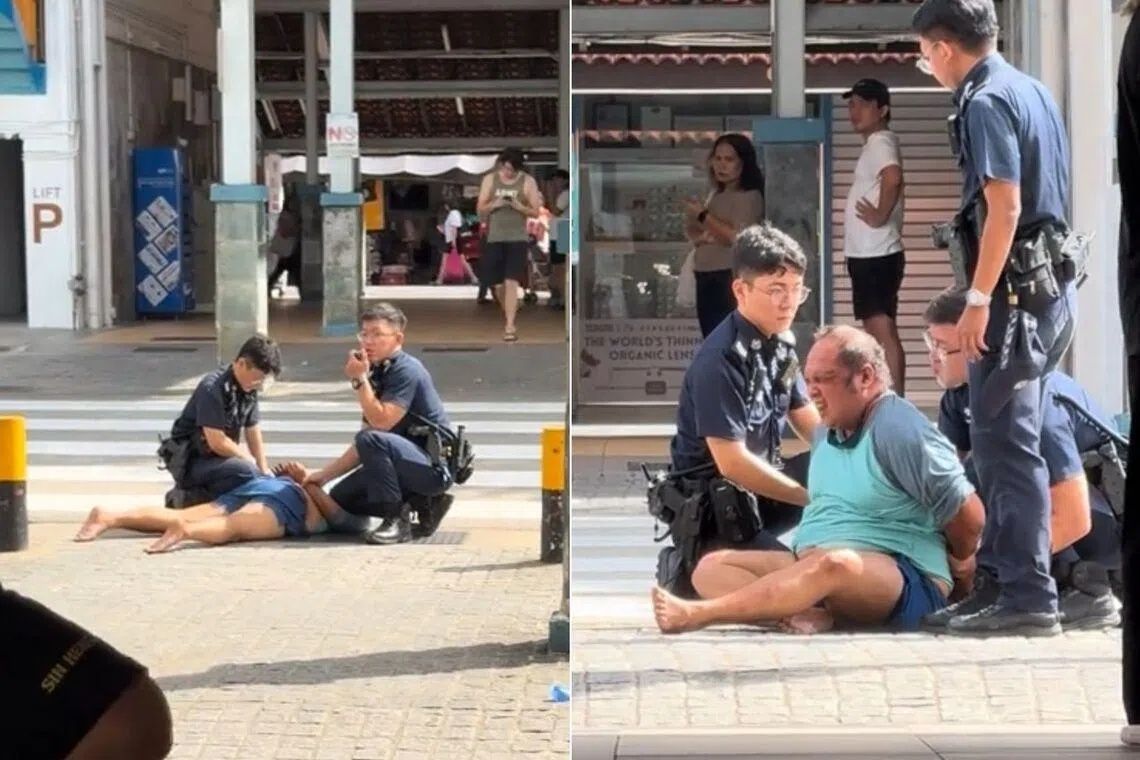
A 36-year-old man has been taken into custody by Singapore police following an incident at a Toa Payoh coffee shop on Sunday morning, June 28, in which he engaged in indecent behaviour and physically attacked an officer responding to the scene. The arrest marks another instance of public disorder and assault on law enforcement personnel in the densely populated residential district, underscoring ongoing challenges facing Singapore's police force in managing behavioural disturbances in public spaces.
The incident unfolded at Block 184 Toa Payoh Central when officers received a distress call at approximately 9:45am regarding a man causing a commotion inside a coffee shop. Police arrived to assess the situation and attempt to bring the individual under control. During the arrest procedure, the suspect became aggressive and struck one of the officers directly in the face, escalating what may have initially been a straightforward public nuisance call into a case of assault against a public servant.
The 19-year-old police officer who sustained the blow received medical treatment for injuries sustained during the confrontation and was transported to hospital while remaining conscious. Medical assessments indicated the injuries were classified as minor, though the psychological impact of being assaulted whilst performing official duties warrants consideration. The incident highlights the occupational hazards faced by Singapore's police force, particularly younger and less experienced officers, who increasingly encounter aggressive behaviour in public settings.
Social media footage captured by TikTok user Kee Wee Shang documented portions of the police response. Video clips show multiple officers engaged in restraining the barefooted suspect, holding him against the ground as they attempted to manage the situation. Additional footage reveals a third officer present at the location, with the handcuffed individual subsequently being escorted away by police personnel. The circulation of these videos on digital platforms illustrates how public incidents are now routinely documented and disseminated, creating both accountability mechanisms and broader community awareness of police operations.
Legal charges filed against the individual encompass two distinct offences under Singapore's criminal framework. The suspect faces accusations of committing an obscene act in public, a charge reflecting the indecent behaviour reported at the coffee shop. Additionally, he has been charged with voluntarily causing hurt to deter a public servant from his duty, a provision designed to protect officers from intimidation and violence whilst executing their lawful responsibilities. This dual charge structure indicates authorities viewed the assault as a deliberate attempt to obstruct police operations.
The Toa Payoh incident reflects broader patterns of public disorder incidents across Singapore's neighbourhoods. Coffee shops, which function as important social gathering spaces in Singapore's culture, occasionally become flashpoints for behavioural disturbances involving individuals experiencing mental health crises, intoxication, or personal crises. The relatively early morning timing of the incident—mid-morning rather than evening hours—suggests the disturbance occurred during what is typically a quieter period, potentially indicating the individual's behaviour was sufficiently disruptive to warrant immediate intervention.
For Malaysian readers and broader Southeast Asian observers, the case demonstrates how Singapore authorities manage public safety challenges in densely populated urban environments. The swift police response, documented social media presence, and structured legal response reflect the city-state's approach to maintaining public order. Furthermore, the incident underscores how assaults on police officers represent serious offences in Singapore's legal system, with specific statutory provisions protecting law enforcement personnel from intimidation and violence during duty.
The investigation remains ongoing as police gather additional evidence and witness statements related to the incident. Authorities will likely review CCTV footage from the coffee shop and surrounding areas to establish a comprehensive account of events preceding the police arrival and the subsequent confrontation. The investigation phase proves crucial for determining whether additional context—such as the suspect's mental state, substance involvement, or precipitating factors—will influence prosecution strategy or sentencing recommendations.
This case joins a constellation of similar incidents affecting Singapore's public safety landscape. Assaults on police officers, though statistically less frequent than in some other developed nations, generate significant concern within law enforcement circles and public discourse. Singapore's government has previously emphasised the importance of protecting officers from violence and has supported legislative measures ensuring robust penalties for individuals who assault public servants. Educational campaigns have also aimed at promoting public respect for law enforcement personnel and reinforcing community understanding of officers' safety challenges.
The broader context of this incident touches on public health dimensions as well. Singapore, like many developed and developing nations, grapples with mental health service provision and early intervention for individuals experiencing crises. Coffee shops and public spaces sometimes become locations where individuals in distress exhibit behaviour perceived as threatening or indecent. The availability of mental health support, crisis intervention training for police, and community mental health services potentially represents preventative infrastructure that could reduce such incidents. Whether the suspect involved in this case was experiencing mental health difficulties remains unknown pending investigation results.

