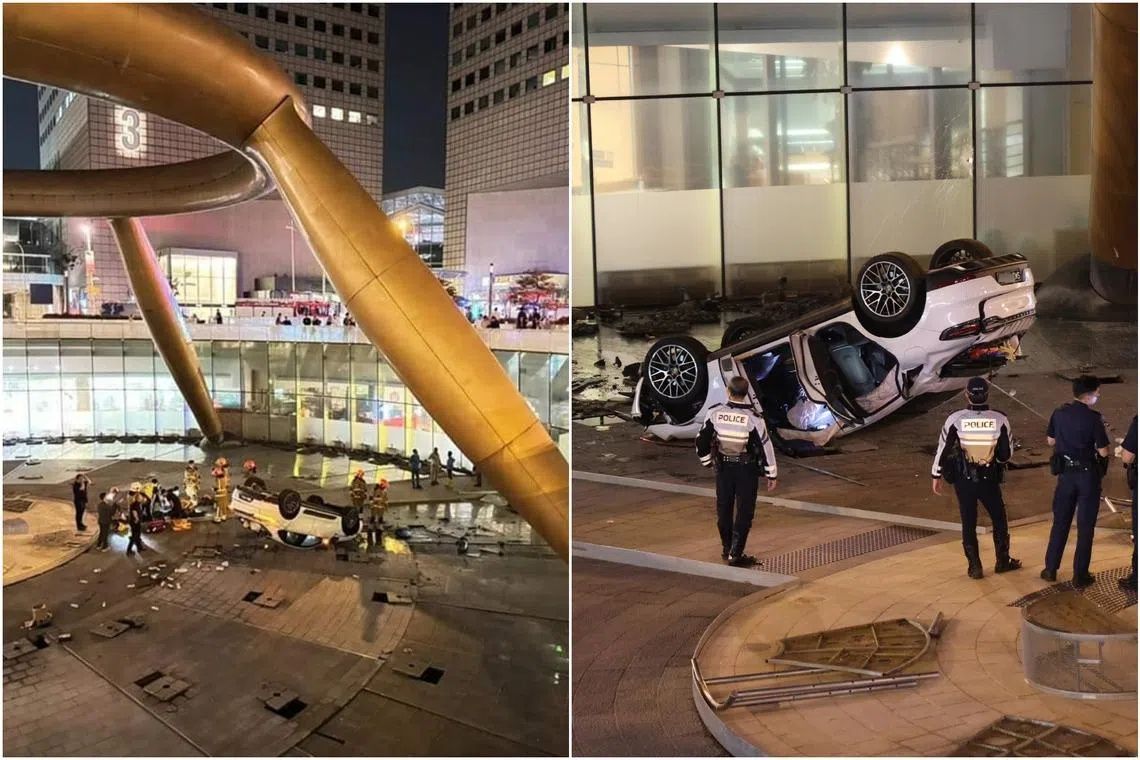
A Singapore court has sentenced a 58-year-old man to five weeks in jail for dangerous driving after he steered his vehicle into the basement of Suntec City's celebrated Fountain of Wealth on July 13, 2024, following a substantial drinking session. Then Shing Chong, who caused nearly S$64,600 in damage and has since made full restitution to authorities, pleaded guilty to the driving offence and faces a driving ban lasting two and a half years from his release date. The case highlights the persistent problem of impaired driving in developed Southeast Asian jurisdictions and raises fresh questions about the adequacy of drink-driving penalties and mental health considerations in criminal sentencing.
According to court proceedings, Then embarked on his journey to Suntec City on the afternoon of July 12, arriving at the shopping mall around 6pm before proceeding to a bar in the basement carpark. Between 6.15pm and midnight, he consumed approximately one litre of beer, a quantity that would significantly elevate blood alcohol concentration in most individuals. The decision to drive after this consumption proved catastrophic. Notably, blood and breath alcohol tests were not administered immediately following the accident, as Then was transported directly to Tan Tock Seng Hospital's emergency department where medical staff treated him for injuries including a lacerated scalp sustained during the collision.
The actual incident unfolded with troubling momentum as Then exited the carpark along Temasek Boulevard. Despite directional signage clearly indicating a left turn into a roundabout, he maintained his trajectory straight ahead, traversing three traffic lanes before breaching the protective barricade surrounding the fountain. The vehicle subsequently plummeted into the basement level of this iconic structure, a development that could have resulted in considerably greater tragedy. Three construction workers were actively engaged in basement work at the time of the crash, but all managed to evacuate the immediate area without sustaining injuries—a circumstance that the Deputy Public Prosecutor emphasised as fortunate, noting that had workers remained in the vehicle's impact zone, the consequences would have been "far more devastating and catastrophic."
The recovery operation itself required substantial resources, with authorities deploying a lorry crane to extract the damaged vehicle from the fountain's basin before towing it away. The incident draws attention to the vulnerability of Singapore's public spaces and infrastructure to accidents of this magnitude, even within heavily secured and monitored commercial districts. The S$64,600 repair bill demonstrates the considerable financial consequences of such reckless behaviour, though the offender's willingness to provide full restitution evidently held some weight with judicial authorities.
Then's legal representatives from Invictus Law Corporation mounted a defence strategy centred on mental health considerations, requesting that the court commission a mandatory treatment order assessment. The defence team presented an Institute of Mental Health report indicating that their client was diagnosed with major depressive disorder at the time of the accident and argued for a causal connection between his psychiatric condition and the driving offence. Additionally, Then had informed IMH assessors that he had consumed either an antihistamine or a sleeping pill before drinking alcohol—a potentially dangerous combination that compounds the depressant effects of alcohol and could impair judgment and motor control further.
However, the Deputy Public Prosecutor Gladys Lim strenuously objected to the mandatory treatment order approach, emphasising that deterrence remained paramount in this particular case. She contended that permitting such an order would inadequately address the seriousness of drink-driving behaviour and fail to send appropriate warning signals to the broader public. This prosecutorial stance reflects a wider philosophy within Singapore's justice system that prioritises general and specific deterrence, particularly for offences involving significant public safety risks.
District Judge Koo Zhi Xuan ultimately sided with the prosecution, rejecting the mental health mitigation arguments and imposing the jail sentence. The judge explicitly highlighted that drink-driving constituted highly irresponsible behaviour, noting that Then's actions had caused substantial property damage while simultaneously placing multiple people at serious risk of injury or death. The judicial reasoning demonstrates judicial reluctance to subordinate public safety imperatives to psychiatric conditions without compelling evidence of direct causation or inability to exercise reasonable judgment.
The case carries particular relevance for Malaysian observers, as it exemplifies how affluent regional jurisdictions handle serious traffic offences and reflects broader East Asian approaches to impaired driving enforcement. While Malaysia has progressively tightened drink-driving laws and penalties, comparative analysis of sentencing outcomes across the region provides insight into varying judicial philosophies. Singapore's relatively strict stance contrasts with enforcement patterns elsewhere in Southeast Asia, where drink-driving remains prevalent despite statutory prohibitions.
The incident at Suntec City also underscores broader questions about venue security and protective infrastructure surrounding public monuments and commercial installations. The fountain's barricade system, despite its protective intent, proved insufficient to prevent a determined vehicle from breaching it—a consideration that may prompt facility managers across the region to reassess protective measures. The presence of active workers within the basement compound during afternoon and evening hours added another dimension of vulnerability that escaped catastrophe largely through fortune rather than through systematic safety protocols.
For Malaysian transport safety advocates and policymakers, the case illustrates the compound dangers when alcohol consumption combines with medications such as antihistamines or sleeping pills. Public education campaigns regarding such interactions remain limited across the region, despite evidence that poly-substance use significantly amplifies impairment and reduces self-awareness regarding driving capacity. The episode provides a cautionary illustration of how seemingly minor decisions—meeting a friend for drinks, choosing to drive rather than utilise public transport or ride-sharing services—can spiral into life-altering consequences for both the offender and innocent bystanders.
Then's mandatory two-and-a-half-year driving disqualification represents a significant personal consequence beyond incarceration, particularly for individuals whose employment or lifestyle depends on vehicle access. The combination of jail time, driving ban, and financial restitution requirement creates a multifaceted punishment framework designed to address the multiple dimensions of his wrongdoing. As Singapore continues to refine its approach to traffic safety governance, this case will likely feature in judicial precedent discussions regarding the intersection of mental health factors and criminal responsibility in impaired driving cases.

