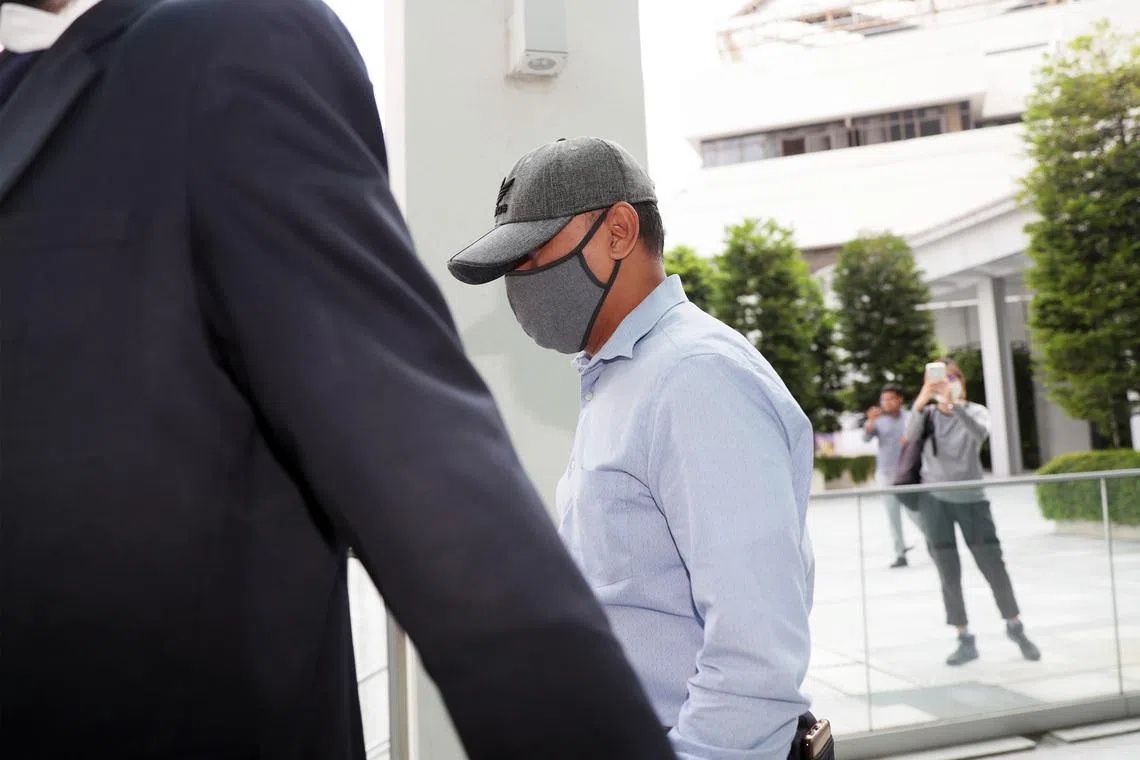
A senior administrator at two prominent Singapore mosques has been sentenced to 14 months imprisonment following a corruption conviction that exposed how insider knowledge was weaponised to funnel lucrative construction contracts to a connected business. Abdul Rahim Mawasi, 59, held the position of executive chairman at both Darul Aman Mosque on Jalan Eunos and Sallim Mattar Mosque in MacPherson while simultaneously serving as a senior officer with the Islamic Religious Council of Singapore (MUIS). He was convicted in April after trial and received his sentence on June 26, with his associate, Mohd Mustaqim Kam (also known as Kam Hock Beng), already having completed a six-month jail term in February 2025 for his role in the scheme.
The corruption scheme operated through a calculated arrangement between the two men that began in July 2018. Abdul Rahim proposed to Kam, a director of construction firm Zeal-Con Engineering with whom he had maintained a personal relationship exceeding a decade, that they establish a joint travel company focused on pilgrimage trips. The arrangement was structured so that Kam would provide initial capital through profits generated from construction projects that Zeal-Con would undertake at the two mosques, while Abdul Rahim would contribute no financial investment upfront. This arrangement explicitly hinged on Abdul Rahim's capacity to facilitate contract awards from the religious institutions he administered.
The mechanics of the corrupt transaction became evident through the Darul Aman Mosque project. In 2018, the mosque sought vendors to undertake construction work in its yard area. Zeal-Con submitted two separate quotations: the initial bid on August 20 came in at S$128,600, but a revised quote dated September 12 lowered the price substantially to S$118,000. The prosecution established that this revised figure positioned Zeal-Con below the next competitive bid of S$125,500 from another contractor. On September 26, 2018, the mosque's management awarded the contract to Zeal-Con for the reduced amount, with the board unaware that Abdul Rahim had conducted extensive discussions with Kam regarding bidding strategy and had provided crucial price guidance that directly influenced Zeal-Con's quotation decisions.
The pattern replicated itself at Sallim Mattar Mosque through a similar manipulation of competitive processes. In September 2018, Zeal-Con submitted a quotation of S$115,700 to perform renovation work across multiple sections of the mosque, including roof repairs and reception area improvements. By July 2019, the company revised its quote downward to S$105,000 for identical scope of work. The prosecution presented evidence demonstrating that Abdul Rahim had specifically advised Kam to reduce the company's pricing to secure contract acceptance. Subsequently, in August 2019, Sallim Mattar Mosque issued formal contract award letters to Zeal-Con aligned with the lower quotation amount.
To obscure the financial arrangement underlying the scheme, the two men implemented a deliberate concealment strategy. In November 2019, Kam converted an existing shell company into Amal Travel and Tour (ATT), capitalizing it with 100,000 shares and increasing paid-up capital from S$37,500 to S$100,000. Critically, Kam allocated 25,000 shares valued at S$1 each to Abdul Rahim's son in November 2019, thereby positioning the executive's family member as the nominal shareholder. This arrangement was designed to distance Abdul Rahim's apparent involvement while maintaining his financial interest. During trial, Abdul Rahim's legal representative Satwant Singh Sarban Singh maintained that his client held no shares in ATT and denied any involvement with the travel company, though records confirmed he had orchestrated the shareholding structure through his son.
The prosecution's case concentrated on establishing that Abdul Rahim had weaponised his administrative authority over mosque procurement processes to deliver competitive advantage to a connected business partner. Deputy Public Prosecutor Bryan Wong emphasised that the former MUIS officer, who had joined the council in 2005, deliberately failed to disclose his financial interest in the travel venture to his employer. The corruption operated through information asymmetry: while Zeal-Con possessed insider knowledge of competitor pricing and bid evaluation criteria through Abdul Rahim's guidance, other contractors operated without such advantages, creating an unfair competitive environment. Wong highlighted that Abdul Rahim had fundamentally breached fiduciary responsibilities by allowing personal financial gain to influence institutional procurement decisions.
Although prosecutors did not establish that either mosque sustained substantial financial losses—the construction work performed by Zeal-Con met satisfactory technical standards—the legal framework against public sector corruption does not require demonstrable pecuniary harm to constitute a serious offence. The corruption consisted in the deliberate perversion of fair procurement processes and the abuse of institutional authority for private benefit. Wong characterised the violation as a grave breach of public trust, particularly given that religious institutions depend on transparent governance to maintain community confidence. The fact that projects were technically completed without quality deficiencies does not exonerate the systematic manipulation of competitive tendering that preceded construction commencement.
The sentence of 14 months reflects Singapore's stance on corruption within institutional governance structures, particularly those involving religious and community organisations. The court implicitly recognised the severity of misconduct that strategically exploited administrative position within a trusted institution to channel resources to associates. Abdul Rahim's legal counsel sought a sentencing outcome capped at six months and highlighted his absence of prior convictions, yet the judiciary determined that the calculated nature of the scheme and its duration across multiple contracts warranted a substantially longer custodial term. The differentiation between Abdul Rahim's 14-month sentence and Kam's six-month imprisonment reflects the greater culpability of the administrative insider who weaponised institutional access.
The case carries significant implications for institutional governance across Southeast Asia's religious and community sectors. Many organisations in the region operate with comparable administrative structures and procurement frameworks, yet may not maintain equally rigorous oversight mechanisms to detect corruption schemes. The sophistication with which Abdul Rahim obscured his involvement through family shareholding structures demonstrates how determined officials can exploit corporate law frameworks to conceal beneficial interests. The prosecution's success in establishing corruption through circumstantial evidence surrounding bid price manipulation—even without explicit documented communications—suggests that financial forensics and pattern analysis can expose schemes that participants believed sufficiently concealed. For Malaysian and regional religious institutions operating similar management models, the Singapore case underscores the necessity for independent procurement committees, mandatory conflict-of-interest declarations, and regular auditing to prevent comparable exploitation of administrative authority.
Abdul Rahim's bail was set at S$30,000, with his imprisonment scheduled to commence on July 10. The resolution of this case through conviction and sentencing establishes prosecutorial precedent for corruption offences within religious institutional contexts, establishing that administrative position within community organisations does not shield individuals from accountability for abuse of authority. The case also reinforces that beneficial ownership concealment through family shareholding arrangements, while potentially complicating investigations, does not ultimately insulate corrupt officials from legal consequences when financial flows and decision patterns establish systematic wrongdoing. As Southeast Asian economies continue strengthening anti-corruption frameworks, particularly within community institutions historically assumed to operate at higher ethical standards, the precedent established through Abdul Rahim's conviction and sentencing demonstrates that institutional position amplifies rather than diminishes accountability for corrupt conduct.

