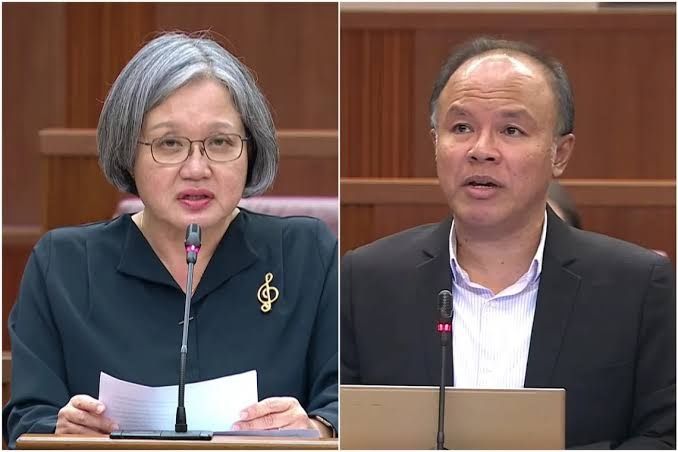
The Singapore Parliament has brought to a formal conclusion a contentious political controversy involving Workers' Party leaders Sylvia Lim and Faisal Manap, determining that no further disciplinary action can be pursued against them despite their confirmed involvement in parliamentary dishonesty. Leader of the House Indranee Rajah delivered this decision through a ministerial statement on July 7, explaining the legal constraints that have rendered Parliament powerless to impose penalties under the Parliament (Privileges, Immunities and Powers) Act, even though their culpability has been established beyond doubt.
The saga traces its origins to former Sengkang GRC Member of Parliament Raeesah Khan, who fabricated a narrative about police conduct during a 2021 parliamentary speech. When investigators from Parliament's Committee of Privileges delved into this transgression, they uncovered that Lim, Faisal, and their party chief Pritam Singh had all provided false testimony to the inquiry committee. Most damningly, the committee established that Pritam had explicitly instructed Khan to conceal her dishonesty, directing her to "take her lie to the grave" during an August 8, 2021 meeting. Lim and Faisal, both present at this encounter, subsequently denied knowledge of these discussions, thereby compounding the original deception.
Rather than moving swiftly against all three individuals, Parliament adopted a tiered approach that reflected the severity of each person's involvement. Pritam's conduct was categorised as substantially more culpable than that of his colleagues, leading Parliament to refer his case to the public prosecutor for independent criminal investigation and adjudication. This decision afforded him proper legal representation and judicial due process. By contrast, Lim and Faisal were characterised as playing ancillary roles, and their cooperation with investigators—though incomplete—was acknowledged as marginally mitigating. Parliament therefore determined to defer action against them pending the outcome of Pritam's criminal proceedings, framing this as a fair approach to the duo.
Pritam's legal journey eventually vindicated Parliament's concerns about his conduct. In February 2025, the District Court found him guilty of lying to Parliament, a conviction he immediately appealed. However, the High Court's December 2025 judgment upheld the conviction, cementing the factual foundations of the original parliamentary committee findings. Indranee observed that the court's decision effectively confirmed what the committee had already established about all three individuals' dishonesty, providing independent judicial validation of Parliament's investigative conclusions.
The technical barrier preventing further action against Lim and Faisal stems from the PPIPA's temporal limitations. Section 22 of this legislation constrains Parliament's disciplinary power to violations occurring either within the current parliamentary session or during the immediately preceding session of the previous parliamentary term. When Pritam's High Court judgment was delivered in December 2025, Singapore had already transitioned from the 14th Parliament to the 15th Parliament following the 2025 general election in September 2025. Since Lim and Faisal's original falsehoods occurred during the opening session of the 14th Parliament—making them now several parliamentary sessions removed from the current legislature—the 15th Parliament has lost all statutory authority to impose consequences under the PPIPA framework.
Indranee articulated the frustration inherent in this outcome with candour, acknowledging that "had the timelines been different, I would have proposed a different course of action." She attributed this predicament partly to Parliament's earlier forbearance, noting that the House had possessed the legal authority to act on the Committee's 2021 findings but chose instead to extend provisional mercy to Lim and Faisal by deferring action pending Pritam's resolution. This benevolent delay inadvertently created the conditions for the statutory time bar to intervene. The decision to wait was motivated by equitable considerations, yet it has produced an outcome where legal formality takes precedence over accountability.
While the statutory mechanism has closed, Parliament retains alternative avenues for expressing institutional displeasure. Indranee noted that the House could theoretically pass a motion registering formal regret regarding Lim and Faisal's conduct. However, she contended that such a gesture would be redundant, since Parliament had already crystallised its disapproval of parliamentary dishonesty when it declared Pritam Singh unsuitable as Leader of the Opposition in January 2025. That motion represented Parliament's unambiguous statement that misleading the legislature or its committees constitutes grounds for loss of confidence in parliamentary leadership. The existence of this prior resolution meant that further expressions of censure would add little substance to the formal record.
The Workers' Party itself had moved past this controversy one week before Parliament's formal closure, when party members gathered on June 28 for internal elections and organisational meetings. Despite the shadow cast by Pritam's conviction and the documentary evidence of his instruction to Khan, party cadres voted decisively to retain him as their leader. This grassroots endorsement, though significant for the party's internal dynamics, carried no bearing on Parliament's legal capacity to proceed. Indranee's July 7 statement therefore represents Parliament's final institutional pronouncement rather than an unexpected development, as the legislative mechanism had already run its course through structural constraints rather than evolving political judgments.
The closure of this chapter illuminates the inherent tension between procedural fairness and accountability mechanisms in parliamentary systems. Indranee emphasised that the law must be observed regardless of policy preferences, noting that "even though the Committee's findings have now been effectively confirmed by the High Court Judgement, the law, in this case the time bar provisions of PPIPA, must be observed." This statement encapsulates the principle that institutional legitimacy ultimately rests upon adherence to constitutionally prescribed procedures, even when such adherence produces outcomes that circumvent accountability. The rigid application of temporal constraints, though sometimes frustrating, protects legislatures from appearing to retroactively alter the rules governing their own proceedings.
Sylvia Lim herself offered a subdued response upon the matter's closure, clarifying that she lodged no objection to Indranee's ministerial statement and reiterating her earlier submissions made during January's leadership motion debate. She highlighted a significant procedural disadvantage she had endured throughout the investigative process: the court proceedings against Pritam Singh relied extensively upon prosecution evidence implicating her, yet she had never been afforded the opportunity to testify or present her own account, as she was never called as a witness. This asymmetry—wherein her culpability was established partly through others' testimony without her participation in cross-examination—underscores the complexities that emerge when parliamentary investigations and criminal prosecutions become intertwined.
For Malaysian observers, this Singapore episode offers instructive lessons regarding the mechanics and limitations of parliamentary discipline, the interaction between legislative and judicial authority, and the structural vulnerabilities created by time-bound enforcement provisions. Malaysia's own Parliament operates within comparable constitutional frameworks, and the experience of the Workers' Party affair demonstrates how procedural postponements, triggered by deference to complementary investigations, can inadvertently extinguish enforcement capacity altogether. The case equally illustrates why maintenance of parliamentary standards depends ultimately on swift action and institutional memory, rather than deferral premised on fairness to those whose conduct is under scrutiny.

