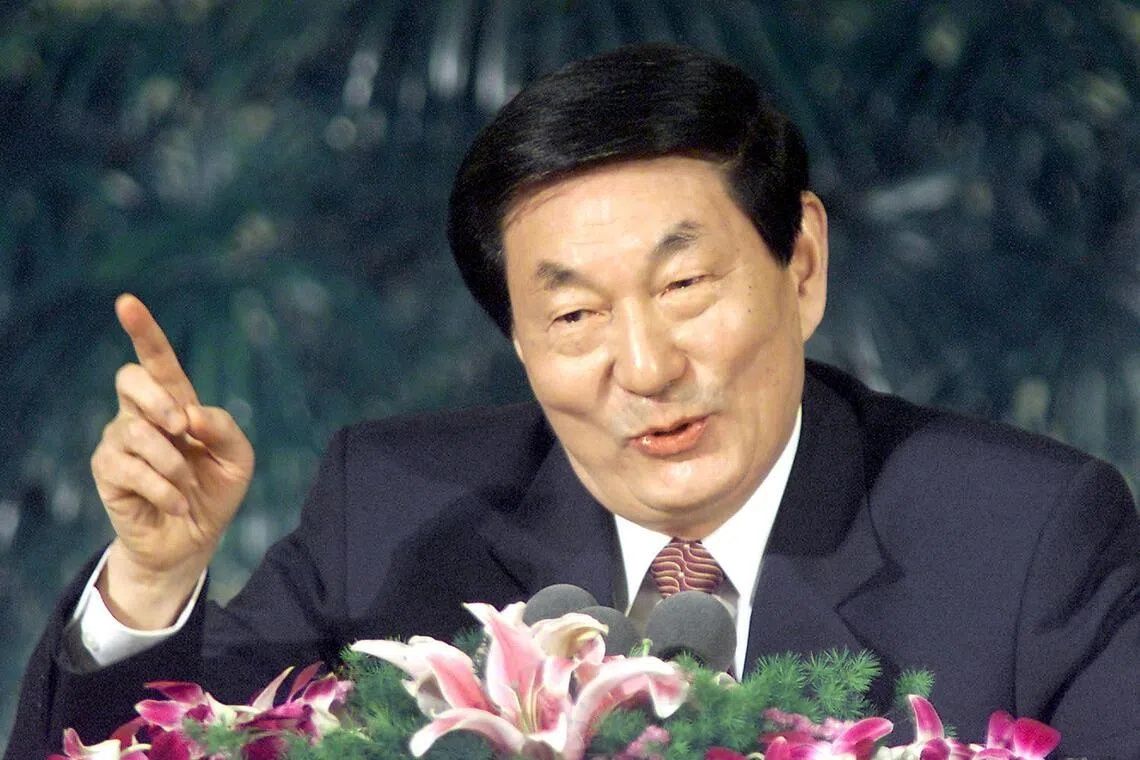
Singapore's Prime Minister Lawrence Wong has extended formal condolences to Chinese Premier Li Qiang following the passing of former premier Zhu Rongji, marking the end of an era for one of China's most transformative economic leaders. Zhu died in Beijing on Wednesday, August 12, according to state news agency Xinhua, just two months before what would have been his 98th birthday. His death closes a significant chapter in modern Chinese history and underscores the deep respect he earned across the Asia-Pacific region.
In a letter dated August 13, PM Wong highlighted Zhu's monumental impact on China's trajectory during his tenure as premier, emphasizing his instrumental role in shepherding the country through critical economic reforms that reshaped the nation's role in the global economy. Wong paid particular attention to Zhu's leadership in facilitating China's accession to the World Trade Organization in 2001, a watershed moment that opened unprecedented opportunities for Chinese enterprises and integrated the country more fully into international commerce. This pivotal achievement transformed not only China but rippled across the entire region, establishing frameworks that continue to govern trade relationships today.
Wong's tribute revealed the depth of historical connections between Singapore and Zhu, characterizing the departed leader as "an old friend of Singapore." The Prime Minister noted that Zhu had maintained substantial personal relationships with Singapore's founding leadership, having met with former prime ministers Lee Kuan Yew and Goh Chok Tong on numerous occasions throughout his career. These encounters reflected the high-level bilateral engagement that has characterised Singapore-China relations for decades, with Singapore punching well above its weight in diplomatic circles through consistent cultivation of relationships with China's senior leadership.
A particularly significant moment in this relationship came in 1999, when Zhu became the first Chinese leader to deliver the Singapore Lecture, a prestigious annual address hosted by the ISEAS – Yusof Ishak Institute. This platform, which regularly attracts prominent world statesmen and intellectuals to share strategic perspectives, provided Zhu with a unique opportunity to articulate China's vision for regional development directly to an influential Southeast Asian audience. His willingness to engage in such public intellectual dialogue demonstrated a forward-thinking approach to diplomacy and a confidence in China's trajectory that would resonate throughout the region.
At that 1999 lecture, Zhu articulated a remarkably prescient strategic vision, arguing that China's economic development and expansion would generate substantial benefits extending far beyond its borders to benefit all of Asia and the broader international community. Significantly, he proposed the establishment of a free trade area between the Association of Southeast Asian Nations and China, an initiative that reflected his understanding of regional economic interdependence and mutual advantage. This proposal would eventually crystallize into the ASEAN-China Free Trade Area, which commenced operations in 2010 and has become one of the world's largest trading blocs by population.
Wong emphasized that Zhu's vision has proven strikingly accurate, noting that China has indeed evolved into a cornerstone economic partner for Singapore and other regional nations. The trade frameworks and economic ties that have flourished across Southeast Asia owe considerable intellectual debt to the kind of strategic thinking Zhu championed during his tenure. For Singapore specifically, this has meant access to vast markets, opportunities for investment, and a position of influence in managing regional economic dynamics.
Beyond broad economic vision, Zhu's legacy in Singapore-China relations extends to concrete developmental projects that built institutional foundations for ongoing cooperation. PM Wong specifically highlighted Zhu's instrumental support for the China-Singapore Suzhou Industrial Park, an early government-to-government collaboration that served as a prototype for subsequent joint ventures. This project, which broke ground in 1994, represented a deliberate decision by Chinese leadership to invite foreign expertise and capital in a controlled environment, with Singapore's renowned administrative efficiency and development experience providing a template for industrial and urban development.
Zhu's tenure as Shanghai mayor prior to his elevation to the national stage also fostered direct exchanges and learning initiatives between officials from that major Chinese metropolis and Singapore. These municipal-level connections facilitated practical knowledge transfer on urban governance, industrial development, and administrative modernization, creating personal relationships and institutional memory that would benefit both societies. Wong credited these foundational efforts with establishing the robust architecture that underpins contemporary Singapore-China engagement across multiple sectors and levels of government.
The passing of Zhu represents the disappearance of a figure who bridged generations of Chinese leadership and embodied the country's transformation from a relatively closed economy to a global powerhouse. His intellectual contributions to economic policy and regional diplomacy extended well beyond China's borders, influencing how Southeast Asian nations conceptualized their own development pathways and their relationships with Beijing. For countries like Singapore, which has maintained a carefully calibrated balance in its relationships with major powers, Zhu represented a particular model of enlightened pragmatism and strategic clarity that transcended purely bilateral considerations.
Wong's formal tribute, while diplomatic in tone, reflects genuine recognition of Zhu's outsized influence on the region's contemporary geopolitical and economic landscape. The acknowledgment that Singapore-China ties have flourished as a result of foundations laid during Zhu's leadership serves as both eulogy and affirmation of enduring institutional relationships. As regional powers continue navigating complex economic and strategic competition, the legacy of figures like Zhu who championed win-win frameworks and mutual development remains pertinent to ongoing deliberations about Asia's future trajectory and the rules that should govern regional commerce and cooperation.

