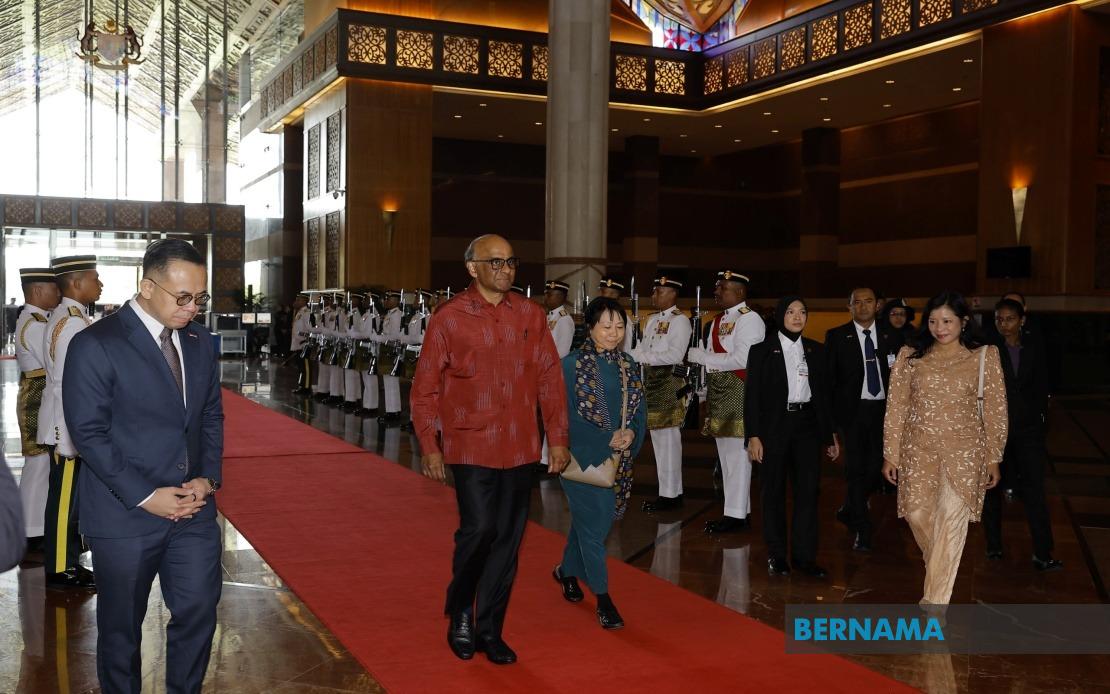
Singapore President Tharman Shanmugaratnam and his delegation departed Malaysia on Tuesday afternoon, concluding a three-day state visit that underscored the enduring partnership between two of Southeast Asia's most economically intertwined neighbours. The President and his spouse Jane Ittogi left Kuala Lumpur International Airport's Terminal 1 at 2.20 pm on a commercial flight returning to Singapore, marking the formal conclusion of his first presidential trip to the country since taking office in September 2023.
The departure was marked by full ceremonial honours befitting a visiting head of state. Upon arriving at the airport's Bunga Raya Complex at 1.45 pm, President Tharman was accorded a static Guard of Honour composed of two officers and 26 personnel from the First Battalion of the Royal Ranger Regiment, commanded by Captain Muhammad Hanafi Ja'afar. Minister of Entrepreneur and Cooperatives Development Steven Sim attended the farewell proceedings, representing the Malaysian government's final courtesies to the departing dignitary.
The three-day visit, which commenced on Sunday at the formal invitation of His Majesty Sultan Ibrahim, King of Malaysia, represented a deliberate reciprocal gesture in the diplomatic calendar between Kuala Lumpur and Singapore. This exchange of state visits demonstrates the mutual respect and commitment both nations maintain towards their relationship—Sultan Ibrahim had undertaken his own official visit to Singapore just over two months earlier, on May 6 and 7, 2024. Such reciprocal visits at the highest levels serve as periodic affirmations of bilateral cooperation and provide platforms for addressing strategic matters affecting both countries.
The presidential itinerary reflected the multilayered nature of Malaysia-Singapore relations. On Monday, President Tharman participated in a formal state welcoming ceremony, followed by a private audience with Sultan Ibrahim at Istana Negara, the official residence of Malaysia's Yang di-Pertuan Agong. These occasions provided space for candid discussions between the two heads of state on matters ranging from trade and economic cooperation to regional security concerns that preoccupy both governments.
Beyond the ceremonial monarch-to-head-of-state engagement, the visit included substantive interactions with Malaysia's political leadership. Prime Minister Datuk Seri Anwar Ibrahim granted President Tharman a courtesy call, during which discussions centred on bilateral and regional issues. The gathering included Foreign Minister Datuk Seri Mohamad Hasan, Investment, Trade and Industry Minister Datuk Seri Johari Abdul Ghani, and Steven Sim, indicating that Malaysia's economic and foreign policy establishments were fully engaged with the visiting dignitary. These multi-ministerial conversations highlight how contemporary state visits go beyond symbolic gestures to encompass practical coordination across multiple policy domains.
The visit extended beyond the federal capital to include engagement with Malaysia's state-level leadership. On his final full day in the country, President Tharman received an audience with the Sultan of Selangor, Sultan Sharafuddin Idris Shah, at Istana Alam Shah. This additional engagement demonstrates the comprehensive nature of the visit and acknowledges the significance of Malaysia's most developed and economically vibrant state in the bilateral relationship.
Timing and sequencing of such high-level visits carry strategic significance in Southeast Asian diplomacy. For President Tharman, this inaugural state visit to Malaysia since assuming the presidency earlier this year provided an opportunity to establish direct working relationships with key Malaysian officials and to reaffirm Singapore's commitment to the regional partnership. As Singapore's largely ceremonial president, Tharman's diplomatic role differs from his predecessor's, yet his visits remain valuable in projecting continuity and respect towards neighbouring states.
The Malaysia-Singapore bilateral relationship exists within a broader Southeast Asian context where these two nations, despite their small geographic footprints, exercise disproportionate influence due to their economic dynamism and strategic locations. Malaysia serves as Singapore's primary hinterland, while Singapore functions as Malaysia's most important financial hub and trading partner for many sectors. The relationship encompasses intricate arrangements covering water supply, land transport, labour mobility, and maritime boundaries, requiring constant high-level attention and goodwill to manage effectively.
For Malaysian readers and policymakers, President Tharman's visit reinforces Singapore's interest in maintaining stable, forward-looking relations despite occasional diplomatic friction. The choice to undertake this state visit demonstrates Singapore's commitment to the bilateral relationship at a time when both nations navigate complex regional geopolitical shifts and economic transitions. The reciprocal nature of the presidential visits also signals to the international community that Malaysia and Singapore remain aligned on fundamental issues affecting regional stability and prosperity.
Looking ahead, such visits establish frameworks for ongoing consultation at the highest levels. Whether addressing maritime boundary demarcation, water price renegotiations, or broader Southeast Asian security matters, the personal relationships established during state visits facilitate more productive conversations during inevitable moments of tension. President Tharman's departure marks the completion of this particular diplomatic exercise, but the visit's significance lies in its contribution to maintaining the foundational goodwill upon which the Malaysia-Singapore partnership rests.

