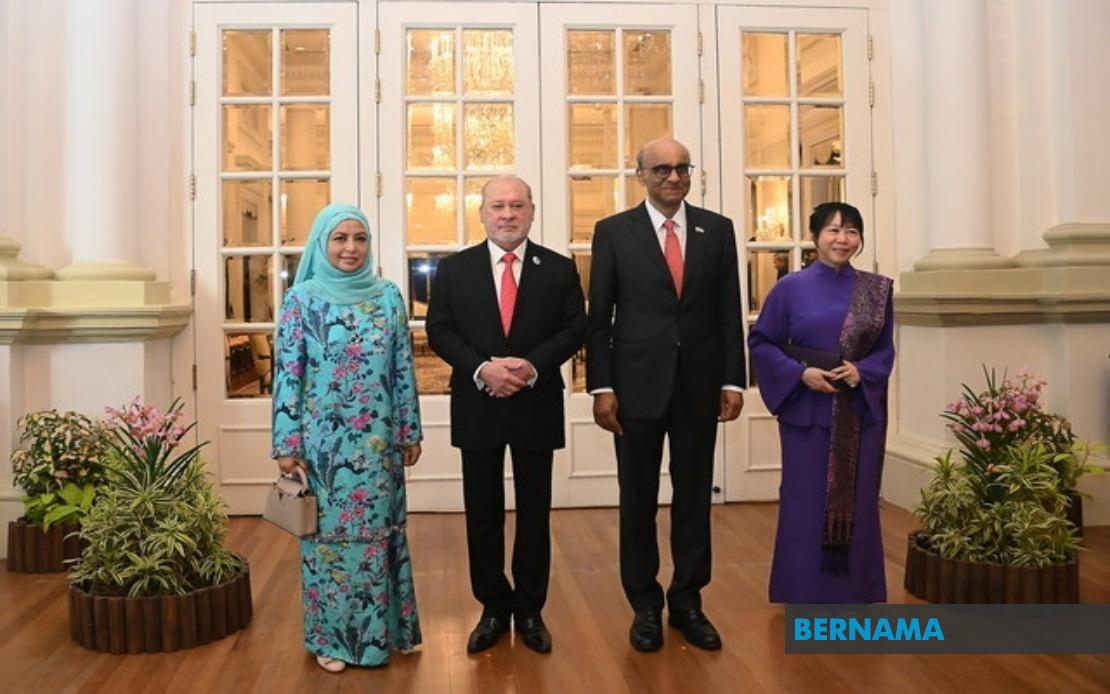
President Tharman Shanmugaratnam arrives in Kuala Lumpur for a three-day State Visit at the invitation of His Majesty Sultan Ibrahim, King of Malaysia, with a message that the two nations must move beyond transactional engagement and deepen cooperation across economic, environmental, and people-to-people dimensions. In remarks ahead of the visit, the Singapore leader underscored that the Malaysia-Singapore partnership rests on foundations laid over six decades—shared history, cultural ties, and economic interdependence—but faces fresh imperatives in an era of fracturing global trade and intensifying geopolitical competition.
The relationship between Malaysia and Singapore carries a unique character shaped by centuries of interconnected heritage and contemporary realities that bind the two societies together. Singaporeans and Malaysians trace lineages and cultural practices spanning generations, while the Johor-Singapore Causeway operates as the world's busiest land border crossing, facilitating the movement of hundreds of thousands of workers and traders daily. Beyond this practical integration, both nations have begun formalising recognition of their shared cultural assets, most recently through the joint UNESCO inscription of the kebaya with Indonesia, Thailand, and Brunei. Current efforts to secure similar recognition for Chingay, the vibrant street procession that showcases multicultural traditions in both countries, represent more than ceremonial achievement—they constitute deliberate strategies to transmit inherited customs to younger generations and anchor cultural identity amid rapid modernisation.
President Tharman's framing of bilateral relations explicitly rejects a narrowly transactional approach, instead emphasising the accumulated trust developed through sustained engagement and the willingness to navigate disagreement without allowing it to corrode the broader partnership. He acknowledges that as close neighbours with a shared colonial past, Malaysia and Singapore inevitably encounter tensions and differing interests on specific issues. The distinguishing factor lies not in the absence of disputes but in the maturity with which successive administrations have chosen to address them—through calm dialogue, mutual respect, and adherence to international legal frameworks. This approach has enabled the two nations to manage sensitive matters without allowing them to derail cooperation across the full spectrum of bilateral engagement.
Looking forward, President Tharman identifies several concrete platforms through which Malaysia and Singapore can amplify mutual benefit. The Johor-Singapore Special Economic Zone represents an opportunity to demonstrate how neighbouring economies can align their comparative advantages to create value for both populations. Similarly, the Rapid Transit System Link promises to reduce friction in cross-border movement, improving daily life for the hundreds of thousands who commute between the two territories. These projects embody a philosophy of symbiotic development rather than zero-sum competition, offering templates that could influence how other regional partners approach collaborative infrastructure and economic integration.
The Singapore leader situates bilateral advancement within the broader context of regional challenges and opportunities. The fracturing of multilateral trade frameworks and rising great-power competition create urgency for Southeast Asian nations to strengthen integration among themselves and deepen partnerships with trusted neighbours. President Tharman contends that Malaysia and Singapore, as founding members of ASEAN, carry particular responsibility for demonstrating how disciplined cooperation can enhance collective resilience. By joining their markets more seamlessly, developing greater energy and supply chain resilience through coordinated investment, and collaborating on emerging sectors such as digital technologies and the green economy, the two nations can showcase a model of partnership suited to a more contested international environment.
Climate change and the transition to renewable energy emerge as especially compelling domains for intensified cooperation. As tropical nations facing complex environmental challenges, Malaysia and Singapore share common vulnerabilities and policy objectives related to sustainability and carbon reduction. Both have committed to energy transition targets that align with global climate imperatives. President Tharman suggests that collaboration in renewable energy infrastructure, carbon credit markets, and sustainable finance mechanisms could unlock value unavailable through unilateral action, while simultaneously advancing the climate agenda that both electorates increasingly demand from their governments.
The digital economy represents another frontier where collaboration could yield exponential returns. ASEAN recently concluded the Digital Economy Framework Agreement, scheduled for signature at the 49th ASEAN Summit in Manila in November 2026. Current projections indicate that without such coordination, the region's digital economy could reach approximately US$1 trillion by 2030. However, implementation of a high-quality DEFA could potentially double this figure to US$2 trillion, suggesting that the framework's effectiveness depends heavily on committed cooperation from large regional economies, particularly Singapore and Malaysia. For Malaysian readers, this implies that deeper digital integration with Singapore—encompassing data governance, financial technology standards, and e-commerce regulations—could unlock significant economic opportunities for Malaysian firms and consumers.
President Tharman emphasises that the challenge of managing disputes and disagreements requires active attention precisely because global turbulence creates pressure for all nations to retreat into narrower calculations. The Singapore-Malaysia example, he argues, demonstrates that regional stability does not emerge from the absence of conflict but from disciplined processes for managing it responsibly. This observation carries implications for how ASEAN as a collective body approaches contentious issues among its members and in its relations with major powers. When two neighbouring economies with deep integration manage differences through dialogue and restraint rather than escalation, they reinforce norms of a rules-based order that benefit all smaller nations operating in a system dominated by larger powers.
Yet Tharman also sounds a note of concern regarding the intergenerational transmission of understanding and goodwill between the two populations. What previous generations experienced naturally—frequent cross-border contact, cultural exchange, and personal relationships—now requires deliberate cultivation and facilitation. He advocates for expanded bilateral exchange programmes, joint internships, youth leadership forums, and collaborative community projects designed to deepen friendships among younger Malaysians and Singaporeans. This emphasis reflects recognition that demographic change and urbanisation in both countries have created populations with diminishing direct experience of cross-border life, and that without intentional effort to maintain people-to-people connections, the emotional and social foundations of the bilateral relationship could gradually erode.
The Singapore leader positions the bilateral partnership within the larger architecture of ASEAN cooperation. Both Malaysia and Singapore have vested interests in maintaining ASEAN's unity, centrality, and relevance as a rules-based organisation capable of preserving regional peace and prosperity amid great-power competition. Malaysia's successful ASEAN Chairmanship in 2025, which saw the accession of Timor-Leste as the 11th member and substantial progress on trade and digital economy agreements, demonstrated the organisation's continued capacity for substantive achievement under capable leadership. As Singapore assumes the ASEAN Chairmanship in 2027, President Tharman suggests that close coordination with Malaysia can help sustain momentum on regional integration initiatives while anchoring ASEAN's value proposition to global partners seeking a reliable, coherent Southeast Asian counterpart.
President Tharman's remarks ultimately reflect a sophisticated understanding of how bilateral partnerships function in an era of systemic fragmentation. Neither Singapore nor Malaysia can pursue prosperity or security in isolation. Each possesses resources, capabilities, and strategic positioning that the other requires. The depth of their integration—economic, cultural, and institutional—creates interdependence that, properly managed, becomes a source of strength. By moving beyond transactional calculations to deepen cooperation on emerging challenges such as digital economy development, renewable energy transition, and climate resilience, while simultaneously investing in the next generation of bilateral relationships, Malaysia and Singapore can model how neighbouring nations navigate turbulence without abandoning the common purpose that binds them.

