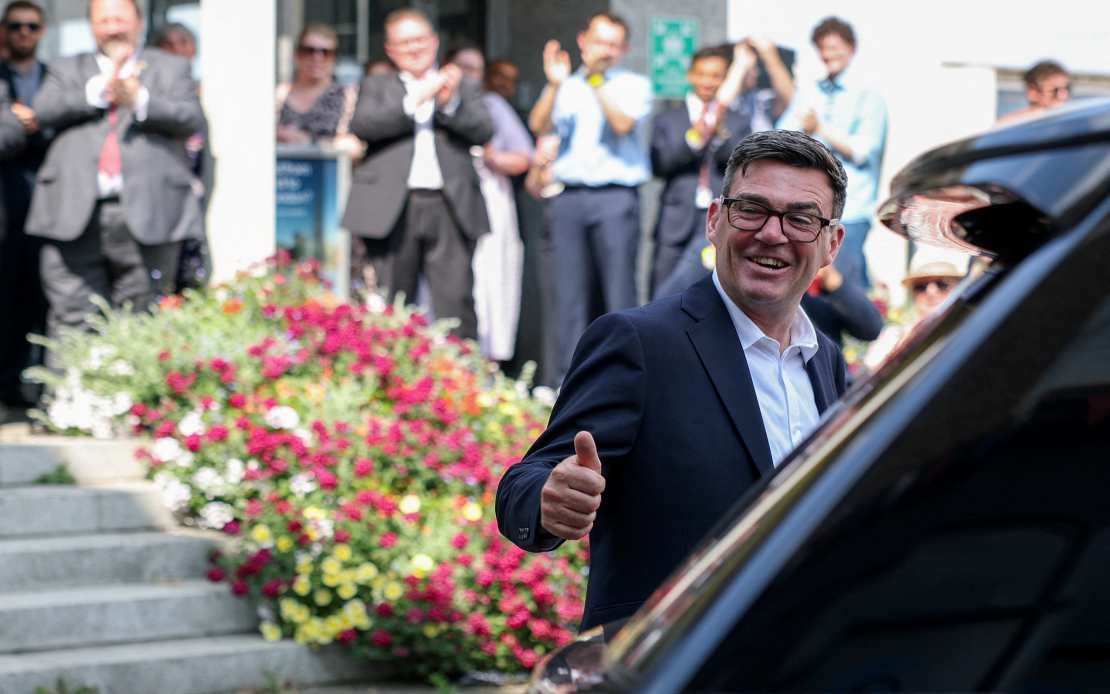
Singapore's Prime Minister Lawrence Wong has formally congratulated Andy Burnham following his appointment as the United Kingdom's new prime minister, underlining the strategic importance both nations place on their bilateral relationship. In a carefully worded congratulatory missive, Wong extended best wishes to the Labour Party leader as he assumes the challenging brief of steering Britain through an era marked by significant geopolitical realignment and economic turbulence, while simultaneously charting a path toward greater prosperity for the British public.
The prime minister's message reflects Singapore's measured diplomatic approach to Britain's domestic political transition. By publicly affirming confidence in strengthened cooperation, Wong signals that the city-state views Burnham's government as a natural continuation partner for advancing shared interests. This is particularly significant given the broader context of power shifts in the Indo-Pacific and Britain's evolving role within the region, making leadership transitions in major Western capitals matters of keen interest to Southeast Asian policymakers.
Singapore and the United Kingdom maintain ties anchored in their Strategic Partnership framework, a formal arrangement that codifies the range and intensity of their collaboration. This partnership, according to Wong, has been cultivated across many decades through sustained dialogue and mutual trust. The relationship extends well beyond ceremonial exchanges, encompassing practical cooperation in areas that directly affect regional security and economic development. Wong's emphasis on the partnership's depth signals to Burnham's new administration that Singapore expects engagement at a substantive level, not merely symbolic gestures.
The Singapore leader identified three priority domains for deepened cooperation: innovation, science and technology, and defence. These sectors reveal strategic priorities for how Singapore views its partnership with Britain. Innovation and technological advancement represent the frontier where economic competitiveness is determined in the twenty-first century, while defence collaboration underscores the security dimension of the bilateral relationship. For Malaysia and the broader Southeast Asian region, Singapore's emphasis on these areas also hints at how the island nation positions itself as a hub connecting Western technological expertise with Asian markets and security arrangements.
Wong's observation that trusted partners achieve more through cooperation during periods of profound global uncertainty carries particular resonance in the current geopolitical climate. The statement appears calibrated to acknowledge the turbulent international environment while positioning the Singapore-UK relationship as a stabilizing force. This framing is noteworthy because it suggests Singapore views the bilateral tie as resilient across political transitions and capable of withstanding the tremors that periodically shake the international system. For regional observers, it reinforces the message that major power partnerships remain functional even when leadership changes occur.
A crucial element of Wong's message concerned Britain's engagement with Southeast Asia more broadly. The prime minister specifically highlighted the UK's status as an ASEAN Dialogue Partner and its participation in the Five Power Defence Arrangements, the latter being a longstanding security framework involving Singapore, Malaysia, Australia, New Zealand and Britain. By underscoring these multilateral mechanisms, Wong was effectively telling Burnham's government that regional expectations exist for Britain to maintain and deepen its involvement in Southeast Asian affairs. This is not incidental to the bilateral relationship but rather central to how Singapore and other regional capitals view Britain's relevance to Asian security and prosperity.
The timing of Wong's message takes on added significance when considering Singapore's assumption of the ASEAN Chairmanship and Britain's hold on the G20 Presidency in 2027. These parallel leadership positions create what Wong characterised as a unique opportunity for coordinated action on global challenges. Singapore's approach to ASEAN leadership will inevitably be shaped by how it manages relations with major powers, making Britain's engagement a factor in the island nation's broader diplomatic strategy. Conversely, Britain's G20 role positions it as a convener of major economies grappling with issues like climate change, economic inequality and technological governance, domains where Asian input is increasingly essential.
The broader implication for Malaysia and Southeast Asia relates to how Britain repositions itself following its European withdrawal. With ASEAN centrality as a stated objective of regional countries, Britain's commitment to engagement through established mechanisms like the Five Power Defence Arrangements and dialogue partnerships becomes a measure of its reliability as a partner. Wong's diplomatic signal that Singapore welcomes continued British engagement suggests the region values these connections and expects them to endure through leadership transitions in London.
Burnham's path to power followed the Labour Party's decisive victory over the Conservative government, bringing an end to a period of political turbulence in Britain. Wong's prompt and substantive congratulatory message demonstrates Singapore's eagerness to establish working relations with the new administration. The content of the message, focusing on shared challenges and mutual interests rather than ideological affinity, reflects how Singapore conducts foreign relations on pragmatic rather than partisan grounds. This approach has served the city-state well in maintaining stable relationships across different political systems and leadership configurations.
For Malaysia and other Southeast Asian capitals, Singapore's diplomatic overture offers instructive lessons in how to engage with new British leadership while advancing regional interests. The emphasis on defence, technology and multilateral cooperation reflects areas where Southeast Asian countries have substantial stakes in British policy. As Britain seeks to define its post-Brexit role on the world stage, its commitment to the Indo-Pacific region will increasingly depend on how deeply it integrates with established frameworks and bilateral relationships. Wong's message suggests that at least from Singapore's vantage point, Britain remains a valued partner whose continued engagement serves regional stability and prosperity, even as global power distributions continue their historic shift toward Asia.

