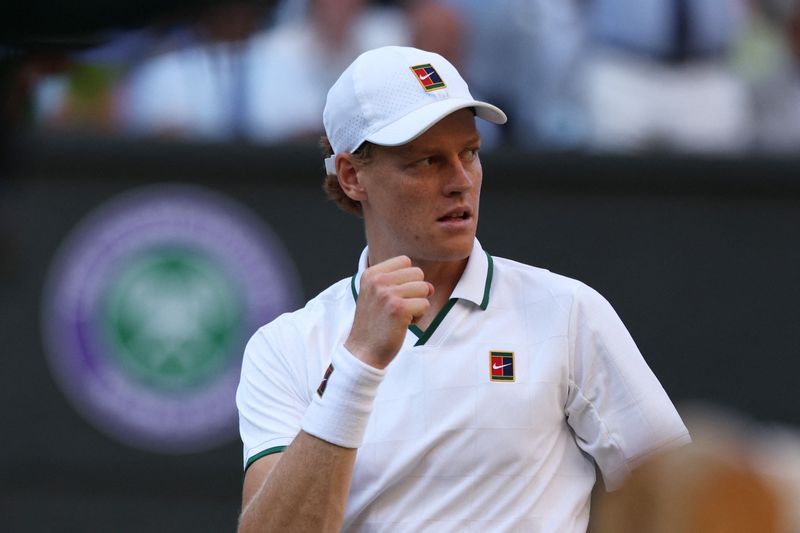
Jannik Sinner demonstrated exceptional mental fortitude on Sunday to retain the Wimbledon singles crown, extending his remarkable dominance over Alexander Zverev in a pulsating final that tested both competitors to their limits. The Italian's 6-7(7) 7-6(2) 6-3 6-4 victory on Centre Court not only secured his fifth Grand Slam title but also elevated him into a select echelon of tennis legends who have successfully defended the Wimbledon crown in the professional era.
Zverev arrived at the final riding a wave of confidence following his maiden Grand Slam triumph at Roland Garros, and the German second seed applied relentless pressure throughout a match that swung dramatically on fine margins and moments of individual brilliance. For nearly three hours, the outcome remained genuinely uncertain as both players unleashed explosive baseline exchanges and precision serving that captivated the crowd. However, Sinner's superior consistency ultimately proved decisive as Zverev's resistance finally fractured during a pivotal moment in the third set.
The opening set epitomised the ferocity of their contest, consuming 65 minutes of uncompromising tennis that offered precious few opportunities for either player to gain the upper hand. Sinner squandered a break point at 4-3 when he uncharacteristically framed a forehand wide, a rare lapse that would prove consequential. Zverev's forehand, historically a source of uncertainty in crucial moments throughout his career, appeared significantly strengthened as he dropped merely eight points on serve. The German's improved aggressive play forced the set into a tiebreak, where he seized the advantage before Sinner recovered to reach set point, only for Zverev to respond with an ace and ultimately prevail with a confident forehand winner, ending Sinner's streak of winning 14 consecutive sets against him.
Sinner's frustration was evident early in the second set as Zverev's serving remained nearly impenetrable, forcing the Italian into a second tiebreak. Here, Sinner elevated his intensity considerably, demonstrating the aggressive shot-making that has made him the world's dominant player. He seized control of the tiebreak and levelled the match, setting the stage for a decisive conclusion that would hinge upon physical resilience and mental acuity.
The critical juncture arrived at 3-3 in the third set when Zverev created his first break point of the match after two hours and 42 minutes of sustained excellence from both players. As Sinner executed a delicate drop shot, Zverev slipped awkwardly behind the baseline while attempting to change direction, landing heavily on the dusty grass. Although the German insisted he could continue, the fall visibly affected his mobility and confidence. Sinner's subsequent hold of serve, followed immediately by a crucial break, shifted the momentum decisively in the Italian's favour as Zverev's movement became increasingly laboured.
With Zverev clearly struggling physically, Sinner capitalised mercilessly in the third and fourth sets, though the German demonstrated admirable fighting spirit by recovering sufficiently to maintain competitive rallies. In the fourth set, Sinner broke serve again at 4-3, and despite Zverev's attempts to mount a comeback, the Italian's superior positioning and aggression proved insurmountable. The final game featured two spectacular baseline rallies before Sinner closed out the match after three hours and 46 minutes of enthralling competition.
At 24 years old, Sinner has now joined an exclusive club of only ten men to successfully defend the Wimbledon title during the professional era. His achievement becomes more remarkable considering the adversity he overcame earlier in the tournament, including a second-round collapse at the French Open and a near-exit against Miomir Kecmanovic at Wimbledon itself. The Italian's ability to regain his rhythm and form during the latter stages of the championship, culminating in not surrendering a single service game during both the semi-final and final, underscores his exceptional mental resilience and technical proficiency on grass courts.
For Zverev, the defeat marked his fourth Grand Slam final loss, yet the 29-year-old German can take considerable pride in his performance and his remarkable progress at Wimbledon. His maiden Grand Slam success at the French Open at his 41st major attempt has clearly reinvigorated his belief in his capacity to challenge for tennis's greatest prizes. The German notably became the first to reach a Wimbledon final and compete at such a high level since Michael Stich's 1991 triumph, making this campaign a watershed moment for German men's tennis on the grass of the All England Club.
Sinner's dominance over Zverev extends to ten consecutive head-to-head victories, though Sunday's encounter provided the closest and most competitive examination of their rivalry in recent years. The Italian's serve-and-volley game, combined with his devastating baseline accuracy and movement, continues to set him apart from his contemporaries. His refusal to take moments for granted, as reflected in his post-match comments about the uncertainty of returning to Wimbledon, reveals a maturity that belies his relative youth in the professional tennis landscape.
The implications of Sinner's success extend beyond individual achievement, signalling the emergence of a generational talent poised to shape men's tennis for the next decade. With five Grand Slam titles by age 24, Sinner stands among the most accomplished players in the sport's modern history. His grass-court mastery, demonstrated through consistent excellence at Wimbledon, suggests that the Centre Court crowd will likely witness many more memorable moments from the Italian champion in years to come.

