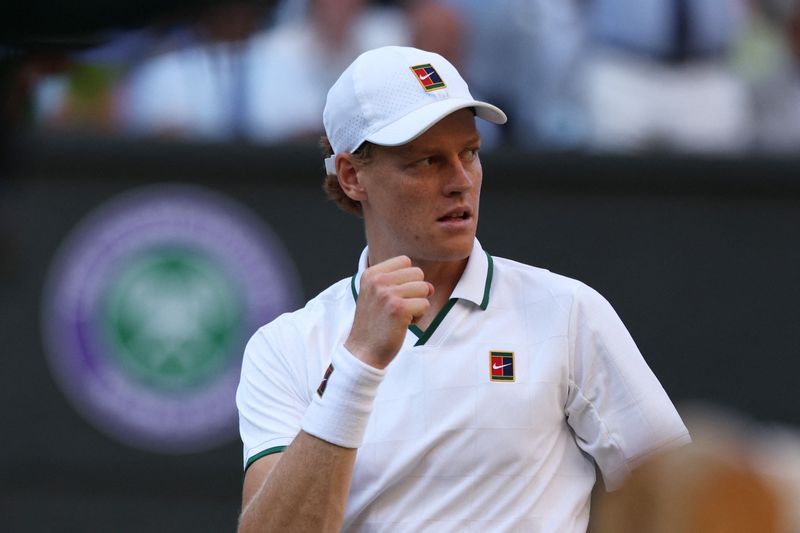
Jannik Sinner has cemented his status as one of tennis's emerging superpowers by retaining the Wimbledon title with a hard-fought victory over Alexander Zverev in the final on Sunday, securing a 6-7(7) 7-6(2) 6-3 6-4 scoreline in a contest that tested the Italian's nerve and resolve across nearly four hours of compelling grasscourt tennis. The win represents Sinner's fifth Grand Slam title overall and elevates him into an elite historical bracket—he becomes merely the tenth man in the professional era to successfully defend a Wimbledon crown, a milestone that underscores both the rarity and significance of back-to-back victories at one of sport's most prestigious tournaments.
The significance of Sinner's achievement extends beyond the immediate satisfaction of claiming another major title. His dominance over Zverev has now reached a remarkable ten consecutive victories, a streak that speaks to the Italian's consistency and mental fortitude when the stakes reach their highest level. At twenty-four years old, Sinner is rapidly accumulating the Grand Slam credentials necessary to position himself among the generation's elite competitors, though he remains behind his chief rival Carlos Alcaraz, who currently holds seven major titles. The trajectory of Sinner's career over the past eighteen months has established him as a genuine threat to Alcaraz's supremacy, particularly on the grass surfaces where precision and movement beneath pressure prove decisive factors.
The final itself unfolded as a masterclass in contrasts, with the opening set developing into an extended tactical and physical battle. Both players demonstrated exceptional ball-striking during the opening twelve games, refusing to surrender ground despite warm, windswept conditions that placed a premium on court positioning and serve placement. Zverev eventually seized the initiative through his powerful forehand, striking a decisive winner to claim the tiebreak and register his competitive response to Sinner's overwhelming dominance in their head-to-head record. The German's celebration, complete with an emphatic crouch, suggested he recognised the psychological importance of matching his opponent's elevated performance levels.
The momentum appeared to shift decisively in the second set as Sinner recovered his rhythm and reasserted control over the match's emotional tempo. Where Zverev had displayed cleaner execution in the first set, the Italian's intensity manifestly increased, enabling him to secure the second-set tiebreak through superior groundstroke consistency and a palpable rise in competitive fire. Zverev's visible frustration during this period indicated mounting pressure as he realised the difficult nature of sustaining the intensity required to overcome a player of Sinner's calibre during a Grand Slam final.
The match's pivotal moment materialised during the third set when Zverev, attempting to create a break point opportunity, was fatefully wrong-footed by a Sinner drop shot. The resulting fall, where Zverev collided with the grass surface and immediately seized his right knee in apparent agony, created a critical juncture that threatened to fundamentally alter the contest's trajectory. Centre Court spectators visibly reacted to Zverev's distress as he lay supine on the threadbare turf, yet the German's competitive spirit compelled him to continue despite obvious discomfort. However, the physical toll became apparent when Sinner immediately capitalised in the subsequent game, breaking for a 5-3 advantage and prompting Zverev's racket slam in frustration—a rare display of emotional rupture that underscored his awareness that opportunity was slipping away.
With Zverev's movement increasingly compromised by the knee injury sustained during the third set, Sinner methodically executed his fourth-set strategy, securing an additional break at 4-3 and maintaining the pressure through the concluding games. The Italian's composure during this crucial phase demonstrated the mental resilience that characterises champions of his calibre, particularly when opponents face physical adversity that threatens to overshadow competitive efforts. Sinner's eventual collapse to the turf upon victory completion provided an emotional counterpoint to his typically reserved demeanour, suggesting the genuine psychological investment he had directed toward retaining his championship status at tennis's most iconic venue.
Zverev's post-match remarks, delivered with gracious professionalism despite evident disappointment, acknowledged both Sinner's superiority and the particular anguish of losing a fourth Grand Slam final. The German's joking reference to their personal rivalry and his self-deprecating acknowledgment of losing count of consecutive defeats against Sinner reflected the sportsmanship that generally characterises interactions between top-tier professionals, even when competitive outcomes disappoint. His observation that Sinner has demonstrated he represents the world's finest player provided testament to the Italian's comprehensive performance across the championship fortnight and his capacity to elevate his standards during the sport's most significant occasions.
The implications of Sinner's successful Wimbledon defence extend throughout the professional tennis landscape. His accumulation of five Grand Slam titles at such a relatively young age positions him as a generational talent whose peak years remain substantially ahead. The mental template he has established—defending major titles, extended winning streaks against elite competitors, and performance consistency across surface types—suggests that Alcaraz's current advantage in major titles may not prove insurmountable over the coming years. For Southeast Asian tennis enthusiasts and emerging players observing elite-level competition, Sinner's trajectory provides instructive lessons regarding the combination of technical excellence, physical conditioning, and competitive mentality necessary to succeed at sport's highest echelons.
Sinner's comments following victory, delivered while holding the pineapple-topped Challenge Cup, emphasised the emotional significance of competing at Centre Court and defending the title. His reflection on the improbability of accumulating multiple Wimbledon victories and his explicit gratitude for spectator support indicated genuine appreciation for the privilege of performing at tennis's spiritual home. The Italian's acknowledgment that a Sunday morning final represents a uniquely special occasion in professional sport reflects the perspective of an athlete acutely aware that major championship moments, regardless of frequency, retain their capacity to inspire profound emotion and gratification.
Looking forward, Sinner's successful Wimbledon defence establishes him as the clear favourite for upcoming grass-season tournaments and positions him favourably in the race for year-end number-one ranking. His capacity to win back-to-back Grand Slams at distinct venues suggests versatility across tournament formats and surfaces, attributes essential for athletes seeking to accumulate the number of majors that define all-time greatness. As professional tennis continues its transitional phase with younger players challenging the establishment order, Sinner's performances at Wimbledon reinforce that generational change is progressing with remarkable speed, and the sport's competitive landscape will be shaped substantially by his rivalry with Alcaraz and their respective pursuits of Grand Slam supremacy.

