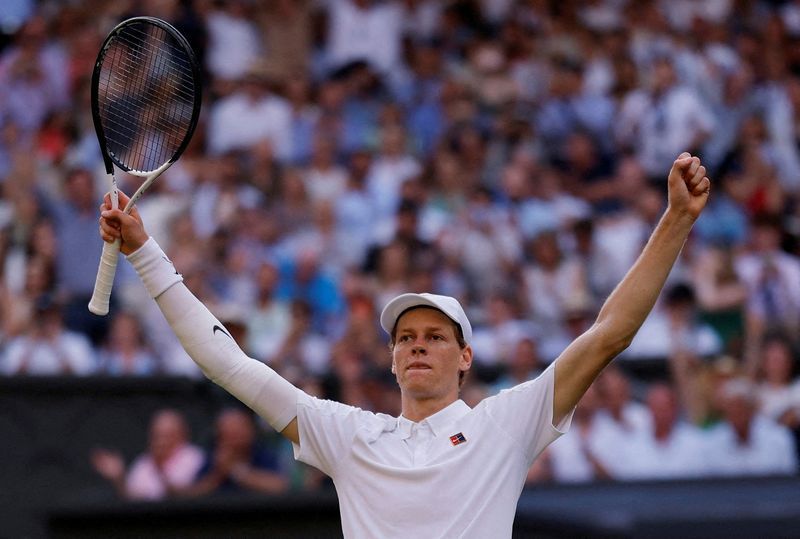
Jannik Sinner's invincibility has been punctured at precisely the wrong moment. The world's top-ranked player returns to Wimbledon as the defending champion, yet his credentials are now under scrutiny following a disappointing collapse at Roland Garros last month that abruptly ended a 30-match winning streak stretching back to February. With the grasscourt season now upon professional tennis, the 24-year-old Italian faces the dual challenge of resetting his game and convincing observers that last month's troubles were merely a temporary blip rather than a portent of systemic vulnerabilities.
Sinner's dominance on clay throughout the spring had seemed almost unassailable. He dispatched opponents with mechanical precision and won tournament after tournament without apparent resistance, establishing himself as the clear favourite for every major championship. That aura of superiority evaporated in Paris when physical ailments mounted and his body finally protested against the relentless schedule he had maintained. The second-round exit shocked the sporting world and prompted legitimate questions about his capacity to handle the mounting pressure and fatigue that accompany sustained excellence at the sport's highest level. Whether such concerns prove warranted remains an open question, particularly given that Sinner declined to enter warm-up tournaments before Wimbledon begins on Monday at the All England Club.
Seven-times Grand Slam champion Mats Wilander, speaking to La Gazzetta dello Sport, offered a sympathetic interpretation of the French Open reversal. According to Wilander, Sinner's decline stemmed primarily from accumulated exhaustion rather than a fundamental flaw in his technique or mental resilience. The Italian had competed almost continuously for two months leading into Roland Garros with minimal recovery intervals and insufficient opportunity for intensive training sessions, a combination that ultimately depleted his physical reserves when the tournament demanded maximum intensity. Wilander observed that Sinner now appears adequately rested and should arrive at Wimbledon in considerably better condition than he managed in Paris. However, the veteran analyst cautioned that grass courts present their own distinct challenges and uncertainties, suggesting that even a refreshed Sinner cannot take the title as guaranteed.
The absence of injured defending champion Carlos Alcaraz, who has won Wimbledon in each of the past two years, has fundamentally altered the competitive landscape. Alcaraz's removal eliminates one of the few players genuinely capable of dominating on grass with the same comprehensive skill set that defines Sinner's superiority on other surfaces. This vacancy has created space for alternative contenders to harbour realistic ambitions, yet it simultaneously places immense pressure on Sinner to consolidate his hold on the sport's elite tier.
Novak Djokovic emerges as perhaps the most formidable challenger to Sinner's throne. The 39-year-old Serbian has transformed his grasscourt expertise into a career-long advantage, and his movement patterns combined with his exceptional return-of-serve capabilities render him extraordinarily dangerous on the sport's fastest surface. Djokovic continues his pursuit of an elusive 25th Grand Slam trophy to stand alone atop tennis's all-time honours list, and he simultaneously hunts for an eighth Wimbledon crown that would match Roger Federer's record. Time operates against Djokovic given his advancing age, yet Wimbledon represents precisely the type of venue where his accumulated experience and refined understanding of grasscourt dynamics could prove decisive.
Djokovic's own French Open campaign ended disappointingly in the early rounds, yet this setback paradoxically enhances rather than diminishes his Wimbledon credentials. Former three-times Wimbledon finalist Andy Roddick suggested on his podcast that Djokovic approaches the All England Club fortnight with calculated determination. The Serb understands that his time for assembling additional Grand Slam titles grows shorter with each passing season, and Wimbledon represents a venue where his tactical acumen and sustained movement patterns provide comparative advantages. Roddick noted that Djokovic possesses the mental tools required to convince himself that a championship remains achievable, particularly given that he last won the title merely four years ago and retains the grasscourt craft necessary for victory.
Alexander Zverev arrives at Wimbledon with momentum entirely different from his usual positioning within the title conversation. The German claimed his first Grand Slam championship at Roland Garros, overcoming years of frustration and repeated semi-final exits to finally capture a major trophy. At 29 years old, Zverev demonstrated that the clay-court mastery sufficient for a French Open victory can transfer effectively onto the faster grass surface if a player possesses the requisite technical foundations. Fellow German and six-times Grand Slam champion Boris Becker endorsed Zverev as a realistic title contender, suggesting that some observers now regard the German as the primary favourite given Alcaraz's injury and uncertainties surrounding Sinner's physical condition. Becker specifically highlighted Zverev's powerful serve as a significant asset on grass, noting that an elite serving performance in grasscourt tennis virtually guarantees reaching the semi-final stages where opportunities proliferate.
Becker's endorsement reflects genuine analytical reasoning rather than mere national bias. Zverev has transformed into a more complete player over recent seasons, and his Grand Slam breakthrough at Roland Garros demonstrates that he has transcended the unfortunate pattern of underperformance in major championships that characterised much of his career. The combination of psychological relief accompanying his first major title, accumulated experience managing tournament pressure, and the confidence derived from knowing he can win at the highest level may produce a player significantly more dangerous than previous versions of Zverev.
Beyond the frontline contenders, a wider cohort of challengers possesses the technical capabilities to trouble favourites and generate surprises. American Ben Shelton, along with fellow Americans Taylor Fritz and Frances Tiafoe, each commands the weapons and tactical flexibility necessary to defeat elite players across individual matches. French Open runner-up Flavio Cobolli represents the next generational wave capable of announcing his arrival among tennis's permanent elite tier. The broader competitive depth suggests that Wimbledon 2024 may prove significantly more open than tournaments where Sinner or Alcaraz typically dominate proceedings.
For Sinner specifically, Wimbledon offers simultaneously a vindication and a final examination. The Italian can demonstrate that his French Open collapse represented merely an aberration caused by physical fatigue rather than a fundamental vulnerability, or he can confirm emerging doubts about his capacity for sustained dominance across different surfaces and circumstances. The grasscourt environment, with its emphasis on speed and tactical adjustment, will test whether Sinner's clay-court refinement translates effectively onto faster courts where risk-taking and aggressive shot selection become paramount. How he responds to this examination will substantially influence perceptions of his standing within professional tennis and determine whether his early-season supremacy represented genuine excellence or a circumstantial phenomenon dependent on specific conditions and matchups.

