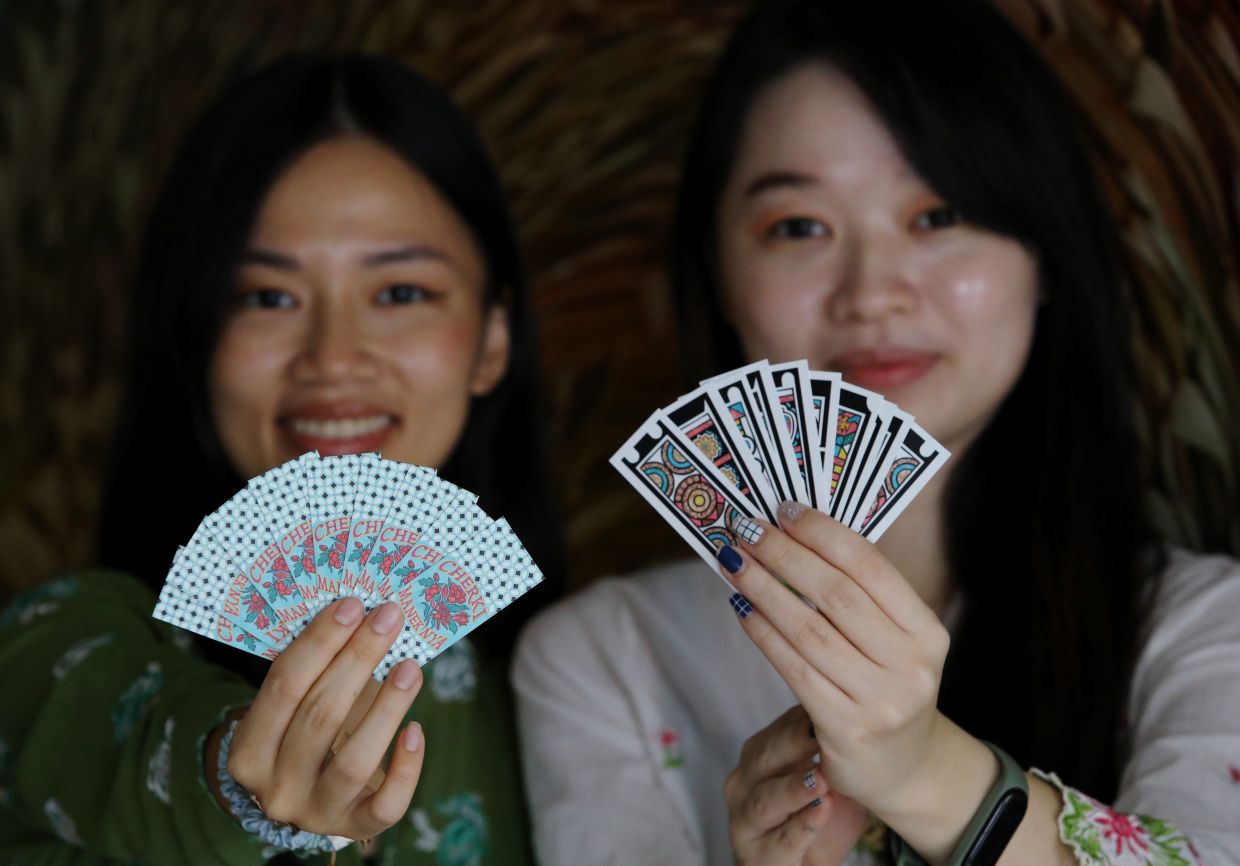
In the vast tapestry of Peranakan heritage—from intricately beaded slippers to the aromatic depths of ayam buah keluak—one cultural gem has slipped quietly from living memory: the card game Cherki. Sisters Lee Swee Lin, 32, and Lee Swee May, 31, are determined to change that. The Melaka-born duo, who already operate a Kuala Lumpur-based enterprise crafting traditional Peranakan beaded footwear and decorative pieces, have reimagined Cherki with bold colours and contemporary illustrations, marrying modern aesthetics with traditional motifs to create something both authentically rooted and genuinely appealing to today's generation.
Cherki occupies a unique position within Peranakan culture, distinct from the more visible and celebrated culinary and sartorial traditions. Historically, the game was played across Baba Nyonya households throughout the region, particularly in Singapore, Malaysia, Indonesia and Thailand, where it was known by various names including Ceki, Chi Kee or Koa. The traditional deck consists of sixty cards arranged in thirty different patterns, each pattern repeated twice, divided into three suits—coins, strings and myriads—with values ranging from one to nine plus three special cards. In Malay, players referred to the cards as daun ceki, with daun meaning "leaf," a term the Peranakan community eventually adopted. Despite its prevalence in earlier generations, the game has become increasingly obscure, with many younger and even middle-aged Peranakans unable to play or even recognise the rules.
The sisters' decision to revive Cherki was not merely commercial opportunism but deeply personal. Their paternal grandmother, Deo Yeok Kim, served as the primary inspiration and custodian of their cultural knowledge. Lee Swee Lin reflects that their late grandmother's influence permeated every aspect of their upbringing in Melaka, extending far beyond gameplay to encompass food, storytelling, language and the daily embodiment of tradition. This foundational relationship shaped not only their understanding of Peranakan heritage but also their beading business, which emerged from techniques learned from their mother and grandmother. The recent passing of their grandmother crystallised their realisation that without active preservation efforts, such knowledge risks disappearing entirely with each generation.
The cultural erosion troubling the Lee sisters mirrors broader challenges facing the Peranakan community. According to Persatuan Peranakan Baba Nyonya Malaysia (PPBNM) deputy president Lee Yuen Thien, 36, younger Peranakans increasingly find themselves disconnected from ancestral traditions due to competing priorities and lifestyle shifts. Modern careers demand substantial time investment, leaving cultural activities—which many do not perceive as urgent or practical—neglected. The association currently comprises three thousand members, with estimates suggesting ten to fifteen thousand Peranakans nationwide, yet the demographic skews heavily toward older cohorts maintaining active engagement with heritage practices. A 2022 academic study examining cultural transmission between original and newer descendants of Baba Nyonya communities in Malacca underscored this reality, noting that younger descendants face mounting exposure to global pop culture and external influences that crowd out traditional knowledge.
Geographic dispersion has compounded these challenges substantially. Many Peranakans have migrated beyond ancestral strongholds in Melaka and Penang, where intergenerational knowledge transfer historically occurred most naturally within family and community networks. Mixed marriages and evolving lifestyles have further reshaped transmission patterns, creating distance between younger Peranakans and the cultural frameworks that once organised daily life. Tan, manager of the Baba & Nyonya Heritage Museum Melaka, acknowledges this reality whilst advocating for cultural evolution rather than rigid preservation. His perspective suggests that heritage need not remain static; rather, society must consciously foster awareness of ancestral identity among younger generations to sustain cultural continuity in transformed contexts.
Understanding Cherki's origins illuminates why its revival carries significance beyond mere nostalgia. Historical records trace card games to China's Tang Dynasty in the ninth century, where documents reference a "leaf game." These games subsequently travelled westward via ancient trading routes, reaching Europe by the fourteenth century. The path by which Cherki reached Southeast Asian Peranakan communities remains connected to these broader historical exchanges, making the game itself a tangible link to centuries of cross-cultural interaction. When Peranakan players called the cards daun ceki, they participated in a linguistic and cultural adaptation that remains visible today.
The Lee sisters commenced their research and design development in 2024, working collaboratively with a small design team to modernise the traditional deck. Employing digital tools including Procreate and Adobe Illustrator, they introduced vibrant colour palettes and contemporary visual language whilst scrupulously preserving the underlying structure and symbolism of the original game. Critically, they expanded the deck to include sixty cards repeated four times rather than twice, maintaining the three traditional suits whilst replacing the original special cards—white flower, red flower and old thousand—with butterfly, dragon and phoenix motifs that carry symbolic weight within Peranakan culture.
Each numerical card in the modernised deck features distinct Peranakan symbols layered with cultural meaning. The kantan, a fragrant flower central to Nyonya cuisine, adorns certain cards, whilst chupu—traditional porcelain jars used for serving food—appears on others. Kerongsang, the jewelled clasp securing kebaya garments, and gelang, the bracelets worn by Nyonya women, further populate the deck with material culture references that younger players may encounter whilst learning the game's rules. This design strategy accomplishes multiple objectives simultaneously: it educates players about Peranakan material culture, grounds the game experience in authentic aesthetic traditions and creates visual interest sufficient to compete with digital entertainment.
Swee May emphasises that their central challenge involved making Cherki feel contemporary and inviting rather than relegating it to historical artefact status. The modernised cards retain authentic Peranakan patterns and traditional structure whilst presenting themselves as gaming equipment genuinely worth extracting from storage to play with friends. By rendering the cards visually appealing and supplementing them with clearer instructional materials designed for novice players, the sisters have lowered barriers to engagement. Their approach recognises a fundamental truth: heritage preservation succeeds not through demanding people value tradition abstractly but by creating experiences that prove enjoyable and meaningful in present contexts. A beautifully illustrated, accessible Cherki deck occupies a different psychological and social space than an opaque set of plainly printed cards associated exclusively with grandmothers' generations.
The implications of this project extend beyond a single card game into broader questions about how communities navigate cultural transmission in globalised contexts. The Peranakan experience—with its history of migration, adaptation and synthesis—has always involved creative reinterpretation rather than unchanged inheritance. The Lee sisters' modernised Cherki represents continuity with this adaptive tradition, not a departure from it. Their work suggests that rather than positioning heritage and modernity in opposition, younger community members might find meaningful connection by thoughtfully evolving cultural forms to speak to contemporary sensibilities whilst maintaining substantive links to ancestral knowledge.
For Malaysia's diverse communities, the Cherki revival offers instructive lessons about grassroots cultural preservation. Large-scale institutional efforts—museums, academic studies, heritage associations—remain valuable but insufficient without engagement from younger community members genuinely motivated to learn and share traditions. The Lee sisters' project gains force precisely because it emerges from personal investment, family memory and commercial creativity rather than top-down mandate. As Lee Swee Lin articulates, reviving Cherki keeps alive stories, traditions and cultural identity that might otherwise vanish, leaving younger Peranakans severed from knowledge systems that formerly integrated them into community and meaning-making. Whether through card games or other cultural forms, such revival efforts ultimately serve all Malaysians by sustaining the layered heritage that defines the nation's distinctive character.

