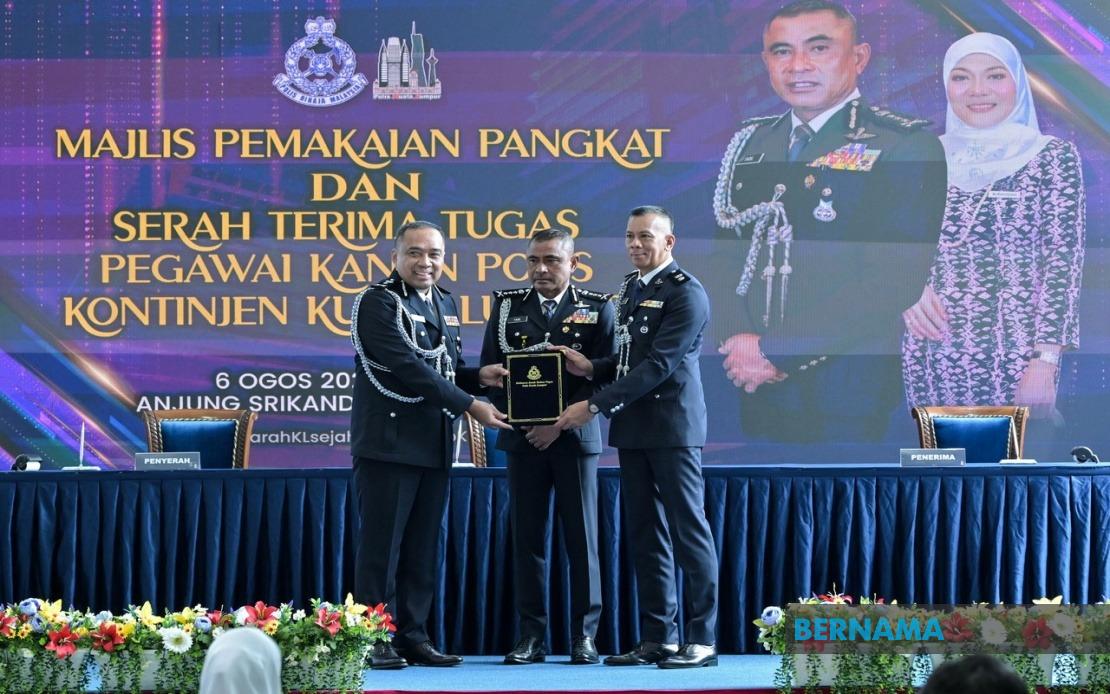
Kuala Lumpur's police establishment witnessed a significant reshuffling of its command structure this week as Datuk Fadil Marsus, the city's police chief, oversaw the formal transfer of duties across six critical senior positions at the Kuala Lumpur police contingent headquarters. The ceremony underscored the force's commitment to maintaining leadership continuity while introducing fresh perspectives into the organisation's operational framework.
The repositioning affected multiple layers of the force's investigative and operational machinery. Among the most notable changes was SAC Zulkarnain Samsudin's departure from the Criminal Investigation Department helm, with SAC Sazlee Adam assuming the role. In parallel, the Narcotics Crime Investigation Department saw ACP Kee Hang Kee step into leadership following SAC Haslah Bachok's handover, signalling potential shifts in the force's approach to drug enforcement at a senior level.
Geographic command structures within the capital also underwent significant transitions. Supt Nuzulan Mohd Din took charge of the Dang Wangi district police operations, replacing SAC Sazlee Adam who had moved to his new CID posting. Separately, Supt Jasni Zolpa assumed command of Sentul district after SAC Basri Sagoni's reassignment, reflecting the kind of internal mobility that keeps the force dynamic while distributing experienced officers across priority jurisdictions.
Special Branch functions, which carry particular weight in Malaysia's security architecture, also underwent reconfiguration. The deputy chief position responsible for Intelligence and Operations transferred from SAC Kamaruzaman Md Alib to ACP Saefuddin @ Mohd Fitri Abdul Rahman, while Supt Ong Seng Keong assumed the CID's Intelligence and Operations deputy chief portfolio from SAC Zulkarnain Samsudin. These appointments reflect the force's recognition that intelligence gathering and operational coordination remain central to countering evolving security threats.
In his remarks at the ceremony, Fadil emphasised that these promotions represented far more than routine administrative adjustments. He characterised them as affirmations of individual officers' performance records and their dedication to police work, while simultaneously reflecting the institutional confidence being placed in them to shoulder expanded responsibilities. His message crystallised a recurring theme in Malaysian police leadership communications: that advancement is earned through demonstrated capability and commitment to professional standards.
The police chief articulated a broader organisational philosophy regarding such transitions. He described the handover process as a mechanism for preserving institutional continuity within the Royal Malaysia Police while simultaneously driving the organisation forward through the introduction of new operational perspectives and methodologies. This balancing act between stability and innovation represents a persistent challenge for security forces navigating rapidly changing threat landscapes, particularly in urban environments like Kuala Lumpur where crime patterns and investigative priorities evolve constantly.
Fadil's comments also touched on the strategic environment confronting Kuala Lumpur's police contingent. He acknowledged that contemporary security challenges have grown increasingly intricate, demanding not merely tactical responses but sophisticated investigative methodologies and preventive strategies. He called upon all personnel under his command to reinvigorate their commitment to fundamental police functions: crime suppression, drug abuse reduction, enhanced investigative capabilities, and heightened operational preparedness.
Community engagement featured prominently in Fadil's vision for the force moving forward. He stressed the importance of strengthening relations between police and residents, recognising that public cooperation remains indispensable for effective law enforcement. This emphasis reflects growing recognition within Malaysian law enforcement that security cannot be achieved through police action alone, but requires sustained community partnership and public confidence in police integrity.
The ceremony's attendance included Datuk Mohd Azani Omar, the Kuala Lumpur deputy police chief, underscoring the event's significance within the contingent's organisational hierarchy. Such formal ceremonies, while sometimes dismissed as procedural formalities, carry symbolic weight within paramilitary organisations, marking transitions of authority and reinforcing the legitimacy of new appointments through structured ritual.
These changes arrive at a time when Malaysian police forces face mounting scrutiny regarding operational effectiveness, investigative thoroughness, and the capacity to address increasingly sophisticated criminal enterprises. The shuffling of senior talent across CID, NCID, and district commands suggests strategic thinking about where expertise is needed most. The elevation of intelligence and operations functions through the Special Branch appointments indicates heightened emphasis on preventive security work alongside reactive crime investigation.
For the officers involved, these postings represent career advancement within Malaysia's police hierarchy, though they also carry substantial professional demands. The Kuala Lumpur contingent, serving the nation's capital and commercial heart, investigates high-profile cases and operates in an environment where police performance directly affects both public safety perceptions and investor confidence in the city's stability.
These transitions will likely influence operational priorities across Kuala Lumpur's police operations over coming months. New leadership typically brings adjusted resource allocation, revised enforcement strategies, and potentially different investigative emphasis within their respective domains. The substance of these changes will become apparent through shift patterns in crime statistics, drug seizure figures, and public reporting of police operations across the contingent's area of responsibility.

