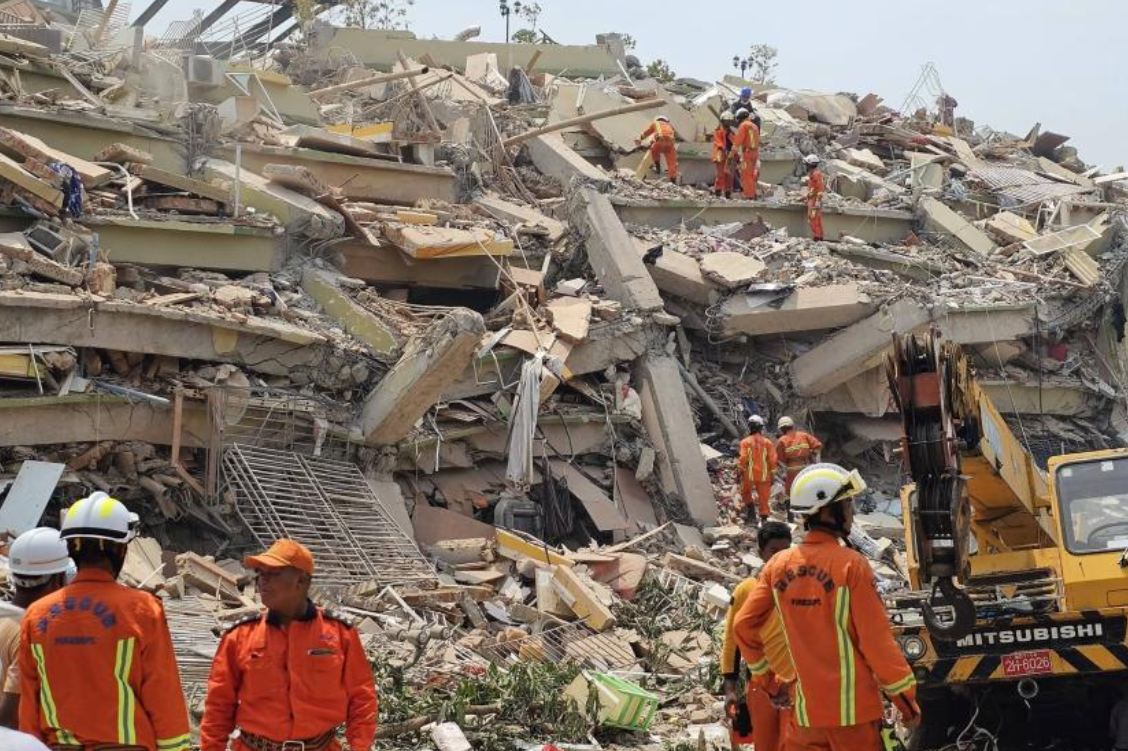
A Myanmar court has handed down a five-year prison sentence with hard labour to U Naing Htun Lin, the owner of Sky Villa Condominium, following the catastrophic collapse of the 11-storey building during the Mandalay earthquake. The Aungmyaythazan Township Court issued the conviction on June 23, holding the developer accountable under Section 304-A of the Penal Code, which addresses deaths caused by negligence. The case represents a significant legal response to one of the most devastating structural failures stemming from the natural disaster, which claimed over 200 lives at the single location alone.
U Naing Htun Lin faced formal charges filed on February 10 at the Aungmyaythazan Township Court, with the case originating from investigations conducted by the No. (1) Area Police Station in Aungmyaythazan Township. The developer was initially released on bail pending trial, a standard procedure that allowed him to maintain liberty while the legal process unfolded. This arrangement proved temporary; on March 17, authorities revoked his bail status, remanding him into custody to ensure his continued presence throughout the trial proceedings. The reversal underscored the severity with which the court regarded the charges and the public interest in prosecuting the case.
The prosecution was led by U Zaw Moe Aung, a staff officer from the Special Investigation Department, who acted as the plaintiff throughout the proceedings. This official involvement reflects the criminal nature of the investigation, distinguishing it from civil liability actions that victims' families might pursue separately. The legal framework invoked—Section 304-A of the Penal Code—focuses on establishing whether negligence in construction, maintenance, or other professional responsibilities contributed to the deaths. This particular charge does not require proving intentional wrongdoing, only demonstrating that the defendant's conduct fell below acceptable standards for someone in his position.
The conviction has triggered broader legal complications, with both prosecution and defence pursuing appeals and revision proceedings to contest the verdict. The Aungmyaythazan District Court has requested the case file for review under Criminal Revision Case No. 39Ka/2026, indicating that higher-level judicial scrutiny is ongoing. These appellate processes suggest the case remains contentious, with significant questions about liability, proper construction standards, and the adequacy of building regulations in Myanmar continuing to be contested through the courts. For observers monitoring Myanmar's legal system and corporate accountability, the appellate stage represents a crucial test of judicial consistency.
The Sky Villa condominium, positioned between 21st and 22nd Streets on 60th Street in Aungmyaythazan Township, stood as one of Mandalay's more prominent residential developments. Its collapse during the earthquake resulted in the recovery of more than 200 bodies from the rubble, making it statistically the single deadliest building failure attributable to that seismic event. Engineers and disaster analysts have pointed to construction quality, design standards, and material compliance as potential factors in the structure's failure, though detailed technical investigations have not been widely publicised. The building's prominence in Mandalay's commercial landscape amplified the tragedy's impact on public consciousness and prompted calls for stricter enforcement of building codes across Myanmar.
NTL Construction Company, which undertook the Sky Villa project, was operated by U Naing Htun Lin and his wife Daw Thet Thet Khine, who served as managing director. The company's role in designing, constructing, and overseeing the condominium's development placed it at the centre of questions about professional responsibility and industry standards. Following the disaster, the company's representatives took limited measures toward reconciliation with affected families, a gesture that some viewed as acknowledgment of responsibility while others criticised as insufficient given the scale of loss.
In the aftermath of the collapse, Daw Thet Thet Khine, the managing director of NTL Construction Company, participated in ceremonial events held at a monastery pavilion on 19th Street. During three separate gatherings, the organisers offered formal apologies to the families of deceased victims and distributed monetary compensation of 10 million kyats per fatality. While these gestures represented financial accountability to grieving families, they occurred outside the formal legal process and did not eliminate criminal charges against the company's owner. The compensation payments, though substantial in local terms, underscored the financial capacity of the development company and raised questions about whether such remedies adequately address the scale of preventable loss.
The sentencing carries implications for Myanmar's construction industry and corporate liability frameworks. Developers and construction firms across the country are now confronted with concrete evidence that courts will prosecute negligence resulting in catastrophic building failures, establishing precedent for future cases. However, the ongoing appeals process means that the legal principles established by this conviction remain unsettled. If higher courts overturn or substantially modify the sentence, the chilling effect on corporate accountability could be similarly altered, potentially emboldening other developers to view regulatory compliance more permissively.
For Malaysian and Southeast Asian observers, the Sky Villa case illustrates broader challenges facing the region's building standards and enforcement mechanisms. Myanmar's experience reflects vulnerabilities common across developing economies, where rapid urbanisation, competing commercial pressures, and sometimes inconsistent regulatory oversight can compromise structural integrity. Malaysia, by contrast, maintains more rigorous building codes and inspection regimes, yet periodic failures still occur. The Sky Villa precedent demonstrates that criminal accountability—when applied—can provide leverage for improving industry practices, though success ultimately depends on consistent enforcement across all projects rather than prosecution following catastrophic failures.
The case also highlights tensions between corporate accountability and the complexities of prosecuting technical negligence in seismic contexts. Determining precisely which construction shortcuts, design failures, or material deficiencies caused the collapse requires sophisticated engineering forensics that may not always be conclusively available. Courts operating in environments with limited technical expertise face challenges in weighing expert testimony and establishing causation with sufficient clarity for criminal conviction. The conviction of U Naing Htun Lin reflects judicial confidence that negligence occurred, though the appellate process will test whether that confidence withstands closer scrutiny of the technical and legal evidence.

