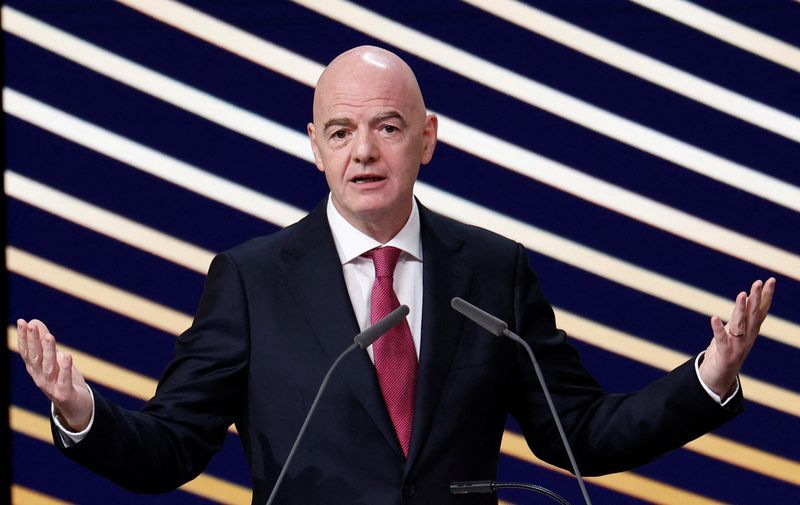
Gianni Infantino's path to extending his FIFA presidency appears to run through the football associations of developing nations rather than the world's traditional soccer superpowers. With regional confederations UEFA and CONCACAF having declared no confidence in his leadership following the collapse of a controversial private equity scheme for the World Cup, the Swiss administrator is navigating his most serious political challenge since taking office a decade ago. Yet his strongest support may come from nations like Bhutan and Vanuatu — countries that have never hosted or even qualified for a World Cup, but have experienced transformative benefits under his stewardship of FIFA's vast financial resources.
The crisis intensified when Wales became the first national football federation to formally withdraw its backing for Infantino, while UEFA announced it was considering legal action against him over the failed private equity proposal. Despite these setbacks, Infantino confirmed in April that he intends to contest a fourth term at next year's Congress. The situation remains fluid: opponents seeking his removal can trigger an Extraordinary Congress with support from just 20 per cent of FIFA's 211 member associations, a threshold well within reach if major confederations unite. UEFA alone possesses the theoretical power to force such a vote with unanimous support from its 55 members, all of whom pledged to boycott FIFA tournaments if the stake sale had proceeded.
Yet converting opposition into Infantino's actual departure presents a far more complicated arithmetic. FIFA's governance structure grants equal voting power to all 211 member nations, regardless of their economic strength, player development capacity, or sporting prestige. This democratic principle, while seemingly equitable on paper, creates an asymmetry that favours sitting executives who have cultivated relationships with the majority. Infantino's strategic engagement with football's peripheral nations has built a political cushion that even his European detractors cannot easily penetrate. The question facing FIFA's discontented members is whether moral authority and sporting legitimacy can overcome the financial dependency he has strategically cultivated.
The financial architecture underpinning this political strategy is substantial and deliberate. Throughout the current 2023-26 World Cup cycle, FIFA member associations have been able to claim up to three million dollars for soccer development projects — an increase of one million dollars compared to the previous four-year period. For wealthy nations with established professional leagues and robust domestic revenue streams, such grants represent a rounding error in annual budgets. For emerging football nations, however, these funds constitute the primary mechanism through which they can develop training facilities, professionalize coaching, and create pathways for players to compete internationally.
Vanuatu exemplifies how Infantino's financial commitment has reshaped football in the Pacific region. The island nation of approximately 340,000 people ranks 160th globally in FIFA's standings, yet its football association president Lambert Maltock holds one of eight vice-president seats on FIFA's Executive Council — a position of genuine influence at the organization's highest decision-making level. The tangible investment has been equally impressive: FIFA granted Vanuatu 4.15 million dollars specifically to construct a 6,500-seat stadium in the capital Port Vila, completed in 2022. For context, this represents approximately twelve dollars per capita invested into a single sports facility, a proportion few developing nations have experienced from international governing bodies.
Brian Kaltak, Vanuatu's first professional footballer playing for Perth Glory in Australia, articulated the perspective of beneficiary nations with unusual candour. He credited Infantino not merely with securing funding but with elevating Vanuatu's representation within FIFA's power structures and using his influence to create development opportunities across the Global South. From this viewpoint, Infantino has fundamentally reoriented FIFA's distribution mechanisms toward nations previously marginalized by soccer's traditional power brokers. The development grants finance infrastructure, coaching education, and competitive opportunities that would otherwise remain unavailable to third-world football associations operating on minimal domestic revenue.
This pattern repeats across Asia, Africa, the Caribbean, and the Pacific. FIFA's funding has financed training pitches in remote locations, gymnasium construction, youth development programs, and international tournament participation costs that national associations would struggle to absorb independently. The cumulative effect has been the creation of a constituency of nations — often with minimal direct influence over global soccer policy — whose football systems have become structurally dependent on FIFA's patronage. These associations have genuine incentives to preserve the institutional arrangements and leadership that have directed resources in their direction.
Critics, however, identify in this funding model a problematic political economy that transforms FIFA's financial power into entrenched political influence. By concentrating development investment in smaller nations while maintaining discretionary control over allocations, the argument goes, FIFA's leadership has created a system wherein removing an incumbent becomes extraordinarily difficult. Member associations face implicit pressure: voting to depose the president who controls access to development funds carries apparent risks. This dynamic does not require explicit coercion; it operates through structural incentives embedded in the financial relationship between FIFA and its membership.
The mathematics of actually removing Infantino illustrate the challenge. An Extraordinary Congress requires majority support to unseat a sitting president, not merely the twenty per cent needed to trigger the vote itself. UEFA's 55 member nations could theoretically coalesce with CONCACAF's support and substantial backing from other confederations and still potentially fall short. Many African, Asian, and Pacific nations may simply lack compelling reason to vote against their interests as they perceive them. Whether this constitutes legitimate democratic deference to member preferences or an unhealthy concentration of power through financial patronage remains contested among FIFA observers and reform advocates.
Infantino's most likely path to surviving this political crisis depends less on convincing France, Spain, or England than on maintaining support from associations whose football development depends on his continued presence and goodwill. The irony for those seeking FIFA reform is that the organization's egalitarian voting structure — theoretically designed to give voice to smaller nations — has instead become a bulwark protecting an incumbent whose political strategy has explicitly targeted those same smaller nations with targeted financial investment. The coming months will reveal whether sporting principle and institutional reform arguments can overcome the structural incentives Infantino has spent a decade constructing.

