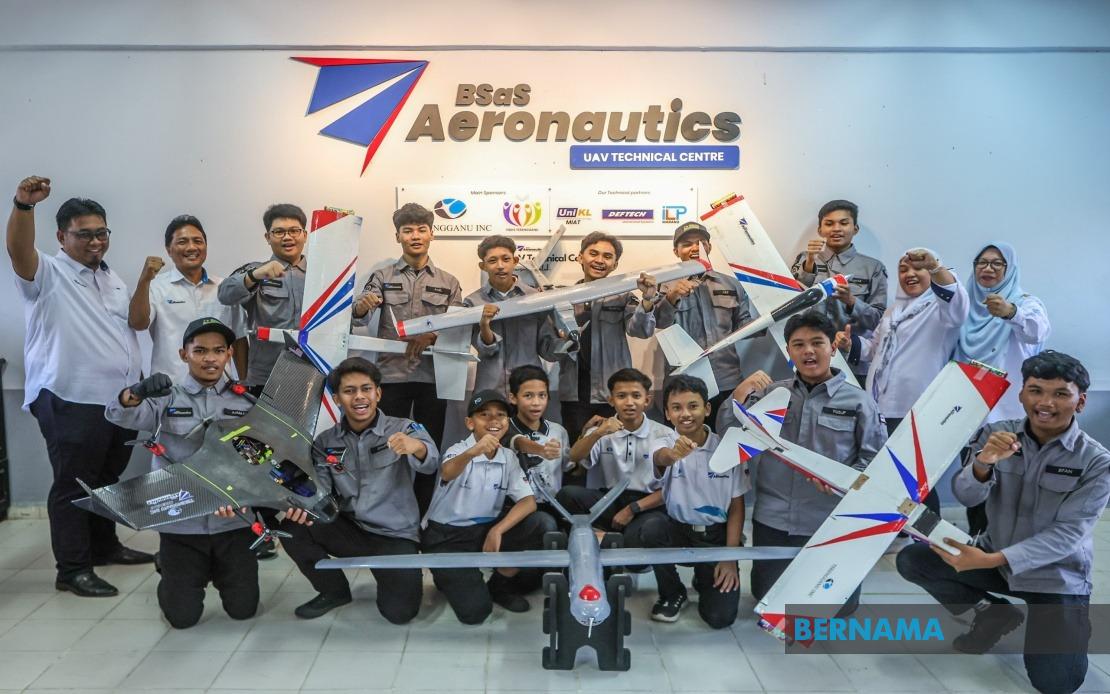
Thirty-five students at Sekolah Menengah Kebangsaan Bukit Sawa in Marang have become part of an ambitious educational initiative that blurs the line between classroom learning and advanced engineering practice. Under the guidance of English teacher Badrul Hisyam Zakaria and two colleagues, these young people have constructed more than five operational unmanned aerial vehicles since the TI-BSAS UAV In School programme launched in 2023. Each completed aircraft represents an investment of between RM6,000 and RM10,000, reflecting the genuine industrial-standard construction methods employed throughout the project.
What sets this initiative apart from conventional science curricula is its commitment to authentic engineering principles. Rather than relying on simplified kits or theoretical exercises, students work with the same techniques and materials used in professional aviation manufacturing, albeit adapted to manageable scales. The UAVs incorporate Global Positioning System navigation technology for autonomous flight and target tracking, creating functional aircraft that operate with real-world capabilities. This hands-on immersion gives participants genuine mechanical and aeronautical competency well before university study, positioning them as informed practitioners rather than novices entering engineering disciplines.
The programme's ambitions have expanded beyond basic GPS-guided systems. Development teams are currently engineering UAVs equipped with artificial intelligence capable of visual target recognition, representing a significant technological leap from the programmed navigation approaches in existing models. This progression reflects strategic thinking about future demands in the aviation and defence technology sectors, where autonomous systems with sophisticated sensing capabilities will dominate. By introducing students to cutting-edge applications during secondary education, the initiative cultivates problem-solving abilities in emerging technological domains.
The tangible validation of the programme's merit arrived in June when SMK Bukit Sawa claimed the championship title at the UAV Avionics Integration Challenge for secondary schools during the MyAERO Challenge 2026 competition at MAEPS Serdang in Selangor. This achievement carries particular significance because it demonstrates that students from a regional secondary school can compete at elite levels against better-resourced competitors. The competitive success translates into genuine career momentum for participants, with two programme alumni now enrolled in aircraft engineering at Universiti Kuala Lumpur while three others pursue matriculation-level science studies.
Badrul Hisyam articulated the long-term vision underpinning the initiative with clarity. Rather than viewing the school programme as a discrete educational experience, coordinators conceive it as the foundation of sustained career development pathways. Students entering Form One in the scheme will be monitored through secondary education and tracked into tertiary study and professional employment. Within three to four years, the first cohort is projected to graduate as qualified aircraft engineers, having accumulated years of practical exposure before formal university training. This longitudinal approach maximises the return on investment while building institutional memory and expertise within the school.
The programme addresses critical workforce gaps in Malaysia's aviation and aerospace industries. By cultivating local talent capable of developing indigenous UAV technology, the initiative reduces economic dependence on foreign suppliers and imported expertise. Badrul Hisyam identified job creation across the aviation sector as a specific priority, recognizing that sustainable economic development requires both skilled personnel and domestic technological capability. As regional competitors including Singapore and Thailand invest heavily in aerospace clusters, Malaysia's investments in secondary-level aviation education become strategically important for maintaining competitiveness.
Terengganu Incorporated has emerged as the principal institutional sponsor, channelling RM75,000 in total support since the programme's inception. The initial investment of RM45,000 in 2023 was followed by an additional RM30,000 commitment in 2026, demonstrating sustained corporate confidence in the initiative's trajectory. Datuk Burhanuddin Hilmi Mohamed, the company's president and group chief executive, framed the contribution as corporate social responsibility directed toward equitable opportunity for B40 group students in Terengganu. Early exposure to high-demand technological fields breaks the cycle of unequal access that typically concentrates advanced educational opportunities among wealthy urban communities.
The collaboration structure underlying the programme illustrates how educational innovation emerges through multi-stakeholder partnerships. The Terengganu State Education Department, SMK Bukit Sawa's institutional leadership, Terengganu Incorporated, and supporting commercial partners have aligned their interests around shared objectives of skills development and economic capability building. This distributed model prevents dependency on any single funding source while creating multiple accountability mechanisms that strengthen programme sustainability. Replication of similar initiatives elsewhere in Malaysia would require comparable institutional cooperation and resource commitment, but the framework has proven viable in a regional context.
The demographic composition of participants reflects intentional inclusivity. By welcoming students across Forms One through Four and ensuring that B40 background students access the programme, coordinators have prevented the exclusivity that often characterizes advanced technical education in Malaysia. This broadened participation base expands the talent pool from which Malaysia draws aviation professionals while potentially identifying capable individuals who might otherwise remain undiscovered in conventional school settings. The emphasis on identifying and nurturing capable students regardless of socioeconomic background strengthens the human capital development imperative.
International comparisons underscore the programme's significance within Southeast Asian educational contexts. Many regional economies recognize aerospace as a strategic sector capable of generating high-value employment and attracting foreign investment. Secondary-level initiatives that build foundational competencies in aviation and drone technology create competitive advantages as this sector develops. Indonesia, Thailand, and Vietnam have launched similar programmes, making Malaysia's participation in this educational movement important for regional positioning. SMK Bukit Sawa's achievements demonstrate that world-class technical capability can be developed outside major metropolitan centres and university settings, a lesson relevant across developing and middle-income economies.
The pathway from secondary school programme to university engineering study to professional employment represents a deliberate skills development trajectory. Alumni pursuing aircraft engineering at Universiti Kuala Lumpur carry practical knowledge accumulated through years of hands-on UAV design and construction, distinguishing them from peers entering engineering programmes without prior exposure. This preparation accelerates their university studies while potentially elevating the calibre of their professional contributions. As Malaysian aviation enterprises scale up, demand for engineers with this combination of formal qualification and practical foundation will intensify, making such coordinated development pathways increasingly valuable.
The TI-BSAS UAV In School programme ultimately exemplifies how secondary education can transcend traditional subject silos to cultivate authentic technical expertise. Rather than treating engineering as theoretical abstraction distant from student experience, the initiative embeds real-world problem-solving at the centre of learning. Students develop not merely abstract knowledge but concrete capabilities, competitive achievement, and career clarity. As Malaysia positions itself as an innovation economy and advanced manufacturing hub, such programmes become essential infrastructure for building the technical workforce and domestic technological capacity that underpin sustained economic development.

