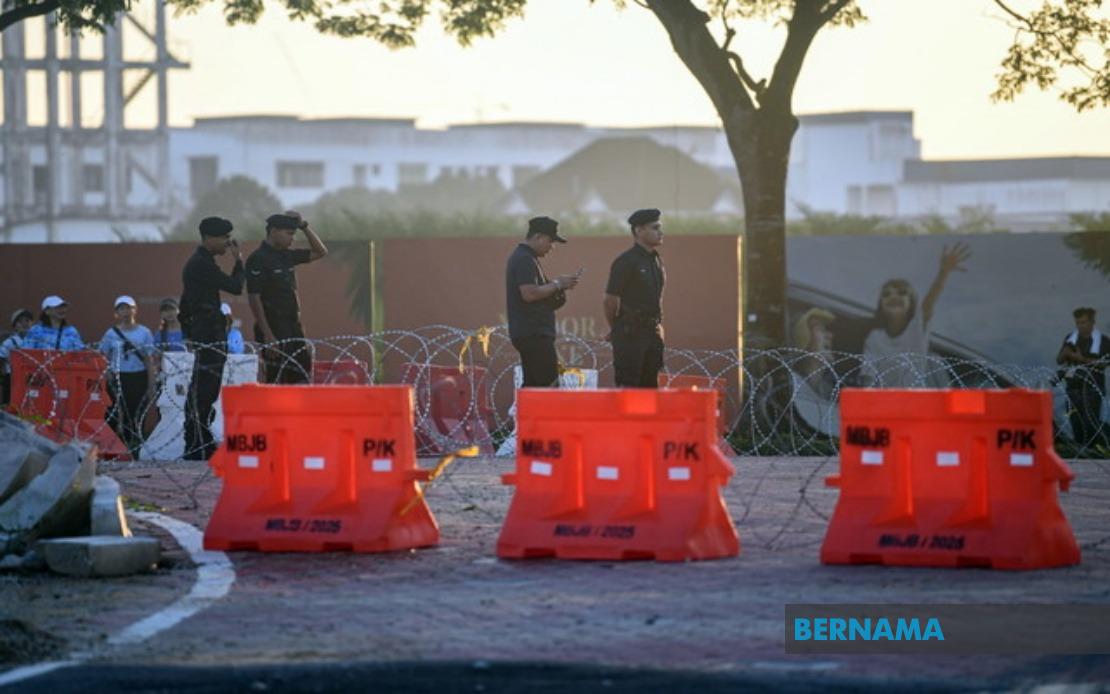
Nomination day for Johor's 16th state election unfolded in an orderly fashion on Thursday, with the process moving smoothly across 56 polling centres spread throughout the state. The clear morning conditions provided an auspicious setting for candidates and their parties to lodge nomination papers, as Election Commission officers finalized preparations and began receiving submissions from 9am onwards. The administrative machinery appeared well-coordinated, with security personnel deployed at every centre to maintain decorum and facilitate the conduct of proceedings without disruption.
Party enthusiasm was evident from the early morning hours, with campaign supporters congregating at numerous centres as dawn broke. Some locations recorded the arrival of backing crowds as early as 7.30am, signalling the intensity of competition expected in this electoral cycle. The visible mobilization of party workers and sympathizers underscored the significant stakes involved in determining representation across the legislature's 56 seats, a number that carries weight in Johor politics given its status as a major state within the federation.
Weather patterns proved cooperative, at least during the critical morning hours when nomination submissions reached their peak. The Malaysian Meteorological Department had forecast dry conditions across most Johor districts through the morning, with only scattered thunderstorms anticipated in select pockets during the afternoon. This forecast proved accurate, allowing proceedings to advance without the logistical complications that heavy rainfall might have introduced. Such meteorological benignity, though often overlooked in electoral narratives, can meaningfully influence voter turnout and administrative efficiency on crucial dates.
The Election Commission's preparatory work had ensured readiness across the network of centres well before the morning's commencement. Officers stationed at each location had completed final checks and assembled necessary documentation, establishing an infrastructure capable of processing the submissions anticipated across the 56-seat chamber. This advance preparation reflected the commission's accumulated experience in managing Johor's electoral affairs, though the scale and complexity of any statewide election demands perpetual vigilance against procedural lapses.
Johor's electoral framework encompasses a substantial registered voting population, with figures released by the commission documenting 2,727,926 eligible voters distributed across ordinary, military, and police categories. The ordinary voter roll accounts for 2,703,175 individuals, while military personnel and spouses comprise 12,041 voters and police personnel and their families total 12,710. This composition reflects Johor's population density and the presence of significant defence and security force concentrations within the state, demographic realities that shape electoral mathematics and campaign strategies.
The dissolution of the Johor State Legislative Assembly occurred on June 1, triggering the electoral calendar that culminates in the July 11 polling day. The commission had intervened on Thursday to enable nomination submissions, a critical procedural checkpoint that determines which candidates advance toward the final contest. Early voting has been scheduled for July 7, providing military and police voters separated from their constituencies with a mechanism to participate in the democratic exercise despite their posting locations.
From a southeastern Malaysian perspective, Johor's state election carries implications extending beyond the state's borders. As one of peninsular Malaysia's largest electoral contests by voter volume and as a bellwether for political sentiment in the region, the results will offer insights into public opinion trajectories and party organizational capacity in a strategically significant territory. The state's economic importance as a trade and industrial hub amplifies the relevance of its electoral outcomes for broader regional stability and policy direction.
The conduct of nomination day itself, while ostensibly an administrative exercise, communicates messages about institutional health and democratic resilience. The orderly atmosphere, the absence of disruptions, and the smooth processing of candidate registrations collectively suggest that formal electoral machinery continues to function with requisite professionalism. In a region sometimes characterized by intense political contestation, such procedural normalcy carries reassuring implications for stakeholders concerned with democratic governance standards.
The early mobilization of party workers at nomination centres indicates that campaigns will intensify significantly in the fortnight separating nomination day from the actual vote. Candidates now possess confirmation of their official status as contenders, enabling them to escalate communication efforts and organize ground-level activities. The nomination process thus marks a transition point in the electoral cycle, shifting focus from bureaucratic prerequisites toward direct voter engagement and message transmission.
Looking toward July 11, the machinery established and tested on nomination day will face its ultimate examination when millions of Johor voters visit polling stations to cast ballots. The infrastructure demonstrated on Thursday—the coordination across multiple centres, the security arrangements, the logistical provisioning—will be replicated at an expanded scale. Success in managing this nomination exercise provides reasonable confidence that the larger undertaking of conducting a simultaneous statewide election can proceed with comparable efficiency and decorum.

