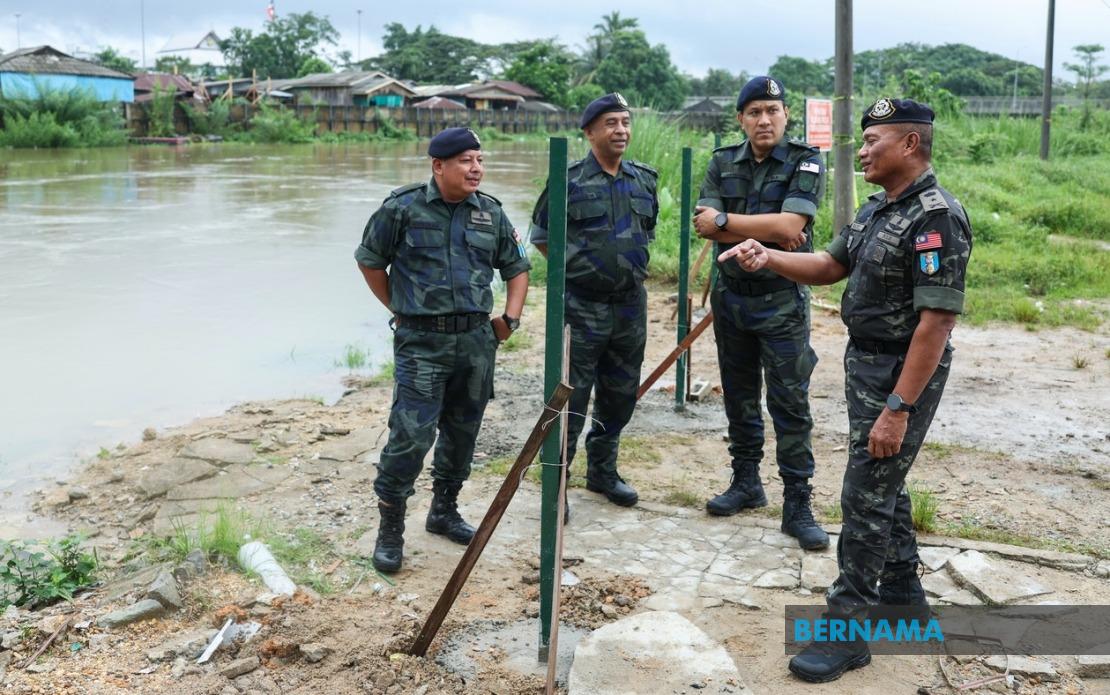
Malaysia's General Operations Force has identified a concerning tactical shift among human trafficking networks operating along the northern border, with smugglers now fragmenting migrant movements into smaller, dispersed groups to outmanoeuvre security patrols. The Southeast Brigade GOF, led by commander SAC Ahmad Radzi Hussain, made the discovery during Operasi Taring Wawasan Kelantan when officers detained 13 Myanmar nationals—five of them women aged between 20 and 37—during coordinated raids in Kampung Banggol Kemian, Pasir Mas, on June 28. The operation, conducted jointly with the Criminal Investigation Division from Pasir Mas district police headquarters, represents a significant success in disrupting what appears to be an increasingly sophisticated smuggling infrastructure adapting to enhanced border enforcement.
The sequence of events during the early morning operation reveals how security forces are now tracking these evolving methods. A GOF patrol spotted a suspicious Proton Exora in the vicinity at approximately 3.30 am, prompting immediate investigation. Upon recognising the presence of uniformed personnel, the vehicle's driver abandoned the automobile and fled into nearby forest, successfully evading capture. The initial inspection yielded four Myanmar nationals occupying the rear seats, all unable to present legitimate travel documentation. This first apprehension triggered a wider search of the surrounding woodlands that culminated, roughly sixty minutes later, in the discovery and detention of nine additional undocumented migrants believed to have recently crossed into Malaysia through unauthorised entry points.
The intelligence gathered from those arrested provides crucial insight into how these networks now operate. All detainees corroborated a consistent narrative: they had been transported from Thailand across the Golok River by two unnamed intermediaries and deliberately deposited in separate forest locations rather than being transported together in a single convoy. This deliberate spacing represents a fundamental recalibration of smuggling methodology, designed to minimise the visibility and footprint of any individual transport movement. By fragmenting larger groups into smaller units and staggering their arrivals across different locations and times, networks reduce the probability that any single security checkpoint or patrol will encounter suspicious concentrations of undocumented persons that might trigger heightened investigation.
The strategic implications of this tactical evolution extend beyond the immediate incident. Smaller, dispersed movements are inherently more difficult to detect through conventional border surveillance, which typically relies on identifying anomalous patterns of activity—unusual vehicle movements, large groups of people in remote areas, or suspicious behaviour at known crossing points. When smugglers distribute migrants across multiple vehicles, different times, and varied locations, they effectively dissolve the conspicuous signatures that security forces have traditionally used to identify trafficking operations. This represents an adaptation to enhanced law enforcement presence and improved intelligence capabilities, suggesting that as Malaysian authorities increase pressure on smuggling routes, criminal organisations are responding with proportionally refined operational security measures.
The migrants themselves appear to be targeted for labour exploitation in the Kuala Lumpur metropolitan area, indicating that these networks form part of a broader supply chain feeding Malaysia's informal employment sectors. The detention of working-age individuals from Myanmar suggests they had been recruited or coerced with promises of employment, representing a pattern consistent with labour trafficking that extends beyond simple irregular border crossing. The involvement of Myanmar nationals is unsurprising given Myanmar's internal instability and limited economic opportunities, which continue to drive migration pressures throughout Southeast Asia. Malaysia, with its relatively developed economy and accessible labour markets, remains a primary destination for such migrants despite stringent immigration enforcement.
The seizure of the Proton Exora, valued at approximately RM30,000, represents not merely the loss of a transport asset but potentially disrupts the logistics of ongoing operations, at least temporarily. Specialised vehicles used for smuggling operations represent significant capital investments, suggesting that the networks operating along the Kelantan-Thailand border maintain sufficient financial resources and organisational capacity to sustain losses and continue activities. The existence of such dedicated transport infrastructure indicates these are not ad-hoc operations but rather structured enterprises with defined roles, supply chains, and contingency planning.
The involvement of the Criminal Investigation Division in processing detainees signals a recognition that these cases require more sophisticated investigative work than routine immigration enforcement. Prosecutions under Section 6(1)(c) of the Immigration Act 1959/63 carry serious penalties, and the joint operation structure suggests authorities are pursuing both the detained migrants and the networks that organised their transport. However, the successful flight of the vehicle driver underscores a persistent challenge in dismantling these operations—the key organisers and facilitators often manage to evade direct apprehension, whilst the most vulnerable individuals within these networks face legal consequences.
From a regional perspective, this incident exemplifies transnational smuggling dynamics that affect multiple Southeast Asian jurisdictions simultaneously. Thailand serves as both a transit point and source of smuggling operations, whilst Malaysia functions as a destination. The Golok River crossing point, though geographically remote, clearly remains an active entry route despite security investments. Myanmar's ongoing political and economic crises ensure continued population outflow, while destination countries' demand for low-cost labour perpetuates pull factors. This creates a sustainable market for smuggling services, ensuring that even as individual operations are disrupted, the overall migration pressures persist.
The tactical innovations observed in this operation suggest that Malaysian security agencies must themselves evolve enforcement strategies. Conventional checkpoint-based approaches may become progressively less effective as smugglers adapt to known enforcement patterns. Greater intelligence-sharing with Thai authorities, enhanced surveillance of known forest entry points, and targeting of transport networks rather than merely apprehending migrants at the final point of detection represent potential countermeasures. The GOF's responsiveness demonstrated in Operasi Taring Wawasan Kelantan indicates that Malaysian security forces maintain capacity to adapt to changing circumstances, but sustained effectiveness requires adequate resourcing and strategic patience.
Beyond security considerations, this incident raises humanitarian questions. The detention of women migrants, some potentially vulnerable to exploitation, requires that immigration enforcement be coupled with victim support mechanisms and investigation into trafficking dimensions. Malaysian authorities increasingly recognise that some undocumented migrants are themselves victims of trafficking networks rather than voluntary law-breakers, though legal frameworks and operational practices have been slow to fully integrate this understanding. The fragmentation of migrant groups—with individuals scattered across forests to avoid detection—creates dangerous situations for vulnerable persons without access to food, water, medical care, or information about their whereabouts.
The broader context reveals that whilst security force operations like this generate short-term success stories, Malaysia's irregular migration challenges remain fundamentally structural. The disparity between Malaysian wages and Myanmar's economic circumstances, combined with informal sector labour demand, creates powerful migration incentives. Without addressing root causes of migration through regional development initiatives or regularisation programmes for certain categories of workers, enforcement operations address symptoms rather than underlying conditions. Countries throughout Southeast Asia grapple with similar dynamics, suggesting that durable solutions require regional cooperation extending beyond border security to encompass labour policy, development assistance, and potentially expanded legal migration frameworks.

