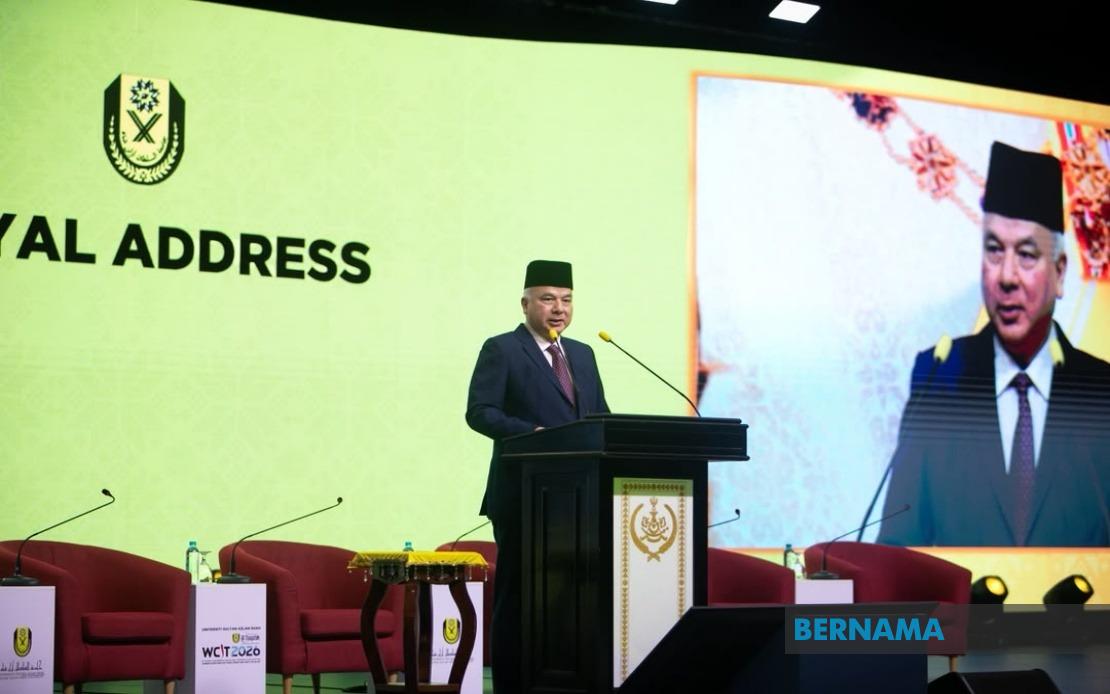
The Sultan of Perak, Sultan Nazrin Shah, has articulated a compelling vision of national security that extends far beyond conventional military and technological defences. Speaking at the 8th World Conference on Islamic Thought and Civilisation in Ipoh, His Royal Highness positioned social cohesion as the most enduring safeguard for any nation, a framework that carries particular resonance for Malaysia's multireligious and multiethnic landscape.
While acknowledging that border protection and defences against cyber threats and extremism remain necessary components of state security, Sultan Nazrin advanced a more sophisticated argument: that these measures alone cannot produce genuine national safety unless accompanied by a deep sense of shared citizenship and mutual belonging. This distinction addresses a fundamental vulnerability in how many nations conceptualise security, treating it primarily as a technical or military problem rather than a social and political one.
Central to His Royal Highness's concerns is the weaponisation of religious sentiment for narrow political advantage. In the Malaysian context, where communal tensions periodically surface around religious and ethnic issues, this warning carries substantial weight. Sultan Nazrin cautioned against the manipulation of faith to justify division rather than unity, and the exclusion of communities rather than their active inclusion. This framing identifies a specific threat vector that has periodically destabilised Malaysian society: the exploitation of religious identity to mobilise political support at the expense of national cohesion.
The Sultan articulated the philosophical foundation of genuine national security: that every citizen, irrespective of ethnicity or religious affiliation, must genuinely perceive themselves as having an equal stake in their nation's future. Without this sense of belonging, no amount of police forces, surveillance apparatus, or military capability can compensate. This observation carries particular relevance for Southeast Asian nations grappling with historical grievances and demographic diversity, suggesting that technical security solutions cannot substitute for authentic political inclusion.
Crucially, His Royal Highness distinguished between a nation that is secure from external threats yet corroded by internal corruption and injustice, and one that has achieved authentic security. This articulation reframes how policymakers should evaluate national vulnerability, highlighting that internal decay poses existential risks regardless of external military strength. For Malaysia, this speaks to ongoing concerns about institutional integrity, judicial independence, and transparent governance.
The Sultan's emphasis on national integrity being maintained not through uniformity but through ensuring genuine stakes in national success represents a rejection of authoritarian security models. Instead, His Royal Highness advocated for resilience built on shared belonging rather than coercion. This approach acknowledges that citizens who feel genuinely represented in laws, economic opportunities, educational institutions, and leadership structures develop voluntary commitment to national stability, whereas forced compliance generates brittleness and eventual rupture.
Switching focus to education as a pillar of long-term security, Sultan Nazrin highlighted the necessity of investing substantially in human capital to navigate coming disruptions including automation, climate change, and economic transformation toward knowledge-intensive sectors. This argument positions education not merely as a social good but as essential infrastructure for national competitiveness and stability, a perspective increasingly relevant as Southeast Asian economies navigate technological transition.
The Sultan's educational vision rejects the false choice between technical and humanistic learning. His advocacy for equal investment and dignity accorded to vocational and academic pathways addresses persistent hierarchies in Malaysian education that channel students toward university degrees while undervaluing skilled trades. This comprehensive approach recognises that national development requires both engineers and electricians, both doctors and mechanics, valued equally and trained rigorously.
Particulately incisive was His Royal Highness's observation that traditional educational methods—rote memorisation and standardised testing—are increasingly maladapted to an era where information is instantaneously retrievable. Instead, Sultan Nazrin argued that young people require capacities that artificial intelligence cannot replicate: critical thinking, ethical reasoning, creativity, and adaptability. This diagnosis aligns with global educational discourse yet carries specific implications for Malaysia, whose examination-driven system faces mounting criticism from educators and employers alike.
The Sultan connected this educational imperative to Islamic intellectual tradition, arguing that properly conceived Islamic education rooted in both revealed knowledge and rational inquiry has historically cultivated precisely these human capacities. This framing positions Islamic thought not as opposed to scientific reasoning or modern adaptation but as fundamentally compatible with the intellectual flexibility demanded by contemporary challenges. Such positioning carries weight within Malaysian discourse where religious and secular modernisation are sometimes presented as opposing forces.
His Royal Highness's remarks were delivered before senior government figures including Deputy Prime Minister Datuk Seri Fadillah Yusof, Perak Menteri Besar Datuk Seri Saarani Mohamad, and Higher Education Minister Datuk Seri Dr Zambry Abd Kadir, suggesting these arguments carry institutional attention. The emphasis on social cohesion, inclusive governance, and educational transformation reflects policy priorities increasingly recognised across Malaysian officialdom as essential to sustained development.
Ultimately, Sultan Nazrin's intervention reframes how Malaysia and neighbouring Southeast Asian nations should conceptualise security in the twenty-first century. Rather than viewing security primarily through hardware—military equipment, surveillance technology, border fortifications—His Royal Highness positioned it as fundamentally dependent on software: the quality of social trust, the inclusivity of political systems, and the educational preparation of citizens to navigate technological and environmental disruption. For policymakers across the region confronting similar challenges of diversity management and economic transformation, this framework offers a thought-provoking alternative to security paradigms emphasising coercion and control.

