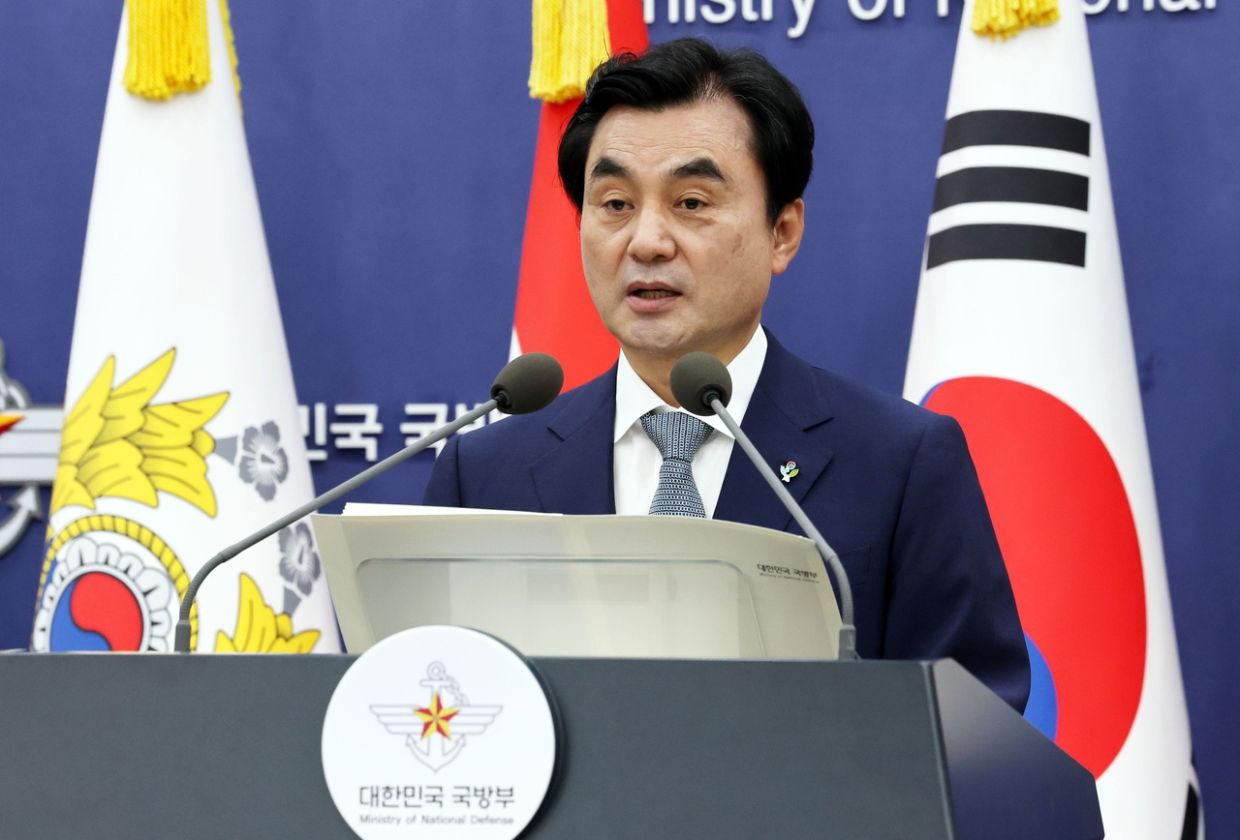
South Korea's Defence Ministry has announced an ambitious overhaul of its unmanned warfare strategy, committing to procure more than 20,000 low-cost drones while expediting the deployment of domestically designed long-range loitering munitions known as K-Lucas. Defence Minister Ahn Gyu-back outlined the comprehensive initiative on Friday, positioning the nation to adapt rapidly to evolving security threats and technological advancements reshaping modern battlefields. The decision reflects Seoul's determination to maintain military superiority on the peninsula while drawing lessons from global conflicts that have demonstrated the tactical and strategic importance of drone systems in contemporary warfare.
The strategic pivot comes against a backdrop of rapid innovation in unmanned systems globally, particularly following Russia's extensive use of budget drones in Ukraine and recent confrontations between the United States and Iran. These real-world applications have underscored how affordable, expendable drone platforms can fundamentally alter operational dynamics and force structures. South Korea's leadership has recognised that outdated procurement methodologies and force structures cannot adequately address this transformation. By embracing a comprehensive drone-centric approach, Seoul is positioning itself ahead of a technological curve that threatens to leave militaries relying on conventional doctrines increasingly vulnerable.
North Korea's expanding unmanned capabilities present a direct impetus for Seoul's accelerated timeline. The regime has systematically developed diverse drone platforms capable of reconnaissance, targeted strikes, and disruption of critical infrastructure. Officials emphasised that these threats extend beyond military installations to encompass civilian infrastructure and population centres, elevating drone defence to a national security priority rather than a niche military concern. The proliferation of affordable drone technology across borders has essentially democratised aerial assault capabilities, compelling South Korea to develop both offensive and defensive competencies in this domain simultaneously.
The acquisition programme targeting 20,000 low-cost, expendable drones represents a philosophical shift in military procurement. Rather than concentrating resources on expensive, high-end platforms, Seoul is embracing a quantity-focused strategy that acknowledges the disposable nature of modern unmanned systems in actual combat. The portfolio includes short-range reconnaissance drones and small loitering munitions designed for rapid deployment and minimal operational cost. Completion of this procurement is scheduled for 2030, providing a realistic timeframe for industrial scaling and integration while allowing for technological refinements as the programme progresses. This approach also creates substantial commercial opportunities for South Korea's emerging domestic drone sector, potentially establishing new export markets across aligned nations facing similar security challenges.
The K-Lucas indigenous loitering munition system represents Seoul's commitment to technological self-sufficiency in critical defence domains. By accelerating this platform's deployment, South Korea demonstrates confidence in homegrown engineering capabilities whilst reducing dependence on foreign suppliers for strategically important systems. The emphasis on Korean-developed solutions carries political significance beyond military calculations, reinforcing narratives of technological prowess and independent defence industrial capacity. For a nation historically dependent on allied technological transfers, the K-Lucas programme symbolises technological maturation and the capacity to design solutions tailored specifically to Korean operational environments and strategic doctrines.
Counterdrone capabilities receive equally prominent attention in the announced strategy. Recognising that drone threats are bidirectional, the Defence Ministry plans deploying counterdrone systems and small unmanned aircraft defence installations in front-line areas adjacent to the inter-Korean border beginning next year. Crucially, the strategy acknowledges that affordable drone proliferation demands equally economical defensive solutions. The ministry outlined intentions to develop directed-energy weapons including laser and high-power microwave systems whilst simultaneously acquiring low-cost interceptor drones. This dual-pronged defensive architecture acknowledges that no single technological solution will prove universally effective, requiring layered capabilities spanning kinetic and non-kinetic options at varying cost points.
Artificial intelligence integration emerges as a crucial longer-term capability development. Plans to develop AI-powered drone swarms represent aspirational technology positioning Seoul at the frontier of autonomous systems research. Swarm capabilities, when operationalised, could fundamentally enhance coordination of large drone formations, enabling complex tactical manoeuvres and overwhelming adversary defences through coordinated multi-platform attacks. This capability development trajectory positions South Korea alongside advanced military powers exploring similar autonomous systems, potentially creating significant technological advantages if successfully implemented before competitors achieve comparable maturity.
Recognising that traditional military procurement processes move too slowly for rapidly evolving technological domains, the Defence Ministry is pursuing legislative reforms to streamline acquisition procedures. Deputy Minister Kim Hong-cheol highlighted the fundamental incompatibility between drone technology's pace of development and conventional defence procurement bureaucracy. The proposed reforms would permit testing of commercially available systems under military conditions with expedited certification processes, enabling rapid transition from commercial platforms to military deployment. For Malaysian defence planners and policymakers, this approach offers instructive precedent. The region's militaries face similar challenges acquiring cutting-edge technologies within constrained fiscal environments, suggesting that legal and administrative reforms enabling faster technology integration may prove as strategically significant as hardware acquisition itself.
The ambitious goal of training 500,000 drone operators reflects Seoul's intent to make unmanned systems ubiquitous throughout military structures. This transformation treats drone operation as a foundational skill equivalent to traditional weapons operation, essentially democratising access to aerial capabilities across the force. Such widespread training creates redundancy protecting operational capabilities against personnel losses whilst establishing a cultural shift where drone employment becomes routine rather than specialised. For smaller militaries like Malaysia's, attempting to train 500,000 operators may prove logistically unachievable, yet the underlying principle—that drone capabilities require diffused rather than concentrated expertise—offers valuable strategic insights.
Administrative restructuring accompanies capability development, reflecting lessons from recent military controversies. The Drone Operations Command, previously implicated in investigations surrounding October 2024 drone incursions into Pyongyang and allegations of evidence destruction, will transform into the National Defence Drone Headquarters functioning as a policy rather than operational organisation. Operational planning responsibility transfers to individual service branches, enabling development of service-specific drone tactics while centralised headquarters manages capability development and procurement. This arrangement balances specialised service requirements with coordinated national-level drone strategy. The restructuring simultaneously addresses institutional accountability concerns whilst preserving the recognition that drone warfare's growing centrality demands dedicated organisational focus rather than dissolution.
The implications for Southeast Asia extend beyond South Korean military modernisation. As the region's most technologically advanced military establishes drone-centric strategic frameworks, allied and neighbouring nations face pressure to accelerate comparable modernisation efforts. The demonstrated vulnerability of traditional air defences to drone swarms creates cascading security pressures throughout Southeast Asia. Malaysia, operating in an increasingly contested maritime environment with limited aerospace resources, confronts difficult strategic choices regarding drone procurement prioritisation. The South Korean experience demonstrates that technological obsolescence in unmanned systems emerges far more rapidly than traditional weapons platforms, potentially rendering today's acquisitions strategically irrelevant within years without sustained technological refresh commitments.
President Lee Jae Myung's concurrent chairmanship of a meeting addressing defence and space industry innovation indicates broader governmental commitment to technological advancement across security domains. This integrated approach treating drone development as part of comprehensive defence industrial strategy rather than isolated procurement suggests Seoul recognises interconnections between commercial drone sectors, military applications, and space capabilities. Malaysia's defence establishment might benefit from similarly integrated strategic thinking, where civilian drone industries receive encouragement not merely for commercial benefits but as incubators for military technological advancement. The synergy between civilian and military drone ecosystems creates efficiencies and innovation pathways that purely military development programmes frequently cannot achieve.
South Korea's drone strategy ultimately reflects sober assessment that contemporary security environments demand fundamental force structure reorientation. The peninsula's specific threat environment—facing a technologically progressing adversary with limited resources but substantial asymmetric capabilities—creates imperatives for cost-effective scale deployments rather than concentration on expensive platforms. Yet the broader strategic logic applies throughout Southeast Asia, where nations with finite defence budgets confront evolving threats requiring urgent capability development. Seoul's willingness to pursue legislative reforms, embrace commercially-derived technologies, and fundamentally restructure institutional arrangements demonstrates that strategic adaptation extends beyond hardware procurement into administrative and legal domains. For Malaysian policymakers monitoring regional military developments, the South Korean approach offers instructive examples of comprehensive strategic modernisation addressing technological, organisational, and human resource dimensions simultaneously.

