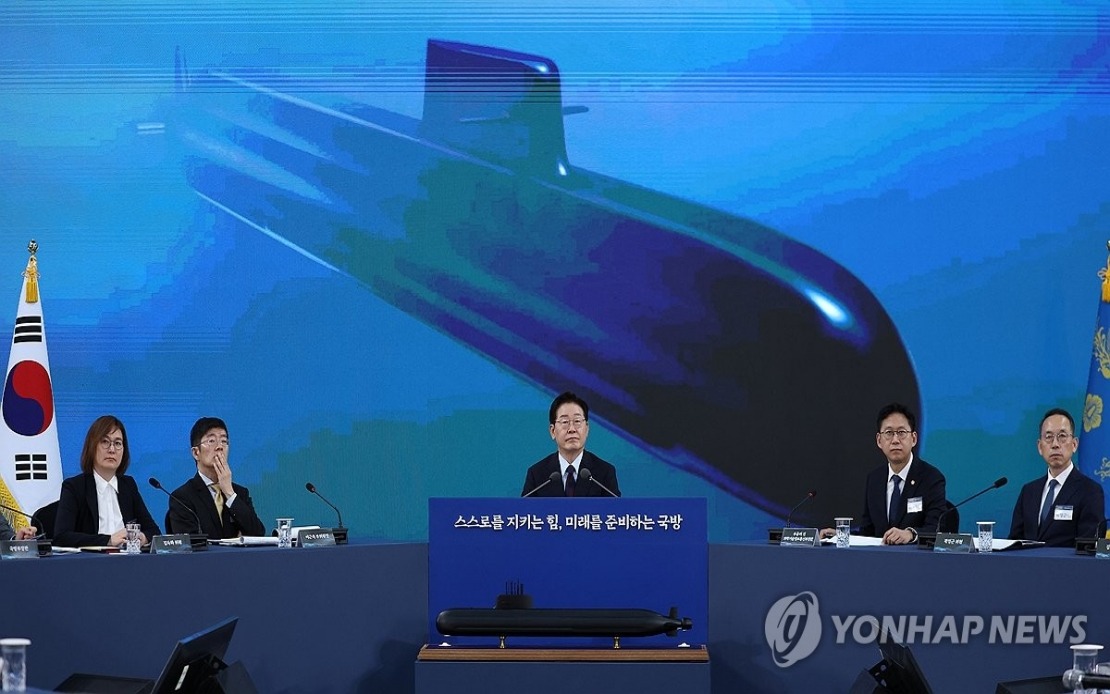
South Korea has taken a significant step forward in its ambitious nuclear submarine initiative by issuing a public notice for proposed legislation that will provide the legal framework for one of the region's most consequential military modernisation projects. The defence ministry's announcement on Wednesday represents a formal transition from conceptual planning toward legislative implementation of the Jang Bogo N programme, which aims to deliver at least three conventionally-armed nuclear-propelled attack submarines displacing 8,000 tonnes each by the mid-2030s. This move comes after President Lee Jae Myung secured approval from US President Donald Trump for the submarine development during bilateral summit talks in October, marking a watershed moment for Seoul's strategic autonomy in regional security.
The nuclear fuel specifications outlined in the programme underscore careful design choices intended to balance operational capability with international security concerns. The submarines will be powered by high-assay low-enriched uranium enriched to below 20 per cent, a crucial technical parameter that distinguishes civil-grade nuclear propulsion from weapons-grade materials. This threshold represents a deliberate engineering constraint that Seoul has committed to maintaining, reflecting not merely technological necessity but also political acknowledgement of regional sensitivities regarding nuclear proliferation in one of the world's most militarily tense areas.
A centrepiece of the proposed legislation is an explicit codification that the nuclear submarine programme harbours no intentions, capabilities, or designs toward developing, manufacturing, or possessing nuclear weapons. This provision addresses a persistent undercurrent within South Korean domestic politics, where some segments have argued for independent nuclear deterrence as a counter to North Korea's advancing weapons arsenals. By embedding nonproliferation language directly into statute law rather than relying on executive policy alone, Seoul is attempting to foreclose opportunities for future administrations to repurpose the submarine programme's nuclear fuel infrastructure for weapons development. The legal commitment extends beyond rhetoric to enforceable obligations.
The bill further stipulates comprehensive safeguards against nuclear material diversion and requires unwavering adherence to the Nuclear Non-Proliferation Treaty (NPT) framework. Seoul commits to full cooperation with the International Atomic Energy Agency (IAEA) across all nuclear safeguard inspection and verification procedures, effectively inviting permanent international oversight of the programme's most sensitive dimensions. For Malaysia and other Southeast Asian nations monitoring regional nuclear developments, these undertakings carry particular weight given the absence of a regional nuclear arms control agreement comparable to those in Europe or the Americas. The inclusion of such language in primary legislation signals Seoul's intention to embed restraint into institutional architecture rather than leaving it vulnerable to policy reversals.
Beyond nonproliferation assurances, the proposed bill addresses public safety and environmental protection from radioactive contamination, establishing a framework for comprehensive safety standards throughout the submarines' lifecycle. This reflects growing regional consciousness about nuclear risk management, particularly relevant for maritime nations whose territorial waters and shipping lanes could be affected by potential nuclear incidents involving submarine propulsion systems. The legislation mandates rigorous environmental and safety protocols that extend from construction through operational deployment and eventual decommissioning, providing reassurance to neighbouring states that Seoul approaches nuclear propulsion with appropriate caution and transparency mechanisms.
The proposed bill seeks to streamline procurement processes typically required for major defence projects, including exemptions from mandatory feasibility studies that would normally precede such ventures. Research and development timelines will be compressed, and testing periods accelerated through the special legislation. Contractual arrangements are designed with greater flexibility regarding cost calculations, acknowledging that first-of-class nuclear submarine development inherently carries unpredictable technical and financial challenges. A defence ministry official characterised the programme as a novel integration of weapon systems with nuclear energy, emphasising that existing legal frameworks spanning defence acquisition and nuclear safety regulation prove inadequate for managing this unprecedented fusion of technologies.
Governance structures proposed in the bill reflect the programme's unprecedented complexity and multisectoral implications. The legislation calls for establishing a strategy committee operating under the Prime Minister's authority to deliberate on implementation logistics, including critical decisions regarding facility site selection. Such high-level political oversight underscores Seoul's recognition that the nuclear submarine programme transcends conventional military procurement to encompass broader questions of nuclear energy management, civil society concerns, and international diplomatic implications. The defence minister will be required to conduct comprehensive programme reviews at ten-year intervals, embedding structured reassessment into the project's governance.
For Malaysia and broader Southeast Asian stakeholders, South Korea's nuclear submarine programme carries multilayered significance extending beyond Seoul's strategic calculus. The programme represents a technological leap that could reshape regional naval power dynamics, particularly given the Korean Peninsula's volatile strategic environment. Chinese and Russian observers will scrutinise the programme's development trajectory, while Southeast Asian nations must consider how advanced nuclear submarine capabilities operating within regional waters might affect security calculations and maritime confidence-building measures. The explicit nonproliferation safeguards written into South Korea's legislative framework may set important precedents for how emerging nuclear submarine operators in the region approach transparency and international oversight obligations.
The public notice period extending until September 7 provides opportunity for South Korean civil society, academic experts, and international observers to submit feedback before the draft bill moves to the National Assembly. This consultative process, while compressed compared to some defence policy reviews, offers a window for scrutiny of technical assumptions, safety protocols, and broader strategic implications. The compressed timeline itself reflects Seoul's determination to advance the programme expeditiously, though the sustainability of accelerated development schedules for complex nuclear systems requires careful balance against quality and safety imperatives that cannot be rushed without consequence.
South Korea's legislative approach to nuclear submarine development demonstrates how advanced military-nuclear integration can proceed within institutional frameworks designed to constrain rather than facilitate proliferation. The simultaneous pursuit of strategic capability enhancement and nonproliferation assurance reflects Seoul's position as a technologically sophisticated nation deeply enmeshed within international legal and security regimes. However, the programme's success in maintaining this balance will ultimately depend on consistent implementation, transparent cooperation with international monitoring mechanisms, and sustaining domestic political consensus around strict nonproliferation discipline even as the submarines enter operational service in the 2030s. For the region, this emerging precedent merits sustained attention as an evolving model of how advancing nuclear submarine capabilities might coexist with robust international oversight.

