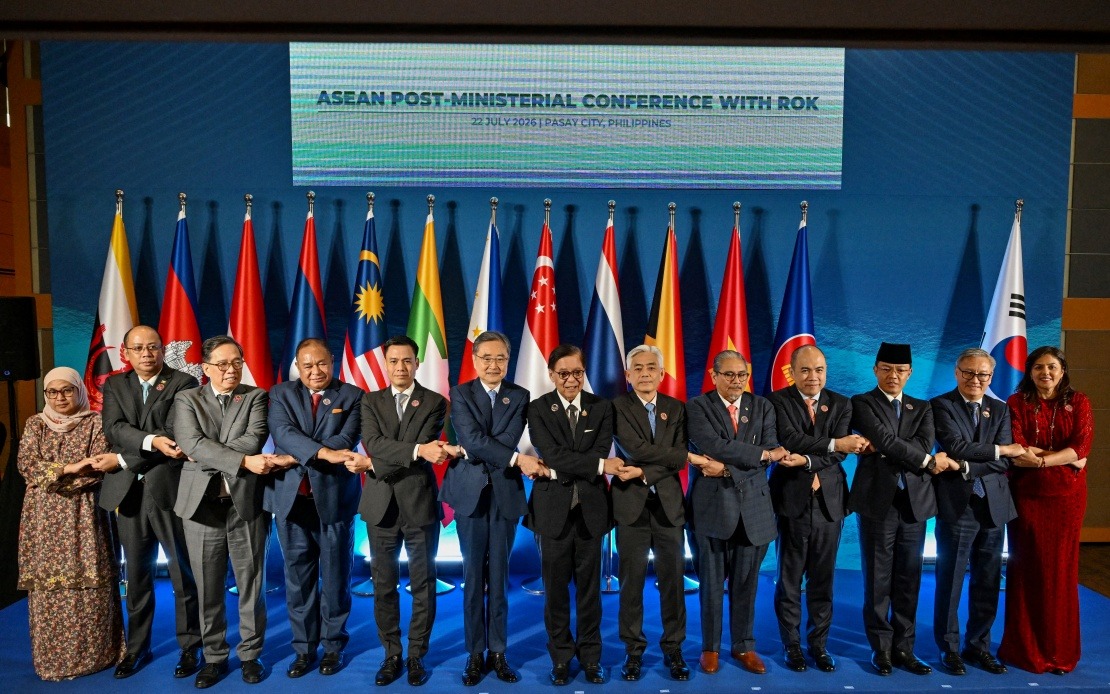
South Korea and ASEAN have signalled deepening commitment to their strategic partnership by launching fresh initiatives in artificial intelligence and cultural industries, marking a significant expansion of bilateral engagement across technology and creative sectors. The announcement came during foreign ministers' meetings held in Manila on Wednesday, where Seoul's top diplomat Cho Hyun co-chaired discussions with Thailand's foreign minister to chart concrete pathways for implementing the Comprehensive Strategic Partnership vision that South Korea's President Lee Jae Myung introduced at last year's summit.
The timing of these announcements reflects Seoul's strategic calculation that ASEAN represents crucial ground for technology transfer and economic cooperation as global supply chains realign and major powers compete for influence in Southeast Asia. By positioning itself as a willing partner in emerging sectors rather than merely a trading nation, South Korea aims to strengthen ties with all ten ASEAN members simultaneously, creating multiple entry points for collaboration beyond traditional areas of manufacturing and trade. This approach acknowledges that ASEAN's diverse economies offer different opportunities—from Vietnam's manufacturing prowess to Singapore's financial hub status to Indonesia's vast consumer market.
The Korea-ASEAN AI Partnership Initiative represents Seoul's most ambitious technology-sharing framework yet, drawing on South Korea's recognised expertise in artificial intelligence development. The initiative focuses on three distinct pillars: constructing robust AI ecosystems across the region, promoting research collaboration and developing skilled talent pipelines, and establishing governance frameworks to ensure responsible AI deployment. For Malaysian technology companies and policymakers, this initiative potentially opens doors to joint ventures, training programmes and access to South Korean AI capabilities that could accelerate the country's digital transformation objectives outlined in Malaysia's own technology roadmaps.
Parallel to technology cooperation, Seoul introduced partnership frameworks addressing cultural and creative industries, recognising that Southeast Asia's growing middle class represents an expanding consumer base for Korean entertainment, design and digital content. South Korea's successful cultural exports—from K-pop and Korean dramas to gaming and animation—demonstrate the commercial potential of creative sector development, a lesson that Malaysian cultural industries could apply. ASEAN member states control significant production capabilities and distribution networks that could amplify the reach of Korean creative content throughout the region while simultaneously developing local creative talent.
Beyond culture and technology, the two sides discussed establishing a joint maritime safety academy, reflecting genuine security concerns in strategically vital waters where shipping corridors experience escalating incidents. This initiative carries particular relevance for Malaysia, whose peninsula and Borneo territories border critical maritime zones. Enhanced maritime safety cooperation, combined with efforts to combat organised online scam networks that increasingly prey on Southeast Asian citizens, addresses transnational challenges requiring coordinated regional responses that individual nations struggle to tackle alone.
The economic dimension of deepening Korea-ASEAN ties centres on substantially upgrading their existing free trade agreement, a framework that has underpinned bilateral commerce since 2006 when South Korea and ASEAN first formalised goods trade terms. Subsequent agreements covering services and investment followed in 2007 and 2009 respectively, establishing a comprehensive trading architecture. Last month, both sides launched formal negotiations to modernise this FTA, recognising that agreements signed nearly two decades ago inadequately address contemporary trade challenges including digital commerce expansion, critical minerals supply chain security and emerging technology sectors. South Korea's 2025 exports to ASEAN totalling approximately US$122.5 billion underscores the partnership's economic weight, making these upgrade negotiations commercially significant for both regions.
Critical minerals cooperation warrants particular attention given global competition for battery materials, rare earths and other substances essential for the green energy transition. Southeast Asia possesses substantial mineral resources while South Korea represents a major manufacturing centre requiring secure supply chains. Malaysia itself holds significant nickel, tin and rare earth reserves, positioning it as a potential beneficiary of formalised critical minerals frameworks within upgraded trade arrangements. Establishing transparent, rules-based supply chain relationships reduces vulnerability to geopolitical disruption and price volatility that both regions face.
The Comprehensive Strategic Partnership vision itself articulates three foundational pillars that structure cooperation frameworks: people-centred initiatives emphasising cultural exchange and people-to-people connectivity; growth and innovation partnerships spanning technology, investment and industrial cooperation; and peace and stability measures addressing regional security challenges. This tripartite structure acknowledges that enduring partnerships require cultural foundations and mutual understanding alongside economic benefits and security cooperation.
During these discussions, South Korea also sought ASEAN support for its Korean Peninsula policy, emphasising that regional peace constitutes a prerequisite for broader Asian stability and prosperity. ASEAN member states reaffirmed backing for Seoul's diplomatic initiatives, recognising that peninsula tensions possess consequences extending throughout Northeast and Southeast Asia through supply chain disruptions, security costs and regional fragmentation. Malaysia and other ASEAN nations have consistently advocated for dialogue-based approaches to Korean peninsula issues, viewing stability there as linked to their own strategic interests.
The broader significance of Korea-ASEAN deepening lies in its potential to establish alternative cooperation architectures less dependent on traditional great power arrangements. While ASEAN maintains official non-alignment policies, pragmatic partnerships with rising powers like South Korea provide flexibility, technological access and economic opportunities without forcing zero-sum alignment choices. South Korea itself navigates complex geopolitical circumstances as a developed democracy with significant security interests, making it a natural partner for ASEAN nations seeking to diversify relationships.
These initiatives also reflect recognition that technology and culture represent increasingly important dimensions of regional power and influence. Neither represents zero-sum competition where one nation's gain constitutes another's loss—AI ecosystem development or cultural industry growth potentially benefits all participants through expanded markets, skill development and technological diffusion. This collaborative framing contrasts with traditional security-focused partnerships and appeals to ASEAN's preference for inclusive, non-threatening cooperation frameworks.
Implementation success will largely determine whether these announced initiatives translate into substantive regional transformation or remain largely declaratory. Establishing functional joint maritime academies, launching operational AI research networks and creating workable cultural exchange mechanisms requires sustained commitment and resource allocation beyond ministerial rhetoric. Malaysian government agencies, universities and private sector entities will need to actively engage with proposed frameworks to ensure domestic interests receive adequate representation in emerging cooperation structures.

