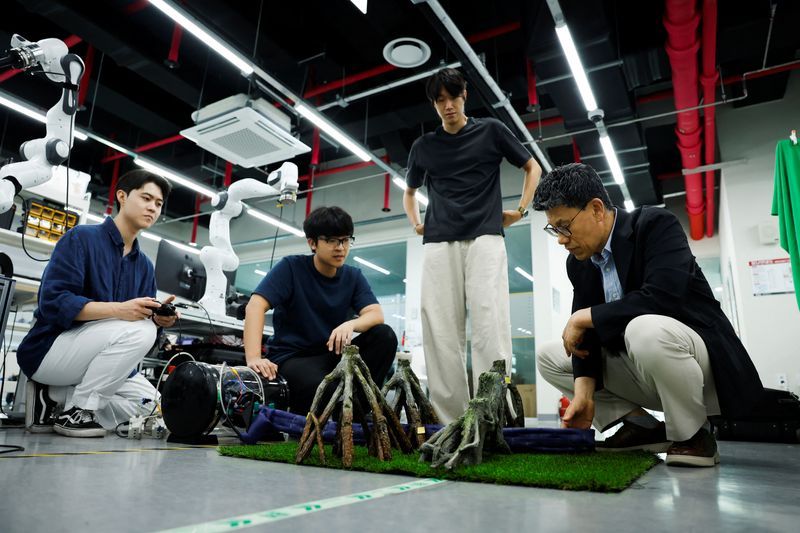
Collaborative research between South Korea's prestigious KAIST university and Stanford University has produced a significant breakthrough in wearable robotics: a system that allows individuals to don protective clothing or suits entirely hands-free and without standing motionless. The technology, which emerged from a Daejeon laboratory, represents a convergence of biomimetic design and practical engineering with far-reaching implications across healthcare, industrial, and emergency response sectors.
At its core, the innovation employs soft, air-pressurised tubes resembling vine tendrils that have been integrated directly into garments. When activated, these pneumatic structures expand and contract in a coordinated sequence, gradually climbing the wearer's body and simultaneously turning the clothing inside out as they advance. This mechanism allows the fabric to conform smoothly to the body's contours, much as ivy naturally adheres to and climbs a wall. The entire process of dressing in a full protective suit takes approximately ten seconds, a dramatically faster timeline than manual donning, particularly significant for scenarios where speed is critical.
The genesis of this innovation offers insight into how practical frustration can spark engineering solutions. Kim Nam Gyun, the postdoctoral researcher who led the project, conceived of the concept during an ordinary moment—caught in sudden rain while cycling and wishing his raincoat could deploy itself automatically without requiring him to stop or use his hands. This observation crystallised into a research question that ultimately produced peer-reviewed results published in IEEE Robotics and Automation Letters, a respected journal in the field.
What distinguishes this robotic system from competing technologies is its remarkable operational flexibility. Unlike conventional robotic assistants or motorised clothing systems that typically demand stationary positioning or complex computational controls, this vine-inspired mechanism functions effectively while the wearer remains in motion. The wearer can move freely, bend, or perform other activities while the pneumatic tendrils progressively dress them, addressing a critical practical limitation of alternative approaches that have reached only partial commercialisation.
Professor Ryu Jee-Hwan of KAIST's civil and environmental engineering department explains that the technological principle derives from how ivy grows naturally. Rather than the entire structure shifting or sliding along the wearer's body, growth occurs primarily at the advancing tip, enabling remarkably stable progression along curved and varied surfaces. This biomimetic approach means the robot can navigate narrow spaces, adapt dynamically to environmental obstacles, and traverse challenging surfaces whether slippery, adhesive, or inclined, without requiring constant positional recalibration.
The immediate applications range across multiple sectors experiencing genuine operational challenges. Healthcare facilities, particularly those serving elderly populations or individuals with mobility impairments, could deploy this technology to assist patients in donning clothing independently, potentially reducing caregiver workload and improving patient dignity. However, the researchers emphasise that industrial and emergency response applications represent equally compelling use cases where the hands-free, rapid-deployment characteristics provide substantial operational advantages.
Within semiconductor manufacturing, the technology addresses a persistent operational bottleneck. Chip fabrication cleanrooms impose stringent requirements on protective clothing protocols, where technicians must don multilayered suits meeting exacting contamination-control standards. Current procedures consume considerable time and frequently require multiple personnel to assist. Implementing self-dressing robotic systems could substantially accelerate technician turnover in critical cleanroom environments, potentially increasing production capacity whilst simultaneously reducing the labour intensity of the dressing procedure.
For emergency services ranging from hazardous materials response teams to disaster relief operations, the capacity to rapidly deploy complete personal protective equipment without manual assistance or complex procedures addresses genuine operational constraints. Firefighters, emergency medical technicians, and specialist responders currently allocate significant pre-operational time to equipment preparation. Automated dressing systems could meaningfully reduce response initiation times when such delays carry life-or-death consequences.
The research also underscores an emerging philosophical tension within technological development that Professor Ryu highlighted during the project's public presentation. Contemporary discourse surrounding innovation tends to concentrate disproportionately on artificial intelligence and software systems, reflecting substantial investment and media attention directed toward computational approaches. Yet this project demonstrates that mechanical engineering innovations, particularly those informed by biomimetic principles drawn from natural systems, retain considerable significance and practical value. The vine robot exemplifies how low-tech mechanical principles can solve problems that high-tech software approaches might overlook or inadequately address.
The peer-reviewed publication of these findings in a prominent robotics journal provides legitimacy and accessibility for researchers worldwide exploring similar biomimetic approaches. The basic design principles—using pneumatic actuation, mimicking natural growth patterns, and eliminating dependency on complex algorithmic control—potentially inspire derivative applications across industries confronting comparable challenges involving protective equipment, assistive technology, or rapid-deployment clothing systems.
Looking forward, the research team acknowledges numerous refinement opportunities, including scaling the technology to accommodate diverse body types and sizes, incorporating additional sensors for enhanced adaptability, and testing real-world performance across varied environmental conditions. Manufacturing at scale and achieving cost-effectiveness sufficient for widespread commercial deployment remain substantive challenges, yet the fundamental proof-of-concept has achieved validation through rigorous peer review. For Malaysia and the broader Southeast Asian region, where electronics manufacturing plays an economic cornerstone role and ageing populations increasingly demand assistive technologies, this innovation offers potential economic and social benefits worth monitoring as the technology matures.

