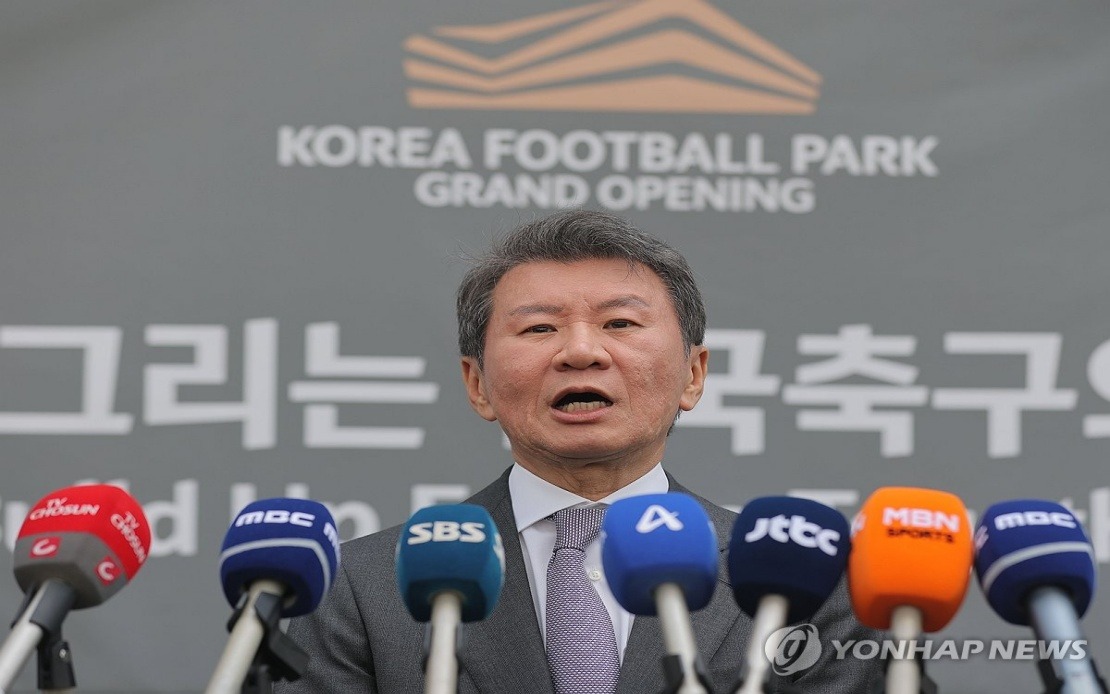
South Korea's Football Association President Chung Mong-Gyu has formally resigned from his position, stepping down two weeks before the FIFA World Cup concludes. The departure marks a significant shift in the federation's leadership at a critical juncture for Korean football, coming in the wake of the national team's unexpected elimination during the group stage of the tournament.
Chung submitted his resignation letter on Monday after conducting his final executive meeting at Korea Football Park in Cheonan, situated approximately 90 kilometres south of Seoul. The timing of his departure underscores the considerable pressure facing football leadership in South Korea, where expectations for international performance run particularly high. Although Chung had initially announced his intention to resign following the World Cup's conclusion on July 20 Korean time, he elected to accelerate his exit as circumstances deteriorated.
The national squad's performance proved deeply disappointing for Korean football enthusiasts and administrators alike. Under coach Hong Myung-bo's guidance, South Korea accumulated just three points from their group campaign, securing one victory against two defeats. This tally proved insufficient to qualify for the knockout phase, even as one of the eight best-performing third-place teams. The coaching staff responded swiftly to the setback, with Hong Myung-bo resigning immediately after the team's mathematical elimination became certain.
Chung's departure reflects not merely the sporting failure but also a broader storm of controversy surrounding his tenure. His appointment of Hong Myung-bo in July 2024 drew considerable criticism from observers who questioned the transparency and propriety of the selection process. The Ministry of Culture, Sports and Tourism launched an extensive investigation into the federation's operations during that period, ultimately concluding that Chung and other senior officials warranted disciplinary action for various procedural irregularities and governance shortcomings.
The contentious relationship between the KFA and government authorities extends beyond individual incidents. Legal disputes remain unresolved between the federation and the Ministry of Culture, Sports and Tourism, which has announced plans to conduct further audits in response to the World Cup exit. This institutional friction highlights deeper tensions within Korean sports governance, where political oversight of sporting bodies remains a recurring flashpoint. For regional observers, the situation illustrates the complex interplay between government involvement and sports administration that characterises many Asian federations.
Per federation regulations, one of the KFA's four vice presidents will assume interim leadership pending a formal election process. Ordinarily, when an incumbent president has more than one year remaining in their contract, a successor must be elected within 60 days. Chung possessed nearly three years left in his fourth term as president, triggering the full electoral machinery. The KFA electoral college comprises heads of regional football associations, chief executives of K League clubs, players, coaches and referees. Previous elections have demonstrated substantial participation, with last year's contest attracting 183 voters from an eligible pool of 192.
However, the election process itself now faces potential restructuring amid mounting public discontent. Minister of Culture, Sports and Tourism Chae Hwi-young has signalled awareness of widespread concerns regarding the federation's electoral mechanisms and made pointed remarks suggesting the KFA cannot simply maintain existing procedures while the nation grapples with World Cup disappointment. Such ministerial commentary hints at potential government pressure to reform the federation's internal democracy and decision-making structures.
The Korean Sport and Olympic Committee, the nation's paramount sports authority, plans to examine possible reforms at a general meeting scheduled for July 16. Among measures under consideration are extending the 60-day election window and potentially introducing direct voting mechanisms rather than relying on an electoral college. These proposed changes represent a significant departure from current practice and would fundamentally alter how Korean football's leadership is selected. For Southeast Asian sports administrators watching these developments, the Korean experience offers instructive lessons regarding electoral reform pressures and government influence over sporting institutions.
The regulatory environment surrounding such changes remains complex. The KSOC establishes rules governing elections within member associations, meaning any electoral innovations must align with broader sports governance frameworks. This layered regulatory structure creates potential complications for rapid reform implementation, even as political momentum builds for electoral overhaul. The interplay between the KFA, KSOC, and government ministry demonstrates how sporting governance often becomes entangled with bureaucratic and political considerations across the region.
In his resignation statement, Chung acknowledged the tension between accomplishments and disappointments during his presidency. He expressed gratitude towards supporters whilst apologising for instances when performance fell short of public expectations. His comments attempted to reframe his departure as consistent with personal accountability and dedication to football development, even as external circumstances demanded his resignation. Chung indicated continued commitment to Korean football as a private enthusiast and expressed confidence in the sport's capacity to overcome current adversities and achieve future success.
The succession question now dominates Korean football discourse. Finding a president capable of navigating government scrutiny, restoring public confidence, and rebuilding team performance represents a substantial challenge for the electoral process ahead. The interim leadership period will prove crucial in stabilising the federation and initiating internal reforms that satisfy both government oversight concerns and football community expectations. Observers across Southeast Asia will likely monitor how South Korea's football federation manages this transition, given parallels with governance challenges facing sports bodies throughout the region.

