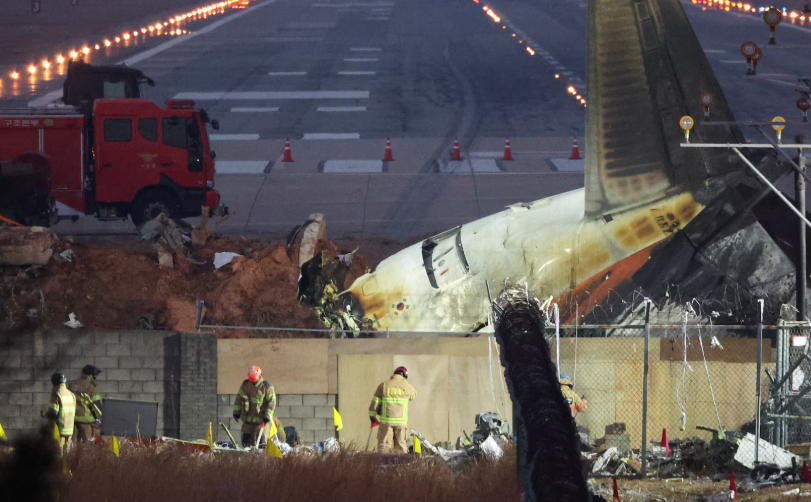
South Korean law enforcement launched a fresh round of raids against the Korea Airports Corporation and two additional government offices on Tuesday to collect evidence as authorities intensify their criminal investigation into the Jeju Air disaster that took 179 lives last December. The coordinated searches targeted the authority responsible for managing most of the country's major domestic airports, the transport ministry, and the Busan Regional Office of Aviation, with investigators focusing on uncovering documentation and records that could establish responsibility for the tragedy.
The December 29, 2024 collision at Muan International Airport emerged as South Korea's deadliest aviation accident in over two decades, triggering a comprehensive criminal inquiry that has already led to charges against 74 individuals. The investigation represents one of the most significant prosecutorial efforts in recent Korean aviation history, reflecting both the scale of the disaster and mounting public pressure to establish who bears responsibility for the catastrophe.
According to a spokesperson from the special investigative team, the raids were conducted specifically to gather supplementary evidence relating to charges of professional negligence resulting in death or injury—a serious criminal category that carries substantial prison sentences. The authorities have already identified this charge as applying to the 74 suspects currently under investigation, suggesting that prosecutors believe multiple parties, rather than isolated individuals, contributed to the conditions that led to the crash.
Tuesday's operation marked the third occasion that investigators have searched the transport ministry's offices, indicating that the focus of the inquiry has repeatedly returned to this central government body. The repeated visits suggest either that new leads have emerged requiring fresh document collection, or that investigators believe the ministry possesses additional records relevant to establishing a timeline of decisions and safety protocols preceding the accident.
Beyond the professional negligence charges already filed, South Korean police have signaled their intention to pursue the more severe charge of causing a serious public disaster. This enhanced charge category would represent a dramatic escalation in culpability, potentially implicating systemic failures rather than merely individual errors. Such charges typically result in longer sentences and carry greater reputational consequences for institutions involved, which explains the intensity of the current investigative phase.
The core investigative focus remains twofold: determining the precise technical and operational factors that caused the aircraft to crash at Muan International Airport, and establishing whether the responsible agencies—including airport operators, aviation safety officials, and the transport ministry—fulfilled their regulatory obligations and emergency response responsibilities. These parallel tracks are essential because even if mechanical failure is identified, prosecutors must prove whether responsible parties either caused, failed to prevent, or inadequately responded to the emergency.
For Malaysian aviation observers, the Jeju Air investigation carries particular relevance given Southeast Asia's shared commitment to international aviation safety standards. The crash has prompted broader scrutiny across the region regarding how airports, aviation authorities, and transport ministries coordinate on safety protocols and emergency procedures. Malaysia's Civil Aviation Authority and airport operators may find themselves reviewing their own protocols in light of findings that emerge from the Korean investigation.
The involvement of multiple government agencies and the Korea Airports Corporation suggests that the crash cannot be attributed to a single point of failure. Instead, investigators appear to be examining a chain of events or decisions spanning operational, regulatory, and administrative domains. This systemic approach to understanding aviation disasters has become standard practice internationally, as aviation authorities recognize that even technically well-maintained aircraft require robust institutional frameworks to prevent accidents.
The 74 suspects currently charged represent a diverse range of individuals, potentially including airport executives, air traffic control personnel, aviation safety inspectors, and government officials. The broad scope of charges indicates that prosecutors believe responsibility is distributed across multiple organizational levels and functions, rather than concentrated among a few individuals. This approach typically leads to longer investigations but more comprehensive accountability, as it examines failures in supervision, training, maintenance protocols, and safety culture.
As the investigation progresses into what appears to be a critical phase of evidence collection and analysis, the Korean authorities are signaling their determination to pursue comprehensive accountability. The decision to apply multiple charge categories—from professional negligence to public disaster—provides prosecutors with flexibility in how they ultimately assign responsibility and determine appropriate penalties. This staged prosecutorial approach allows for charges to be refined as evidence accumulates and expert analysis clarifies causation.
For aviation safety professionals across Asia, the unfolding Jeju Air case will serve as an important reference point for understanding how responsibility is allocated in complex accident scenarios. The willingness of Korean prosecutors to pursue charges against both individuals and institutional entities demonstrates that modern aviation accountability extends beyond pilot error or mechanical failure to encompass regulatory oversight, safety culture, and organizational decision-making. The outcome of these charges will likely influence how other nations in the region approach similar investigations.

